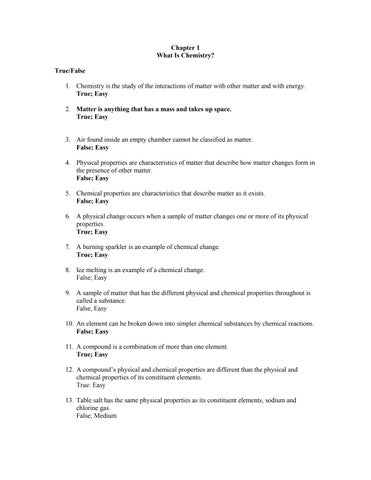
Chapter 1 What Is Chemistry? True/False 1. Chemistry is the study of the interactions of matter with other matter and with energy. True; Easy 2. Matter is anything that has a mass and takes up space. True; Easy
3. Air found inside an empty chamber cannot be classified as matter. False; Easy 4. Physical properties are characteristics of matter that describe how matter changes form in the presence of other matter. False; Easy 5. Chemical properties are characteristics that describe matter as it exists. False; Easy 6. A physical change occurs when a sample of matter changes one or more of its physical properties. True; Easy 7. A burning sparkler is an example of chemical change. True; Easy 8. Ice melting is an example of a chemical change. False; Easy 9. A sample of matter that has the different physical and chemical properties throughout is called a substance. False, Easy 10. An element can be broken down into simpler chemical substances by chemical reactions. False; Easy 11. A compound is a combination of more than one element. True; Easy 12. A compound‘s physical and chemical properties are different than the physical and chemical properties of its constituent elements. True: Easy 13. Table salt has the same physical properties as its constituent elements, sodium and chlorine gas. False; Medium
14. Carbonated water, before it is opened, is an example of heterogeneous mixtures. False; Easy (the CO2 dissolved in the water makes it homogeneous. However, students will think of the water after it is opened, the CO2 bubbles are present making it look like it is heterogeneous. 15. Solution is another word used to describe homogenous mixtures. True; Easy 16. A metal is an element that is brittle at room temperature. False; Easy 17. Elements that have properties of both metals and nonmetals and are called antimetals. False; Easy 18. Nonmetals do not conduct electricity or heat very well. True; Easy 19. Science is the process of knowing about the natural universe through observation and experiment. True; Easy 20. A hypothesis is a general statement that explains a large number of observations. False; Easy 21. Experiments are not performed if a hypothesis exists on the issue to be tested. False; Easy 22. A law is a specific statement that is thought to be never violated by the entire natural universe. True; Easy 23. Science is concerned only with the natural universe. True; Easy 24. Physics and astronomy are scientific fields concerned with the fundamental interactions between matter and energy. True; Easy 25. Chemistry is widely regarded as the language of science. False; Easy 26. A qualitative description implies a description of the extent to which a compound is used in a reaction. False; Easy 27. The temperature outside is 95 degrees Fahrenheit; this is an example of a quantitative description. True; Easy (students might not know the color of rhodochrosite unless they look it up)
28. A qualitative description means knowing how much of something is present. False; Easy Multiple Choice Questions 29. Which of the following statements is the correct description of chemistry? a. It is the study of the interactions of matter with other matter and with energy. b. It is the study of the static behavior of particles and substances. c. It is the study of conversion of one form of energy to another form. d. It is the science that deals with kinetic and potential energy. e. It is the science that deals with matter, energy, and force. a; Easy 30. Anything that has mass and takes up space is known as _____. a. gravity b. matter c. leverage d. vacuum e. force b; Easy 31. Which of the following is not classified as matter? a. Air in a room b. Gas in a chamber c. Blood in blood vessels d. Thoughts of a human brain e. Air in human lungs d; Easy 32. Which of the following statements describes a chemical property? a. Mercury is the only metal that exists as a liquid at room temperature. b. Women usually have long nails. c. The stereo system is silver in color. d. A kilogram of iron weighs one thousand grams. e. Sodium reacts with water to produce sodium hydroxide and hydrogen. e; Moderate 33. Chemical properties are characteristics of matter that describe _____. a. how matter changes form in the presence of other matter b. how matter changes form when it releases kinetic or static energy c. how matter changes form when it acquires static energy d. how matter changes form when it acquires kinetic energy e. how matter changes form when it is heated or cooled a; Easy 34. Which of the following is an example of chemical change? a. Ice melts to form water. b. Water is turned to steam by heating. c. Temperature of the engine goes up by 5oC. d. Alkanes have less mass than alkenes.
e. Alkanes burn in the presence of oxygen. e; Easy 35. A burning match stick is an example of a(n) _____ change. a. physical b. mechanical c. chemical d. ionic e. nuclear c; Easy 36. A sample of matter that has the same physical and chemical properties throughout is called a _____. a. form b. base c. substance d. particle e. structure c; Easy 37. A(n) _____ is the simplest type of chemical substance; it cannot be broken down into simpler chemical substances by ordinary chemical means. a. compound b. element c. mixture d. base e. structure b; Easy 38. A _____ is a combination of more than one element. a. physical change b. phase c. thought d. chemical change e. compound e; Easy 39. Which of the following is an example of a heterogeneous mixture? a. Oxygen dissolved in water b. Carbon dioxide dissolved in water c. Sodium chloride in water d. A combination of salt and steel wool e. A combination of oxygen and hydrogen d; Moderate 40. A(n) _____ is an element that is solid at room temperature, is shiny and silvery, conducts electricity and heat well, can be pounded into thin sheets, and can be drawn into thin wires. a. sub-atom b. metal c. ion
d. semimetal e. nonmetal b; Easy 41. Which of the following elements‘ property allows them to be pounded into thin sheets? a. Conductivity b. Resistivity c. Malleability d. Ductility e. Impeditivity c; Easy 42. Which of the following elements‘ property allows them to be drawn into thin wires? a. Malleability b. Ductility c. Conductivity d. Resistivity e. Impeditivity b; Easy 43. A nonmetal is an element that is _____. a. brittle when solid b. conductive to electricity c. hard when solid d. conductive to heat e. characterized by high ductility a; Moderate 44. Which of the following terms refers to the elements that have properties of both metals and nonmetals?
a. Base metals b. Precious metals c. Noble metals d. Metalloids/Semimetals e. Extracted metals d; Easy 45. _____ can be regarded as the process of knowing about the natural universe through observation and experiment.
a. Science b. Civics c. History d. Psychology e. Geography a; Easy 46. Which of the following terms refers to an educated guess about how the natural universe works? a. Experimentation b. Empirical analysis