Test Bank For Introduction to Radiologic Technology, 9th Edition 2025 William J. Callaway Chapter 1-16
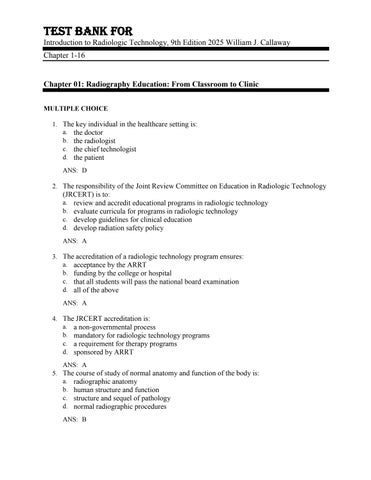
Chapter 01: Radiography Education: From Classroom to Clinic MULTIPLE CHOICE 1. The key individual in the healthcare setting is: a. the doctor b. the radiologist c. the chief technologist d. the patient ANS: D 2. The responsibility of the Joint Review Committee on Education in Radiologic Technology
(JRCERT) is to: a. review and accredit educational programs in radiologic technology b. evaluate curricula for programs in radiologic technology c. develop guidelines for clinical education d. develop radiation safety policy ANS: A 3. The accreditation of a radiologic technology program ensures: a. acceptance by the ARRT b. funding by the college or hospital c. that all students will pass the national board examination d. all of the above ANS: A 4. The JRCERT accreditation is: a. a non-governmental process b. mandatory for radiologic technology programs c. a requirement for therapy programs d. sponsored by ARRT ANS: A 5. The course of study of normal anatomy and function of the body is: a. radiographic anatomy b. human structure and function c. structure and sequel of pathology d. normal radiographic procedures ANS: B
6. The student/patient relationship is mainly taught in: a. medical ethics b. radiographic procedures c. patient care methods d. patient radiation protection ANS: C 7. The clinical education will include: a. medical ethics and law b. radiographic procedures c. radiation protection d. all of the above ANS: D 8. Students begin clinical education as: a. an adjunct radiography volunteer b. a passive radiography participant c. a part-time hospital employee d. an adjunct radiography employee ANS: B 9. The language of medicine teaches the student how to: a. interact with other medical employees b. communicate with patients of different backgrounds c. understand anatomic and medical terms d. address the medical hierarchy properly ANS: C 10. Radiation protection teaches the student: a. how to protect the patient b. how to protect the student c. how to protect the other health workers d. all of the above ANS: D 11. The clinical practice involves cognitive learning, which is a function of: a. relative facts and information b. attitudes and feelings c. values and beliefs d. applying knowledge ANS: A 12. Student independent clinical performance phase begins when: a. students perform radiographic procedures alone b. students perform radiographic procedures as an employee c. students perform radiographic procedures with indirect supervision d. students request the opportunity to act independently ANS: C
Chapter 02: Becoming an Outstanding Student Callaway: Introduction to Radiologic Science, 9th Edition MULTIPLE CHOICE 1. The most important information you should have as you begin your radiography program
is: a. b. c. d.
tuition and textbook costs knowledge of yourself location of clinical sites your classmates
ANS: B 2. The hierarchy of human needs was described by: a. Freud b. Einstein c. Piaget d. Maslow ANS: D 3. Nutrition, sleep, relaxation, and exercise are what types of needs? a. Psychologic b. Physiologic c. Mental and emotional d. Anatomic ANS: B 4. The most important factor to consider when resolving conflict is to: a. attack the issue b. attack the other person so as to gain an advantage c. abandon the relationship so that no more conflict arises d. speak first to establish the higher ground ANS: A 5. Retrieving from memory is: a. aided by the association and organization of data b. a function fully understood c. a function of short-term memory d. aided by ignoring relevant material ANS: A 6. Slow learning versus fast learning is more effective in memorization. a. True b. False ANS: B
7. The difference between the speed of a speaker’s presentation and your ability to listen
provides the opportunity for: a. daydreaming b. texting c. comparing notes with a classmate d. reading the chapter in the text ANS: A 8. The type of memory required for success as a radiography student is: a. short-term b. distant c. long-term d. fleeting ANS: C 9. Optimizing memory can be achieved through: a. adequate sleep b. proper nutrition c. organized reading and study d. all of the above ANS: D 10. Emotionality is: a. placing others’ feelings first b. the quality or state of a sound emotional balance c. the same as empathy d. part of Maslow’s hierarchy ANS: B 11. Critical thinking implies: a. making a choice agreeable to the group b. weighing all aspects of the situation c. making a decision according to current norms d. relying on surveys and graphs ANS: B 12. Analytical thinking means: a. obtaining a consensus among the group b. being open to the concerns of others c. gathering opinions from the group d. gathering evidence of the situation ANS: D 13. Critical thinking is on basis of: a. background beliefs b. a set of universal values c. self-awareness
d. respect for others ANS: B 14. The first step in becoming a critical thinker is having: a. your opinion conform with the group b. a humble approach in weighing the evidence c. charts and graphs to analyze d. at least three articles on the subject ANS: B 15. Maintaining the status quo is: a. always harmful b. always helpful c. comfortable d. always the consensus of the group ANS: C 16. Critical thinking may be hindered by: a. background beliefs b. emotional baggage c. deeply ingrained group loyalty d. all of the above ANS: D 17. Group loyalty is: a. often good b. often harmful c. often rewarded d. all of the above ANS: D 18. Emotions are most likely to run high in discussing: a. religion and gun control b. best movie of the year c. most popular pop singer d. most efficient study method ANS: A 19. An unbiased solution is most likely obtained by: a. an attitude of humility and respect b. disregarding multiple and conflicting opinions c. a straightforward decision with confidence d. a group consensus ANS: A 20. Characteristics of a critical thinker are: