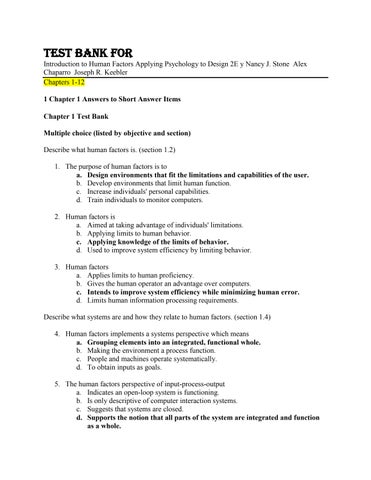
Test Bank For Introduction to Human Factors Applying Psychology to Design 2E y Nancy J. Stone Alex Chaparro Joseph R. Keebler Chapters 1-12 1 Chapter 1 Answers to Short Answer Items Chapter 1 Test Bank Multiple choice (listed by objective and section) Describe what human factors is. (section 1.2) 1. The purpose of human factors is to a. Design environments that fit the limitations and capabilities of the user. b. Develop environments that limit human function. c. Increase individuals' personal capabilities. d. Train individuals to monitor computers. 2. Human factors is a. Aimed at taking advantage of individuals' limitations. b. Applying limits to human behavior. c. Applying knowledge of the limits of behavior. d. Used to improve system efficiency by limiting behavior. 3. Human factors a. Applies limits to human proficiency. b. Gives the human operator an advantage over computers. c. Intends to improve system efficiency while minimizing human error. d. Limits human information processing requirements. Describe what systems are and how they relate to human factors. (section 1.4) 4. Human factors implements a systems perspective which means a. Grouping elements into an integrated, functional whole. b. Making the environment a process function. c. People and machines operate systematically. d. To obtain inputs as goals. 5. The human factors perspective of input-process-output a. Indicates an open-loop system is functioning. b. Is only descriptive of computer interaction systems. c. Suggests that systems are closed. d. Supports the notion that all parts of the system are integrated and function as a whole.
Test Bank For Introduction to Human Factors Applying Psychology to Design 2E y Nancy J. Stone Alex
Issuu converts static files into: and more. Sign up and create your flipbook.