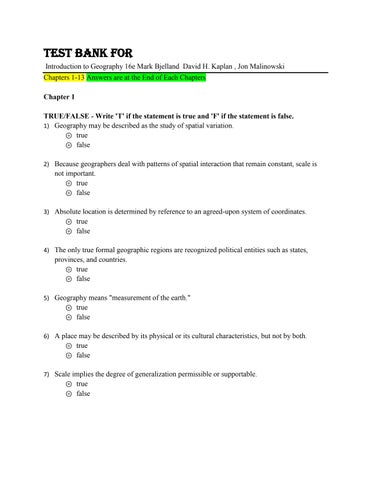
Test Bank For Introduction to Geography 16e Mark Bjelland David H. Kaplan , Jon Malinowski Chapters 1-13 Answers are at the End of Each Chapters Chapter 1 TRUE/FALSE - Write 'T' if the statement is true and 'F' if the statement is false. 1) Geography may be described as the study of spatial variation. ⊚ true ⊚ false 2) Because geographers deal with patterns of spatial interaction that remain constant, scale is
not important. ⊚ true ⊚ false 3) Absolute location is determined by reference to an agreed-upon system of coordinates. ⊚ true ⊚ false 4) The only true formal geographic regions are recognized political entities such as states,
provinces, and countries. ⊚ true ⊚ false 5) Geography means "measurement of the earth." ⊚ true ⊚ false 6) A place may be described by its physical or its cultural characteristics, but not by both. ⊚ true ⊚ false 7) Scale implies the degree of generalization permissible or supportable. ⊚ true ⊚ false
8) The term cultural landscape suggests the visible imprint of human activity upon the natural
environment. ⊚ true ⊚ false 9) To a geographer, site and situation are interchangeable concepts. ⊚ true ⊚ false 10) Globalization refers to the increasing spatial interconnection of the world's social, cultural,
and economic activities. ⊚ true ⊚ false 11) Between the Middle Ages and the revival of geography in the 17th century, Muslim scholars
were engaged in describing and analyzing their known world and its physical, cultural, and regional variation. ⊚ true ⊚ false MULTIPLE CHOICE - Choose the one alternative that best completes the statement or answers the question. 12) Spatial interaction is affected by A) mobility, economics, and anticipation. B) the physical environment, the cultural landscape, and the interchange potential of places. C) distance, accessibility, and connectivity. D) absolute location, spatial parameters, and network design. 13) Since humans are the active agents in human-environmental interactions, people in general A) have no contact with the physical landscape. B) are frequently unmindful of the dangers of inappropriate environmental exploitation. C) are immune from adverse natural events. D) alter the physical environment so that any potential dangers it holds are made
harmless or removed totally.
14) Which of the following is not true of the natural landscape? A) It provides the setting for human action. B) It is perceived, interpreted, and used in different ways by different cultures. C) It determines how people live in a particular place. D) It is shaped by human action into a cultural landscape. 15) A street address is an example of A) relative position. B) conformality. C) absolute location. D) situation. 16) Geography as a discipline A) originated in ancient Greek interest in the nature of the universe and the varying
character of the known parts of the earth. B) developed as an outgrowth of the "Age of Discovery," beginning in the 15th century. C) emerged in the 20th Century with the development of geographic information systems (GIS). D) was developed in response to a national need to map and describe the American West. 17) As geographers use the term, scale tells us A) the weight of a given commodity. B) the intrinsic character of the object or area studied. C) the relationship between earth distance and map distance. D) the length of a degree of longitude along different parallels. 18) An example of a formal region is A) the hub and spoke network for a particular airline. B) 100,000 square kilometers. C) Dixie. D) the area of France where the Breton language is spoken. 19) The attributes of a place A) represent the current state of continuing processes of change and development. B) are determined by natural processes and remain unchanged over time. C) are not influenced by relationships with other places. D) are primarily cultural, with little influence of the physical landscape.
20) Absolute location A) is an abstract concept unrelated to real-world circumstances. B) is a temporary and changing characteristic of place. C) cannot be defined with precision in a world of conflicting cultural perspectives. D) is a precise position on the surface of the globe. 21) The word geography is derived from Greek words meaning A) human society and the earth. B) the cultural landscape of the earth. C) the description of the earth. D) the measurement of the earth. 22) When real estate agents say that "location matters," they are referring to A) an absolute location. B) a relative location. C) the impact of distance decay. D) site conditions alone. 23) The term "geography" was reportedly coined by which Greek scientist? A) Pythagoras B) Strabo C) Aristotle D) Eratosthenes 24) The relationship between the size of an area on a map and its actual size on the earth's surface
is called the A) map scale. B) map key. C) map projection. D) relative location. 25) Geography differs from disciplines such as geology, meteorology, and cultural anthropology
in that it A) involves greater accuracy of measurement of phenomena studied. B) is more precisely defined in terms of the phenomena studied. C) is concerned with more abstract concepts. D) uses data from related disciplines to study spatial relationships.
26) The location of Chicago at 41° 49' N latitude and 87° 37' W longitude is an example of A) intensive location. B) absolute location. C) relative location. D) remote location. 27) Geography is BEST described as A) the location of countries, state and national capitals, major rivers, and continents. B) the study of the origin and behavior of humans and the development of societies and
cultures. C) the study of how and why human and physical attributes vary from place to place on the surface of the earth. D) the study of the choices made by individuals and societies with regard to the alternative uses of scarce resources. 28) Which one of the following best identifies the cultural landscape? A) the natural resources of the earth B) the natural landscape as modified by human occupancy C) the landscape as modified by recent catastrophic events such as hurricanes, volcanic
eruptions, and earthquakes D) places where intense human activities have obliterated any trace of the natural landscape 29) Which of the following distance measures refers to absolute distance? A) a 10-minute drive B) a $10 taxi ride C) a one-mile walk D) a scary trip through a dangerous neighborhood at night 30) Human systems in geography include A) Population, political, cultural B) Human impact on the environment, service activities, geographic techniques and
skills C) Human interaction, weather and climate, human impact on the environment D) Primary activities, political, landforms