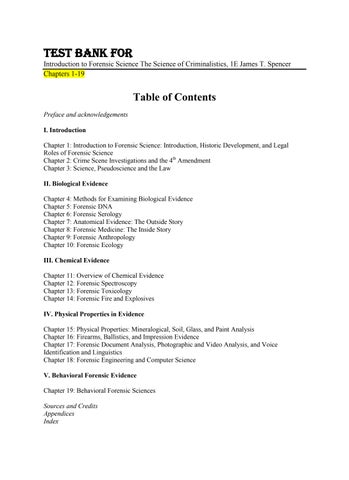
Test Bank For Introduction to Forensic Science The Science of Criminalistics, 1E James T. Spencer Chapters 1-19
Table of Contents Preface and acknowledgements I. Introduction Chapter 1: Introduction to Forensic Science: Introduction, Historic Development, and Legal Roles of Forensic Science Chapter 2: Crime Scene Investigations and the 4th Amendment Chapter 3: Science, Pseudoscience and the Law II. Biological Evidence Chapter 4: Methods for Examining Biological Evidence Chapter 5: Forensic DNA Chapter 6: Forensic Serology Chapter 7: Anatomical Evidence: The Outside Story Chapter 8: Forensic Medicine: The Inside Story Chapter 9: Forensic Anthropology Chapter 10: Forensic Ecology III. Chemical Evidence Chapter 11: Overview of Chemical Evidence Chapter 12: Forensic Spectroscopy Chapter 13: Forensic Toxicology Chapter 14: Forensic Fire and Explosives IV. Physical Properties in Evidence Chapter 15: Physical Properties: Mineralogical, Soil, Glass, and Paint Analysis Chapter 16: Firearms, Ballistics, and Impression Evidence Chapter 17: Forensic Document Analysis, Photographic and Video Analysis, and Voice Identification and Linguistics Chapter 18: Forensic Engineering and Computer Science V. Behavioral Forensic Evidence Chapter 19: Behavioral Forensic Sciences Sources and Credits Appendices Index
Equations and Tables
Constants: c = 3.00 x 10⁸ m/sec h = 6.63 x 10⁻³⁴ Js mp = 1.67 x 10⁻²⁴ g (mass of proton) Rydberg Constant (RH) = 2.18 x 10⁻¹⁸ J Avogadro‟s Number (Na): 6.022 x 10²³ Equations: c = lv KE= ½ mv2 Momentum (p = mv) Work (W = Fd) Force (F = m a) ⌈(
)
(
)⌉
Engineering Equations: o Velocity at the beginning of a skid: v = (2 g f d)½, where g is the gravitational constant, f is the frictional coefficient, and d is the distance; o Velocity at the beginning of a skid with an impact/crush: v = [2 g d f + 2 (K/m) x]½, where K is the measured crush coefficient for the car, x is the crush depth measured from the crashed car, and m is the mass of the car;
o o
Minimum speed skid formula: S1 = √ , where S1 is the initial speed at the start of the skid (in mph), d1 is the distance of the skid before stopping, and f is the frictional coefficient; Initial speed when striking a vehicle at the start of the skid: Sc = ] [ ], where Sc is the initial speed at the start √[ of the skid (in mph), d1 is the distance of the skid before impact, f is the frictional coefficient, d2 is the depth of the crush in ft, and cf is the crush factor in lb./ft.
CONFIDENTIAL PLEASE DO NOT SHARE ANY OF THESE WITH STUDENTS! Introduction to Forensic Science: The Science of Criminalistics
by James T. Spencer, Ph.D., Syracuse University FNSSI Chapter One Questions 1. Explain the importance of the Joiner (1995) case as it pertain to forensic testimony. a. It required that experts limit their opinions to straightforward extensions of the data. b. It set the trial judge as the “gatekeeper” for what scientific testimony is admissible. c. It established the minimum standards for the admissibility of scientific evidence. d. It required analysts to “face” defendents in court when presenting scientific analyses. e. It required courts to stand by earlier decisions of higher courts. Correct Answer Reply: A. Joiner: There must be a significant connection between the science/facts and the testimony of an expert in the field. 2. How did the Frye decision of 1923 impact the admissibility of forensic evidence? a. It required that experts limit their opinions to straightforward extensions of the data. b. It set the trial judge as the “gatekeeper” for what scientific testimony is admissible. c. It established the minimum standards for the admissibility of scientific evidence. d. It required analysts to “face” defendents in court when presenting scientific analyses. e. It required courts to stand by earlier decisions of higher courts. Correct Answer Reply: C. Established the scientific discipline as the gatekeeper for scientific evidence and established minimum standards for the admissibility of scientific evidence into courtroom proceedings.
3. How does basic research differ from applied research? a. Basic research uses physical principles discovered through scientific research to obtain a desired goal. b. Basic research focuses upon the simpler aspects of a field while applied research studies more complex problems. c. Basic research deals primarily withjust the fundamental understanding of phenomena. d. Basic research seeks to understand the physical world for its own sake while applied research usually has an immediate problem to solve. e. It required courts to stand by earlier decisions of higher courts. Correct Answer Reply: D. “The realm of science can be divided into pure science, or research, and applied science. Basic research seeks to understand the physical world for its own sake; in applied science we seek to use the physical principles discovered to obtain a desired goal.” [K. Inman and N. Rudin. Principles and Practice of Criminalistics: The Profession of Forensic Science, CRC Press, 2001] Chemistry, biology and physics are generally basic scientific fields while disciplines such as medicine, engineering, and forensic science are applied sciences. 4. In his famous book of 1248, “Washing Away of Wrongs” or “Injustices Rectified”, the Chinese magistrate named Sung T‟ze described one particularly famous case to determine the person who committed homicide in a rice field using a harvesting knife. The field that he primarily employed to solve the case was: a. Forensic blood spatter. b. Forensic entomology. c. Forensic fingerprint analysis. d. Forensic medicine. e. Forensic ballistics. Correct Answer Reply: B. In his text, Sung T‟ze reports the first written use of forensic entomology to solve a murder case where a worker in the rice fields had been murdered by means of a harvest scythe. Through physical inspection, such as looking for blood and identifying marks, no evidence could be found linking any possible assailants with the crime. To solve the case, however, T‟ze ingeniously had all the suspects line up before him in the hot afternoon sun while holding their scythes. Only one of the scythes attracted a swarm of blowflies to the blade – the one with invisible, minute traces of blood remaining on the blade. The owner later confessed to the crime. This use of forensic entomology to solve a case brought about by an understanding of how the natural world works, a basic tenant of forensic science. 5. Locard‟s Principle says that: a. The trial judge will serve as the gatekeeper regarding the admissibility of evidence in court. b. While two objects may be indistinguishable, no two objects are ever identical.
c. Whenever two objects come into contact they must affect each other in some way (material transferred between the two). d. Scientific evidence provides the most accurate evidence presented in court. e. None of the above. Correct Answer Reply: C. Locard formulated the basis for a principle today bearing his name that is fundamental to all of forensic science today – Locard‟s Exchange Principle. Locard wrote that: “Wherever he steps, wherever he touches, whatever he leaves, even without consciousness, will serve as a silent witness against him. Not only his fingerprints or his footprints, but his hair, the fibers from his clothes, the glass he breaks, the tool mark he leaves, the paint he scratches, the blood or semen he deposits or collects. All of these and more, bear mute witness against him.” 6. Probably one the earliest true forensic expert and detective from fiction was the character of C. Auguste Dupin who appeared in The Murders in the Rue Morgue (1841), The Mystery of Marie Roget (1842), and The Purloined Letter (1844). The author of these books, and inventor of this early true forensic detective, was: a. Sherlock Holmes. b. Arthur Conan Doyle. c. Edgar Allen Poe. d. Agatha Christie. e. F. Scott Fitzgerald. Correct Answer Reply: C. The fictional Dupin used a combination of deductive reasoning and insightful imagination to uncover the hidden causes and effects of baffling criminal mysteries – techniques that were not commonly employed by real investigators during the age when the stories were written. Adgar Allen Poe‟s work came about even before the term detective had been put forward. The groundbreaking detective work of his fictional Dupin, a private citizen investigating crime for his own motivations rather than an official of the police force, proved to be both very popular with readers and led the way to new paths of thinking about solving crimes. 7. Some credit an ancient scholar as the original “father of forensic science.” This person is: a. Aristotle. b. Democritus. c. Archimedes. d. Julius Caesar. e. Leonardo DaVinci. Correct Answer Reply: C. Some credit Archimedes as the “father of forensic science” and there are a number of instances where he certainly used science to unravel difficult legal questions, including his most famous “case” concerning the question of cheating in the creation the emperor‟s new crown.