Name:
Class:
Date:
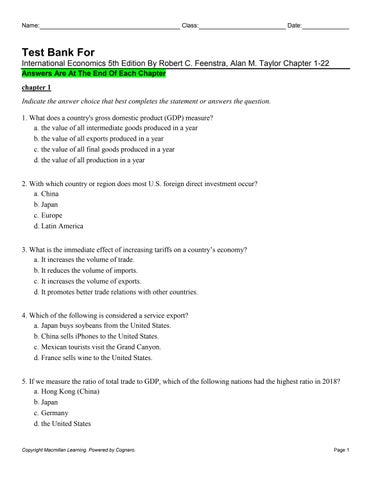
Test Bank For International Economics 5th Edition By Robert C. Feenstra, Alan M. Taylor Chapter 1-22 Answers Are At The End Of Each Chapter chapter 1 Indicate the answer choice that best completes the statement or answers the question. 1. What does a country's gross domestic product (GDP) measure? a. the value of all intermediate goods produced in a year b. the value of all exports produced in a year c. the value of all final goods produced in a year d. the value of all production in a year 2. With which country or region does most U.S. foreign direct investment occur? a. China b. Japan c. Europe d. Latin America 3. What is the immediate effect of increasing tariffs on a country’s economy? a. It increases the volume of trade. b. It reduces the volume of imports. c. It increases the volume of exports. d. It promotes better trade relations with other countries. 4. Which of the following is considered a service export? a. Japan buys soybeans from the United States. b. China sells iPhones to the United States. c. Mexican tourists visit the Grand Canyon. d. France sells wine to the United States. 5. If we measure the ratio of total trade to GDP, which of the following nations had the highest ratio in 2018? a. Hong Kong (China) b. Japan c. Germany d. the United States
Copyright Macmillan Learning. Powered by Cognero.
Page 1
Name:
Class:
Date:
6. If a country's GDP is $10 trillion and its overall trade flows are $2 trillion (imports + exports/2), then: a. its trade/GDP ratio is 20%. b. it is not a successful country. c. its GDP needs to increase. d. its trade/GDP ratio is too high. 7. An American tourist buys a ticket to an opera in Paris. The U.S. government classifies this transaction as: a. an import of a French opera, a good. b. a service export. c. a service import. d. an export of a good. 8. Which of the following make up Latin America? a. the United States, Mexico, and Canada b. Mexico, Guam, and Puerto Rico c. Mexico, Central and South America, and the Caribbean d. Central and South America and Granada 9. One of the main reasons for China to actively invest in foreign companies is to a. enhance the competitiveness of Chinese firms globally. b. take advantage of low wages in foreign countries. c. make best use of its technological expertise in the world market. d. meet the growing demand of the high population in China. 10. The coronavirus has had a dramatic impact on international trade in services. One service sector involves airline travel, which is an example of a a. service export for the countries whose citizens are passengers. b. service import for the country whose company owns the airline. c. service export for the country whose company owns the airline. d. good export for the country whose company owns the airline. 11. What ushered in the ―second golden age‖ of trade? a. the increase in trade among countries in the period after World War II b. the introduction of the gold standard c. the increase in trade restrictions as a reaction to the Smoot–Hawley Tariff Act d. the decline in volume of trade among industrialized countries
Copyright Macmillan Learning. Powered by Cognero.
Page 2
Name:
Class:
Date:
12. Which of the following is NOT a reason for firms in an industrial nation to undertake vertical FDI in a lowincome nation? a. access to raw materials in the low-income nation b. lower wages in the low-income nation c. avoidance of export taxes in the low-income nation d. avoidance of import taxes in the low-income nation 13. Between 2018 and 2020 (prior to the coronavirus pandemic), which of the following happened regarding U.S. trade barriers? a. The United States significantly reduced trade barriers with its international trading partners. b. The United States did not erect any new trade barriers with its trading partners, but it also did not remove existing barriers. c. The United States erected new trade barriers with its international trading partners, especially China. d. The United States erected new trade barriers with China, but with none of its other international trading partners. 14. Which of the following statements is true? a. FDI is largely restricted between high-income countries but rarely faces restrictions in developing countries. b. FDI is largely unrestricted between high-income countries but sometimes faces restrictions in developing countries. c. FDI is never restricted among high-income or developing countries. d. FDI is always heavily restricted among high-income and developing countries. 15. Import restrictions in the form of import tariffs and import quotas are supported by: a. the industrial sector of the tariff-imposing country. b. the import sector of the foreign country. c. the production sector in the tariff-imposing country that uses imported intermediate input. d. the sector of the tariff-imposing country that produces the final good. 16. What is the principal reason for Intel (a U.S. computer chip producer) to establish a computer chip manufacturing plant in a developing country (e.g., Malaysia)? a. to take advantage of the low wages in Malaysia b. to take advantage of Malaysia's climate c. to take advantage of Malaysia's low tariffs on imported computer chips d. to avoid Malaysia's low export taxes on computer chips 17. Which of the following countries is NOT a member of the European Union? Copyright Macmillan Learning. Powered by Cognero.
Page 3
Name:
Class:
Date:
a. Denmark b. Finland c. Norway d. Sweden 18. Which of the following countries is NOT a member of the Organisation for Economic Co-operation and Development? a. China b. the United States c. Germany d. the United Kingdom 19. A relatively new feature of world trade that involves spreading the production process across multiple countries is called: a. bilateral trade. b. offshoring. c. industrial landscaping. d. foreign direct investment. 20. After 1945, world trade: a. grew more slowly than in the decade before World War II. b. grew more rapidly than in the decade before World War II. c. grew in absolute dollar terms but not as a ratio of GDP. d. fell in both absolute and relative terms. 21. Which of the following statements best explains the low level (about $35 billion in 2018) of trade between the United States and Russia? a. Russia doesn't produce goods that Americans want to buy. b. The Russian market is smaller than the markets of most other countries. c. Political tensions reduce the level of trade between the two countries. d. The United States has banned food imports from Russia. 22. Between 2018 and 2019, average U.S. tariffs: a. increased substantially. b. decreased substantially. c. remained unchanged. d. could not be measured. Copyright Macmillan Learning. Powered by Cognero.
Page 4
Name:
Class:
Date:
23. ―Value-added‖ in the context of international trade refers to: a. the difference between the value of exports and the value of imported inputs used in producing exports. b. the additional value a worker provides to a firm when she is hired. c. the value added by being able to purchase goods in a competitive market. d. the value added by import brokers when they mark up the price of the products. 24. One of the impacts of the novel coronavirus in 2020 was that trade in medical equipment improved in the world economy to meet the need for medical products in a. Asia. b. Europe. c. North America. d. Asia, Europe, and North America, along with the developing countries with dense populations. 25. If a country's trade/GDP ratio is 38% and the GDP is $500 billion, then what is the overall value of its trade (imports + exports/2)? a. $390 billion b. $190 billion c. $100 billion d. Not enough information is provided to answer the question. 26. Which of the following is NOT classified as horizontal FDI? a. NUCOR, a U.S. steel manufacturer, purchases an iron ore mine in Australia. b. BMW, a German auto manufacturer, constructs an auto assembly plant in South Carolina. c. Burger King, an American fast-food chain, buys Canadian fast-food chain Tim Horton's. d. General Motors, an American auto manufacturer, constructs an auto assembly plant in Toronto, Canada. 27. If a country's GDP is $3 trillion and its trade balance is $0.5 trillion, what is that country’s trade/GDP ratio? a. $3.5 trillion b. 16.67% c. 6% d. Not enough information is provided to answer the question. 28. One factor mentioned in the text as a reason for the ―first golden age‖ of trade was: a. the invention of the cotton gin. Copyright Macmillan Learning. Powered by Cognero.
Page 5