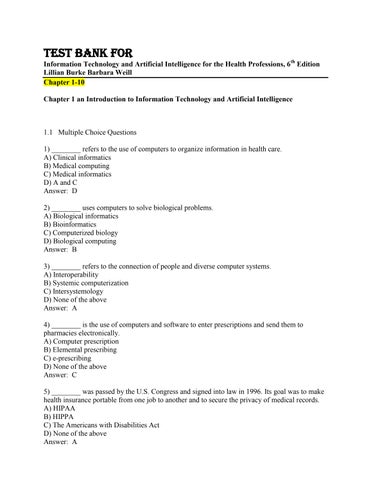
Test Bank For Information Technology and Artificial Intelligence for the Health Professions, 6th Edition Lillian Burke Barbara Weill Chapter 1-10 Chapter 1 an Introduction to Information Technology and Artificial Intelligence
1.1 Multiple Choice Questions 1) ________ refers to the use of computers to organize information in health care. A) Clinical informatics B) Medical computing C) Medical informatics D) A and C Answer: D 2) ________ uses computers to solve biological problems. A) Biological informatics B) Bioinformatics C) Computerized biology D) Biological computing Answer: B 3) ________ refers to the connection of people and diverse computer systems. A) Interoperability B) Systemic computerization C) Intersystemology D) None of the above Answer: A 4) ________ is the use of computers and software to enter prescriptions and send them to pharmacies electronically. A) Computer prescription B) Elemental prescribing C) e-prescribing D) None of the above Answer: C 5) ________ was passed by the U.S. Congress and signed into law in 1996. Its goal was to make health insurance portable from one job to another and to secure the privacy of medical records. A) HIPAA B) HIPPA C) The Americans with Disabilities Act D) None of the above Answer: A
6) ________ has the task of overseeing the adoption and meaningful use of EHRs, setting standards, and judging the impact. A) ARRA B) The Congress C) The President D) ONCHIT Answer: D 7) The ________ was signed into law on February 17, 2009, by President Obama; it included billions of dollars for the expansion of health information technology. Through Medicare and Medicaid, monetary incentives would be offered to doctors and hospitals to adopt EHRs. A) Americans with Disabilities Act B) USA PATRIOT Act C) Homeland Security Act D) American Recovery and Reinvestment Act (ARRA) Answer: D 8) Administrative applications of computers include ________. A) scheduling B) coding C) accounting D) all of the above Answer: D 9) Medical offices must use ________ billing to accommodate two or three insurers, who must be billed in a timely fashion before the patient is billed. A) super B) partial C) bucket D) None of the above Answer: C 10) Which of the following are obstacles in the way of adopting electronic records? A) Cost B) Privacy concerns C) Lack of interoperability D) All of the above Answer: D
1.2 Short Answer Questions 1) The emphasis in ________ is on the use of technology to organize information in health care. Answer: medical informatics 2) ________ (HITECH) which is a part of the ARRA encourages the "Meaningful Use of Electronic Medical Records," with 19 billion dollars in incentives through Medicare and Medicaid for doctors and hospitals to adopt them. Answer: The Health Information Technology for Economic and Clinical Health Act 3) List three administrative uses of computers: ________. Answer: scheduling, coding, accounting 4) One of the obstacles in the way of introducing the EHR is ________. Answer: cost or resistance by personnel 5) Patients may establish their own records through the ________. It is a personal medical record that the patient can create and maintain at no cost. Answer: iHealth Record 6) Charges, payments, and adjustments are called ________. Answer: transactions 7) ________ analytics help in finding hidden trends. Answer: Big data 8) Billing is based on diagnosis; the relevant code is called the ________. Answer: DRG 9) The first information systems introduced into hospitals (in the 1960s) were used for ________ purposes (managing finances and inventory). Answer: administrative 10) A ________ information system is concerned with the financial details of running a hospital. Answer: financial 11) ________ software allows the user to enter, organize, and store huge amounts of data and information. Answer: database management system 12) ________ information systems monitor drug allergies, interactions, fill and track prescriptions. They also track inventory and create patient drug profiles. Answer: Pharmacy 13) ________ information systems are supposed to improve care by using computers to manage charting, staff scheduling, and the integration of clinical information. Answer: Nursing
14) ________ manages radiological images in digital form in hospitals. Answer: Picture archiving and communication systems 15) ________ information systems use computers to manage both laboratory tests and their results. Answer: Laboratory Chapter 2 An Introduction to Health Informatics 2.1 Multiple Choice Questions 1) ________ uses computers and telecommunications equipment to deliver medical care at a distance. A) Medical informatics B) Telemedicine C) Computer informatics D) None of the above Answer: B 2) The Department of ________ of the United States has spent millions of dollars on telemedicine equipment and installation. A) Veterans Affairs B) Defense C) Education D) Health Answer: A 3) ________ treats skin rashes at a distance. A) TeleStroke B) Telecardiology C) Teleoncology D) Teledermatology Answer: D 4) ________ technology involves sharing information in a time- and place-independent way over the Internet. A) Store-and-send B) Send-and-store C) Store-and-forward D) Interactive videoconferencing Answer: C 5) ________ or teleconferencing allows doctors to consult with each other and with patients in real time, at a distance. A) Store-and-send B) Send-and-store C) Store-and-forward D) Interactive videoconferencing Answer:
6) ________ involves the sending of radiological images in digital form over telecommunications lines. A) Teleradiology B) Telekinetics C) Both A and B D) None of the above Answer: A 7) In ________, the pathologist sees images on a monitor instead of under a microscope. A) teleradiology B) telepathology C) interactive radiology D) None of the above Answer: B 8) ________ technology can link devices such as a pacemaker and a cell phone. A) Wi-Fi B) Satellite C) Bluetooth D) None of the above Answer: C 9) ________ helps patients by speeding diagnosis so that tPA can be given within a few hours if appropriate. A) TeleStroke B) Teleoncology C) Telecardiology D) Telepsychiatry Answer: A 10) ________ involves the delivery of therapy using teleconferencing. A) TeleStroke B) Teleoncology C) Telecardiology D) Telepsychiatry Answer: D 2.2 Short Answer Questions 1) ________ uses computers and telecommunications equipment to deliver medical care at a distance. Answer: Telemedicine 2) ________ involves sharing information in a time- and place-independent way over the Internet. The information is stored, digitized, and then sent. Answer: Store-and-forward technology 3) Interactive videoconferencing or ________ allows doctors to consult with each other and with