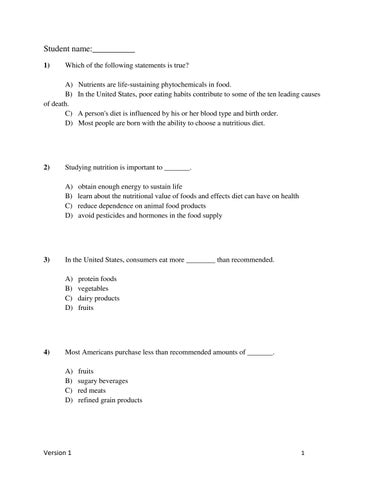
Student name:__________ 1)
Which of the following statements is true?
A) Nutrients are life-sustaining phytochemicals in food. B) In the United States, poor eating habits contribute to some of the ten leading causes of death. C) A person's diet is influenced by his or her blood type and birth order. D) Most people are born with the ability to choose a nutritious diet.
2)
Studying nutrition is important to _______. A) obtain enough energy to sustain life B) learn about the nutritional value of foods and effects diet can have on health C) reduce dependence on animal food products D) avoid pesticides and hormones in the food supply
3)
In the United States, consumers eat more ________ than recommended. A) protein foods B) vegetables C) dairy products D) fruits
4)
Most Americans purchase less than recommended amounts of _______. A) fruits B) sugary beverages C) red meats D) refined grain products
Version 1
1
5)
Which of the following is NOT true about water? A) Water is an essential nutrient. B) Water plays a role in regulation of body temperature. C) Water is necessary for elimination of waste from the body. D) Water is necessary for immune function.
6) Which of the following substances is a nutrient that does NOT supply any energy for the human body? A) Carbohydrate B) Fat C) Protein D) Vitamin D
7)
Which of the following statements is true? A) Nutrient-deficiency diseases develop when diets lack essential nutrients. B) Skin rashes are always a symptom of vitamin deficiency diseases. C) Headaches are a common sign of a mineral deficiency disease. D) Most phytochemicals are classified as essential nutrients.
8)
An essential nutrient _______.
A) is found only in fortified foods B) is found only in foods from animal sources C) must be supplied by the diet D) provides energy (kcals) to the diet
Version 1
2
9)
Which of the following describe a conditionally essential nutrient?
A) A nutrient that is normally nonessential, but becomes essential under certain conditions. B) A nutrient that may be made in the body, but in amounts that are inadequate. C) A nutrient that becomes essential due to a metabolic disorder or serious disease (e.g. kidney or liver disease). D) All of the choices are correct.
10)
Which of the following is a micronutrient? A) Iron B) Glucose C) Fat D) Protein
11)
Which of the following substances is a macronutrient? A) Protein B) Vitamin C C) Calcium D) Sodium
12)
Which of the following foods is naturally a rich source of phytochemicals?
Version 1
3
A) Margarine B) Tuna C) Blueberries D) Chicken
13)
Which of the following foods is NOT a rich natural source of phytochemicals? A) Cherries B) Green tea C) Whole-grain bread D) Lean meat
14)
A teaspoon of sugar supplies about 16 kcals, which is the same as ________ calories.
A) 1.6 B) 1600 C) 16,000 D) 160,000
15)
A small apple supplies approximately 40,000 ________. A) calories B) kilocalories C) Calories D) Kilocalories
16) A serving of food contains 15 g carbohydrate, 3 g protein, 5 g fat, 5 mg vitamin C, and 100 mL water. Based on this information, a serving of this food supplies _______.
Version 1
4
A) 87 kcals B) 97 kcals C) 107 kcals D) 117 kcals
17) Approximately how many grams of carbohydrate are in a sugar-sweetened beverage that supplies 240 kcals and contains no fiber, fat, protein, or alcohol? A) 50 grams of carbohydrate B) 30 grams of carbohydrate C) 40grams of carbohydrate D) 60grams of carbohydrate
18)
Which of the following conditions is NOT a leading cause of death in the United States? A) Tuberculosis B) Cancer C) Heart disease D) Stroke
19) Which of the following conditions or diseases is a leading diet-related cause of death in the United States?
A) Chronic lower respiratory infections B) Stroke C) Suicide D) Influenza and pneumonia
Version 1
5