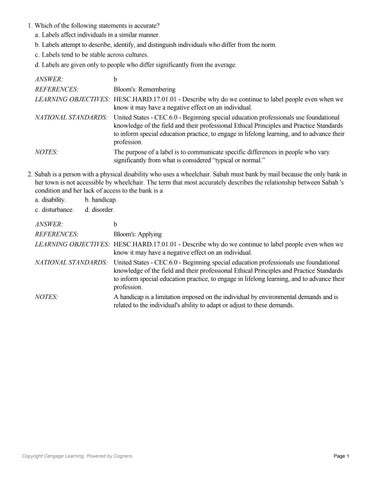
1. Which of the following statements is accurate? a. Labels affect individuals in a similar manner. b. Labels attempt to describe, identify, and distinguish individuals who differ from the norm. c. Labels tend to be stable across cultures. d. Labels are given only to people who differ significantly from the average. ANSWER: b REFERENCES: Bloom's: Remembering LEARNING OBJECTIVES: HESC.HARD.17.01.01 - Describe why do we continue to label people even when we know it may have a negative effect on an individual. NATIONAL STANDARDS: United States - CEC.6.0 - Beginning special education professionals use foundational knowledge of the field and their professional Ethical Principles and Practice Standards to inform special education practice, to engage in lifelong learning, and to advance their profession. NOTES: The purpose of a label is to communicate specific differences in people who vary significantly from what is considered “typical or normal.” 2. Sabah is a person with a physical disability who uses a wheelchair. Sabah must bank by mail because the only bank in her town is not accessible by wheelchair. The term that most accurately describes the relationship between Sabah 's condition and her lack of access to the bank is a a. disability. b. handicap. c. disturbance. d. disorder. ANSWER: b REFERENCES: Bloom's: Applying LEARNING OBJECTIVES: HESC.HARD.17.01.01 - Describe why do we continue to label people even when we know it may have a negative effect on an individual. NATIONAL STANDARDS: United States - CEC.6.0 - Beginning special education professionals use foundational knowledge of the field and their professional Ethical Principles and Practice Standards to inform special education practice, to engage in lifelong learning, and to advance their profession. NOTES: A handicap is a limitation imposed on the individual by environmental demands and is related to the individual's ability to adapt or adjust to these demands.
Copyright Cengage Learning. Powered by Cognero.
Page 1
3. The term "exceptional" describes individuals who a. are limited because of environmental demands. b. have higher than average general ability. c. deviate either higher or lower from the norm and may require specialized services. d. have a general malfunction of mental processing. ANSWER: c REFERENCES: Bloom's: Remembering LEARNING OBJECTIVES: HESC.HARD.17.01.01 - Describe why do we continue to label people even when we know it may have a negative effect on an individual. NATIONAL STANDARDS: United States - CEC.6.0 - Beginning special education professionals use foundational knowledge of the field and their professional Ethical Principles and Practice Standards to inform special education practice, to engage in lifelong learning, and to advance their profession. NOTES: Exceptional is a comprehensive label. It describes an individual whose physical, intellectual, or behavioral performance differs substantially from what is typical (or normal), either higher or lower. 4. All labels are a. positive. c. based on perceptions
b. negative. d. factual.
ANSWER: c REFERENCES: Bloom's: Applying LEARNING OBJECTIVES: HESC.HARD.17.01.01 - Describe why do we continue to label people even when we know it may have a negative effect on an individual. NATIONAL STANDARDS: United States - CEC.6.0 - Beginning special education professionals use foundational knowledge of the field and their professional Ethical Principles and Practice Standards to inform special education practice, to engage in lifelong learning, and to advance their profession. 5. Labels are used to a. distinguish who is eligible for services and who is not and to help professionals communicate effectively with one another. b. ensure that characteristics within a culture have the same meaning. c. prohibit discrimination. d. confirm environmental bias. ANSWER: a REFERENCES: Bloom's: Understanding LEARNING OBJECTIVES: HESC.HARD.17.01.01 - Describe why do we continue to label people even when we know it may have a negative effect on an individual. NATIONAL STANDARDS: United States - CEC.6.0 - Beginning special education professionals use foundational knowledge of the field and their professional Ethical Principles and Practice Standards to inform special education practice, to engage in lifelong learning, and to advance their profession.
Copyright Cengage Learning. Powered by Cognero.
Page 2
6. The developmental approach to labeling a. defines normal according to standards established by a given culture. b. uses statistics to describe what characteristics occur most frequently at a given age. c. reflects an individual's perceptions about himself/herself. d. defines normal as the absence of psychological abnormality. ANSWER: b REFERENCES: Bloom's: Understanding LEARNING OBJECTIVES: HESC.HARD.17.01.02 - Identify three approaches to describe human differences. NATIONAL STANDARDS: United States - CEC.6.0 - Beginning special education professionals use foundational knowledge of the field and their professional Ethical Principles and Practice Standards to inform special education practice, to engage in lifelong learning, and to advance their profession. NOTES: The developmental approach is based on an understanding of normal human development. This approach to labeling differences is based on observations of large numbers of individuals and comparing an individual’s growth to the group average. Differences in development are labeled accordingly. 7. According to the developmental approach, typical development can be determined a. by assessing whether an individual is physically healthy. b. by standards of parental perceptions. c. by comparing a child's growth pattern to a group average. d. by extensive psychological testing. ANSWER: c REFERENCES: Bloom's: Understanding LEARNING OBJECTIVES: HESC.HARD.17.01.02 - Identify three approaches to describe human differences. NATIONAL STANDARDS: United States - CEC.6.0 - Beginning special education professionals use foundational knowledge of the field and their professional Ethical Principles and Practice Standards to inform special education practice, to engage in lifelong learning, and to advance their profession. NOTES: The developmental approach is based on an understanding of normal human development. As such, this approach to labeling differences is based on deviations from what is considered normal physical, social, or intellectual growth.
Copyright Cengage Learning. Powered by Cognero.
Page 3
8. “Typical” as defined by the cultural perspective is determined by a. values that are established within a given society. b. a set of universal standards that can be applied from culture to culture. c. by observing large number of individuals whose characteristics occur most frequently at a given age. d. the range of abnormal behaviors that are present in a society. ANSWER: a REFERENCES: Bloom's: Remembering LEARNING OBJECTIVES: HESC.HARD.17.01.02 - Identify three approaches to describe human differences. NATIONAL STANDARDS: United States - CEC.6.0 - Beginning special education professionals use foundational knowledge of the field and their professional Ethical Principles and Practice Standards to inform special education practice, to engage in lifelong learning, and to advance their profession. NOTES: From a cultural view, “typical” is defined by what any given society values. 9. Mohammed has just arrived at O'Hare Airport and is being greeted by Ms. Storm, a top executive of the Lakeshore Development Company. Ms. Storm extends her hand to Mohammed, and he becomes embarrassed and agitated. Where he lives shaking hands with a woman is considered to be inappropriate behavior. This difference is best described by the _____ to labeling. a. self-labeling approach b. developmental approach c. universal approach d. cultural perspective ANSWER: d REFERENCES: Bloom's: Applying LEARNING OBJECTIVES: HESC.HARD.17.01.02 - Identify three approaches to describe human differences. NATIONAL STANDARDS: United States - CEC.6.0 - Beginning special education professionals use foundational knowledge of the field and their professional Ethical Principles and Practice Standards to inform special education practice, to engage in lifelong learning, and to advance their profession. NOTES: The standards in Mohammed's culture are different from those of Ms. Storm. What is acceptable behavior for Mohammed places him in conflict with what is acceptable for Ms. Storm.
Copyright Cengage Learning. Powered by Cognero.
Page 4
10. Nathan is seventeen years old and a senior at Valley View High School. Nathan is exceptionally bright and excels in his academic endeavors. He is well liked by his teachers and has a small circle of close friends. Nathan views himself as being inferior to his peers because of his small stature and his lack of athletic abilities. However this view is not shared by his friends. The labeling process that best describes Nathan's view is a. formal labeling. b. peer-imposed labeling. c. self-imposed labeling. d. culturally-imposed labeling. ANSWER: c REFERENCES: Bloom's: Applying LEARNING OBJECTIVES: HESC.HARD.17.01.02 - Identify three approaches to describe human differences. NATIONAL STANDARDS: United States - CEC.6.0 - Beginning special education professionals use foundational knowledge of the field and their professional Ethical Principles and Practice Standards to inform special education practice, to engage in lifelong learning, and to advance their profession. NOTES: Because Nathan does not perceive himself in the same way as his peers and is imposing his own labels, he is engaged in a self-labeling process. The labels he imposes upon himself are not recognized by his peers. Everyone engages in a process of self-labeling that may not be recognized by others with whom they interact. Thus, self-imposed labels reflect how we perceive ourselves, not how others see us. 11. Reactions to being labeled a. are the same for everyone. c. are all positive.
b. are all negative. d. vary greatly from person to person.
ANSWER: d REFERENCES: Bloom's: Understanding LEARNING OBJECTIVES: HESC.HARD.17.01.02 - Identify three approaches to describe human differences. NATIONAL STANDARDS: United States - CEC.6.0 - Beginning special education professionals use foundational knowledge of the field and their professional Ethical Principles and Practice Standards to inform special education practice, to engage in lifelong learning, and to advance their profession. NOTES: Reactions to a label differ greatly from one person to another but can often be negative 12. David is sitting in the school office waiting to talk to the principal. Students passing the office assume that he must be in trouble. The term that best describes the students' behavior is a. self-imposed bias. b. teacher bias. c. contextual bias. d. self-fulfilling prophecy. ANSWER: c REFERENCES: Bloom's: Applying LEARNING OBJECTIVES: HESC.HARD.17.01.02 - Identify three approaches to describe human differences. NATIONAL STANDARDS: United States - CEC.6.0 - Beginning special education professionals use foundational knowledge of the field and their professional Ethical Principles and Practice Standards to inform special education practice, to engage in lifelong learning, and to advance their profession. NOTES: The context in which we view someone can clearly influence our perceptions of that person. In this case, the students made a direct association between the environment (principal's office) and David's presence there. The reaction was because David is present in this environment, he must be in trouble. Copyright Cengage Learning. Powered by Cognero.
Page 5