Exam Name___________________________________
SHORT ANSWER. Write the word or phrase that best completes each statement or answers the question.
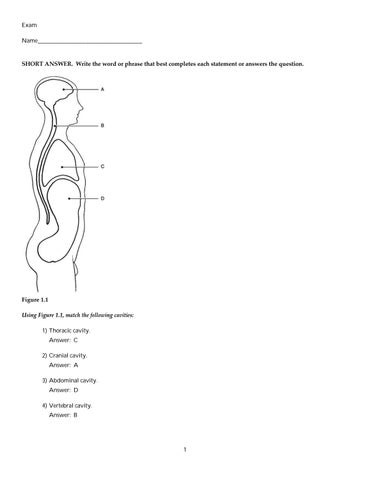
Figure 1.1 Using Figure 1.1, match the following cavities: 1) Thoracic cavity. Answer: C 2) Cranial cavity. Answer: A 3) Abdominal cavity. Answer: D 4) Vertebral cavity. Answer: B
1
Figure 1.2 Using Figure 1.2, match the following descriptions to the most appropriate letter on the diagram: 5) Information about body temperature is sent through afferent pathways to the brain. Answer: C 6) Free nerve endings in the skin detect changes in skin temperature (getting warmer). Answer: B 7) Appropriate response information is sent through efferent pathways. Answer: D 8) A change in the temperature of the external environment (getting warmer). Answer: A 9) Sweat glands are stimulated as well as blood being distributed to the skin to allow cooling of the body to return the body's temperature to a physiological level. Answer: E MATCHING. Choose the item in column 2 that best matches each item in column 1. Match the following systems to their functions: 10) Provides the force to move bones about their joints.
A) Muscular
Answer: A
2
11) Responds to environmental changes by transmitting appropriate electrical impulses. Answer: C 12) Provides a ridged framework to support the body and stores minerals.
A) Integumentary B) Skeletal C) Nervous
Answer: B 13) Prevents water loss, entry of germs into the body and synthesizes vitamin D. Answer: A Match the following systems to their functions: 14) Controls the body with chemical molecules called hormones. Answer: C 15) Delivers oxygen and nutrients to the tissues. Answer: D
A) Lymphatic B) Immune C) Endocrine D) Cardiovascular
16) A functional organ system which provides a means of protecting us from foreign invaders. Answer: B 17) Picks up and cleans excess fluid from tissues. Answer: A Match the following examples of feedback mechanisms: 18) Used for changes in blood glucose levels. Answer: B
A) Positive feedback B) Negative feedback
19) Used for changes in blood pressure. Answer: B 20) Used for blood clotting. Answer: A 21) Used for childbirth. Answer: A
3
Match the following systems and organs: 22) Arteries, veins, heart. Answer: E 23) Trachea, bronchi, alveoli. Answer: C 24) Adrenal glands, pancreas, pituitary. Answer: A 25) Esophagus, large intestine, rectum.
A) Endocrine B) Digestive C) Respiratory D) Urinary E) Cardiovascular
Answer: B 26) Kidneys, bladder, ureters. Answer: D Match the following cavities and organs: 27) Stomach. Answer: C 28) Heart. Answer: A 29) Uterus. Answer: B
A) Thoracic B) Pelvic C) Abdominal D) Cranial
30) Brain. Answer: D 31) Lungs. Answer: A Match the following regional terms and common terms: 32) Arm. Answer: A 33) Buttock.
A) Brachial B) Gluteal
Answer: B
4
34) Head.
A) Thoracic
Answer: C
B) Patellar
35) Knee (anterior aspect). Answer: B
C) Cephalic
36) Chest. Answer: A Match the regional/directional terms and examples: 37) The bridge of the nose is ________ to the left eye. Answer: E
A) Lateral B) Anterior
38) The upper arm is ________ to the forearm. Answer: D
C) Distal D) Proximal
39) The lungs are ________ to the heart. Answer: A
E) Medial
40) The fingers are ________ to the wrist. Answer: C 41) The stomach is ________ to the spine. Answer: B TRUE/FALSE. Write 'T' if the statement is true and 'F' if the statement is false. 42) Positive feedback mechanisms tend to enhance the original stimulus so that the response is accelerated. Answer:
True
False
43) Digital Subtraction Angiography (DSA) imaging is most useful in discovering obstructed blood supplies in organs and tissues. Answer:
True
False
44) The elbow is proximal to the shoulder. Answer:
True
False
45) The part of the serous membrane that lines the peritoneal cavity wall is called visceral peritoneum. Answer:
True
False
46) A major function of serous membranes is to decrease friction. Answer:
True
False
47) The right hypochondriac region contains the majority of the stomach. Answer:
True
False
5