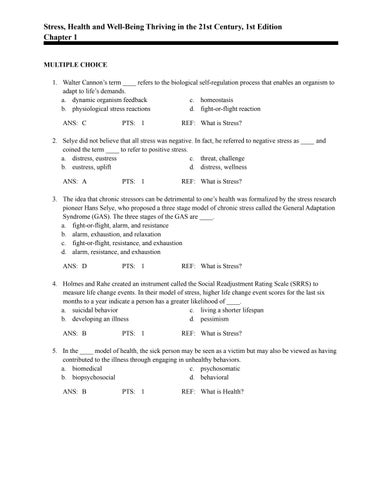
Stress, Health and Well-Being Thriving in the 21st Century, 1st Edition Chapter 1 MULTIPLE CHOICE 1. Walter Cannon’s term ____ refers to the biological self-regulation process that enables an organism to adapt to life’s demands. a. dynamic organism feedback c. homeostasis b. physiological stress reactions d. fight-or-flight reaction ANS: C
PTS: 1
REF: What is Stress?
2. Selye did not believe that all stress was negative. In fact, he referred to negative stress as ____ and coined the term ____ to refer to positive stress. a. distress, eustress c. threat, challenge b. eustress, uplift d. distress, wellness ANS: A
PTS: 1
REF: What is Stress?
3. The idea that chronic stressors can be detrimental to one’s health was formalized by the stress research pioneer Hans Selye, who proposed a three stage model of chronic stress called the General Adaptation Syndrome (GAS). The three stages of the GAS are ____. a. fight-or-flight, alarm, and resistance b. alarm, exhaustion, and relaxation c. fight-or-flight, resistance, and exhaustion d. alarm, resistance, and exhaustion ANS: D
PTS: 1
REF: What is Stress?
4. Holmes and Rahe created an instrument called the Social Readjustment Rating Scale (SRRS) to measure life change events. In their model of stress, higher life change event scores for the last six months to a year indicate a person has a greater likelihood of ____. a. suicidal behavior c. living a shorter lifespan b. developing an illness d. pessimism ANS: B
PTS: 1
REF: What is Stress?
5. In the ____ model of health, the sick person may be seen as a victim but may also be viewed as having contributed to the illness through engaging in unhealthy behaviors. a. biomedical c. psychosomatic b. biopsychosocial d. behavioral ANS: B
PTS: 1
REF: What is Health?
6. ____ , inspired by Sigmund Freud’s idea that repressed memories and intrapsychic conflict can lead to somatic conversions expressed as physical symptoms, broke rank with the conventional medical thinking of the time and became one of the first medical areas to challenge the mind-body duality aspect of the biomedical model. a. Psychoanalysis b. Illness prevention c. Somatic interpretation of physical agents d. Psychosomatic medicine ANS: D
PTS: 1
REF: What is Health?
7. Persons with ____ are more motivated to engage in health-promoting behaviors like physical exercise and avoid health-destructive behaviors like tobacco smoking. a. strong SOCs c. positive SOCs b. weak SOCs d. balanced SOCs ANS: A
PTS: 1
REF: Antonovsky's Salutogenic Model
8. Stressors produce ____ changes that can be detrimental to both our physical and psychological health. a. cognitive, emotional, physiological, and behavioral b. cognitive, genetic, and psychological c. physiological, pathogenic, and behavioral d. genetic, physiological, behavioral, and cognitive ANS: A
PTS: 1
REF: The Impact of Stress on Health and Performance
9. The autonomic nervous system is responsible for enervating the organ systems of the body, and with a few important exceptions (e.g., organs of the gastrointestinal system), its ____ branch is generally responsible for the arousal response of these organs. a. parasympathetic c. sympathetic b. sensory d. primary physiological ANS: C
PTS: 1
REF: The Physiology of Stress
10. Sympathetic nervous system activation in concert with adrenal gland catecholamine secretions such as ____ (known also as adrenalin) and ____ (known also as noradrenalin) prime the body to physically fight off threats to safety or to flee from these threats through such activities as increasing cardiac output and blood pressure that transit additional blood to the brain and large muscles of the body where the blood is most acutely needed. a. cortisol, norepinephrine c. cortisol, glucocorticoids b. epinephrine, norepinephrine d. ephedrine, norephedrine ANS: B
PTS: 1
REF: The Physiology of Stress
11. The ____ model suggests that many illnesses may result from an interaction of biology and the environment. a. diathesis-stress c. bio-eco b. General Adaptation Syndrome d. multi-axial stressor
ANS: A
PTS: 1
REF: The Physiology of Stress
12. Cannon and Selye paved the way for research in fields like psychoendocrinology. What do psychoendocrinologists examine? a. The effects of psychological processes on endocrine dysfunction b. The effects of endocrine dysfunction on mental processes c. The relationship between stress levels and endocrine function d. The relationship between psychological processes and endocrine function ANS: D
PTS: 1
REF: The Physiology of Stress
13. Following an adaptive fight-or-flight reaction, the homeostatic mechanisms return the body back to normal ____. a. baseline c. homeostatic rest b. homeostasis d. pre-reactive functioning ANS: A
PTS: 1
REF: The Physiology of Stress
14. During the fight-or-flight response, hormones such as epinephrine, norepinephrine, and cortisol are secreted from the hormonal system to stimulate the release of ____. a. awareness-altering hormones b. energy for action c. neurotransmitters to stimulate cognitive activity d. oxygen to the muscles ANS: B
PTS: 1
REF: The Physiology of Stress
15. Based on various physical stressors, Hans Selye determined through autopsies that the rats in his experiments experienced common physiological patterns of change over time, such as reductions in the size of the thymus and lymph glands, enlarged adrenal cortexes, and ulcerated stomachs. He described these physiological changes as stress reactions. They were characterized as ____ because they represented common patterns to a host of different stressors. a. generic responses c. physiological responses b. alarm responses d. non-specific responses ANS: D
PTS: 1
REF: The Physiology of Stress
16. Most modern biological models of stress build on the work of Cannon and Selye by focusing on the measurement of stress reactions through ____ (i.e., epinephrine and norepinephrine) and cortisol excretions. a. noradrenaline c. catecholamine b. adrenaline d. dopamine ANS: C
PTS: 1
REF: The Physiology of Stress
17. The less our perceived amount of ____ in relation to a stressor, the more stressful we perceive the event to be. a. understanding c. orientation b. control d. coping
ANS: B
PTS: 1
REF: The Psychology of Stress
18. According to Lazarus, events can be appraised during primary appraisal in three possible ways. They can be seen as ____, ____, or ____. a. benign-stressful, distressful, indifferent b. irrelevant, distressful, positive-stressful c. distressful, eustressful, neutral-stressful d. irrelevant, benign-positive, stressful ANS: D
PTS: 1
REF: The Psychology of Stress
19. ____ appraisals are past or present oriented and result from appraisals of loss or damage that is happening or has already happened. The losses can be tangible such as loss of a loved one or a job, or psychological, such as loss of self-esteem. a. Primary-loss c. Harm-loss b. Secondary d. Threat ANS: C
PTS: 1
REF: The Psychology of Stress
20. If we want to live the good life, we also want to build on our ____ and our sense of well-being. a. sense of coherence c. management skills b. mindfulness d. good feelings ANS: D
PTS: 1
REF: The Promise of Positive Psychology
SHORT ANSWER 1. What is the Hassles and Uplifts Scale? ANS: Lazarus and his colleagues created a scale for hassles and another one for uplifts. Lazarus later developed the Hassles and Uplifts Scale which combines measures for both constructs. Examples of hassles on The Hassles Scale include misplacing things, noise, filling out forms, too many interruptions, and having to wait whereas uplifts on The Uplifts Scale include engaging in a hobby, laughing, having fun, eating out, and completing a task. The Lazarus group gave their scales to a middle-aged adult sample and reported that the sample’s top three most frequent hassles in rank order were concerns about weight, health of a family member, and rising prices of common goods and uplifts were relating well with your spouse or lover, relating well with friends, and completing a task. PTS: 1
REF: What is Stress?
2. Holmes and Rahe created an instrument called the Social Readjustment Rating Scale (SRRS). Describe this scale and what it measures. ANS:
Holmes and Rahe created an instrument called the Social Readjustment Rating Scale (SRRS) to measure life change events. On the Social Readjustment Rating Scale, life change events range from a low of 10 points for events like "minor violations of the law" to a high of 100 points for "death of a spouse." In their model of stress, higher life change event scores for the last 6 months to a year indicate a person has a greater likelihood of developing an illness. This idea spurred debate over whether stress is determined by objective life events or subjective appraisals of these events. PTS: 1
REF: What is Stress?
3. What is behavioral medicine? ANS: Behavioral medicine is the field of study that applies elements of the behavioral sciences to illness prevention and treatment. In practical terms, it uses a multidisciplinary approach including professionals from the medical field (e.g., preventive medicine specialists), registered dieticians, exercise physiologists, psychologists, health educators, or other professionals to assist those who wish to maximize their health goals through behavioral approaches to illness prevention. It also focuses on treatments of existing illnesses or health disorders with behavioral approaches using stand-alone interventions when appropriate or, more commonly, treatments that are designed to assist traditional medical approaches. PTS: 1
REF: What is Health?
4. Explain the concept of wellness. What are four elements of wellness that are believed to lead to the highest level of life satisfaction? ANS: Wellness encompasses a global approach to health that not only includes stress management and emotional self-regulation, but also focuses on healthy living, including exercise and proper nutrition as well as activities that promote personal growth. These may include promoting physical, mental, emotional, and spiritual well-being. When working together as a harmonic whole, these four elements of wellness are believed to lead to the highest level of life satisfaction. PTS: 1
REF: What is Health?
5. What are generalized resistance resources (GRRs) and what function do they perform in Antonovsky’s Salutogenic Model? ANS: Antonovsky considers stressors to be omnipresent. Thus, his model suggests that adaptation to our stress-filled environments involves finding inputs from resources that enable us to resist entropy or make order out of chaos (i.e., negative entropy resources). Such resources can be classified as our personal reserves (e.g., our sense of optimism), our social environment (e.g., our social relationships), and our physical environment (e.g., our physical resources like money and possessions). He called these inputs generalized resistance resources (GRRs), which serve to reduce the pressure on us to move toward the negative end of the pole, the entropic direction, when encountering stressors.