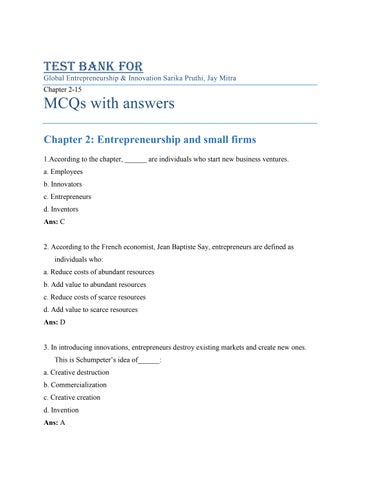
Test Bank For Global Entrepreneurship & Innovation Sarika Pruthi, Jay Mitra Chapter 2-15
MCQs with answers Chapter 2: Entrepreneurship and small firms 1.According to the chapter, ______ are individuals who start new business ventures. a. Employees b. Innovators c. Entrepreneurs d. Inventors Ans: C
2. According to the French economist, Jean Baptiste Say, entrepreneurs are defined as individuals who: a. Reduce costs of abundant resources b. Add value to abundant resources c. Reduce costs of scarce resources d. Add value to scarce resources Ans: D
3. In introducing innovations, entrepreneurs destroy existing markets and create new ones. This is Schumpeter‟s idea of______: a. Creative destruction b. Commercialization c. Creative creation d. Invention Ans: A
4. Individuals who hold or have held a minority or majority ownership stake in two or more firms, at least one of which was established or purchased are called______: a. Novice entrepreneurs b. Solo entrepreneurs c. Corporate entrepreneurs d. Habitual entrepreneurs Ans: D
5. Large firms like GE and Motorola are increasingly employing entrepreneurial thinking to enhance their futures. This phenomenon is an example of______: a. Technical entrepreneurship b. Academic entrepreneurship c. Social entrepreneurship d. Corporate entrepreneurship Ans: D
6. ______ of entrepreneurship propose that entrepreneurs perceive market gaps or identify unnoticed opportunities. a. Cognitive theories b. Personality theories c. Psycho-sociological theories d. Network theories Ans: A
7. All of following are qualitative features of small firms, except: a. Small number of employees b. Informal culture c. Lack of market power d. Informal structure and organization
Ans: A
8. ______are microenterprises that permit their owners to follow a desired pattern of living based on their passion. a. Salary-substitute firms b. Micro firms c. Lifestyle firms d. Entrepreneurial firms Ans: C
9. According to the chapter, small firms face a number of disadvantages in trying to be innovative. These include the lack of: a. Financial resources b. Human resources c. Technical resources d. All of these Ans: D
10. Small and Medium-Sized Enterprises (SMEs) are small firms with 500 or fewer employees in: a. India b. Europe c. USA d. Kenya Ans: C
MCQs with answers
Chapter 3: Comparative development of entrepreneurship 1. According to the findings of the GEM (2018) study, early-stage entrepreneurial activity is more likely to be opportunity-driven in high-income countries and necessity-driven in low-income countries. a. True b. False Ans: A
2. Total Entrepreneurial Activity (TEA) index refers to the percentage of adult population that: a. Has taken some action towards creating a new business in the past year b. Are owner/managers of an active business less than 42 months old c. Have sold a business in the past year d. Both A and B Ans: D
3. In general, compared to social/cultural and technological factors, political and economic factors have a greater impact on the development of entrepreneurship in a country. a. True b. False Ans: B
4. According to the chapter, controlled economies are more likely to foster entrepreneurship than market-oriented economies. a. True b. False Ans: B
5. Interest and tax rates are useful measures for evaluating the role of economic factors in the international development of entrepreneurship. a. True b. False Ans: A
6. Cultural factors that influence the international development of entrepreneurship refer to all the following, except: a. Power distance b. Uncertainty avoidance c. Wellness Index d. Long-term orientation Ans: C
7. According to the chapter, GEM refers to: a. Greater entrepreneurship monitor b. Global entrepreneurship measure c. Greater entrepreneurship mentor d. Global entrepreneurship monitor Ans: D
8. According to the chapter, government intervention to spur the international development of entrepreneurship can take all the following forms, except: a. Investment in education b. Investment in community housing c. Investment in research & development d. Investment in training Ans: B