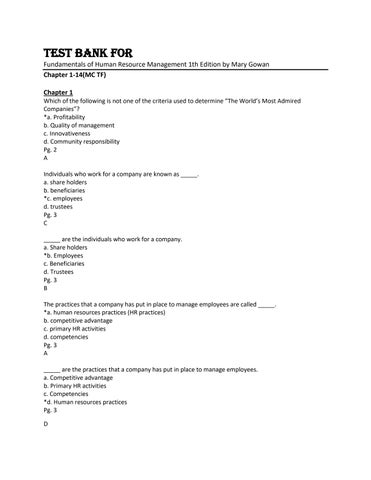
Test Bank For Fundamentals of Human Resource Management 1th Edition by Mary Gowan Chapter 1-14(MC TF) Chapter 1 Which of the following is not one of the criteria used to determine “The World’s Most Admired Companies”? *a. Profitability b. Quality of management c. Innovativeness d. Community responsibility Pg. 2 A Individuals who work for a company are known as _____. a. share holders b. beneficiaries *c. employees d. trustees Pg. 3 C _____ are the individuals who work for a company. a. Share holders *b. Employees c. Beneficiaries d. Trustees Pg. 3 B The practices that a company has put in place to manage employees are called _____. *a. human resources practices (HR practices) b. competitive advantage c. primary HR activities d. competencies Pg. 3 A _____ are the practices that a company has put in place to manage employees. a. Competitive advantage b. Primary HR activities c. Competencies *d. Human resources practices Pg. 3 D
An individual who is responsible for supervising and directing the efforts of a group of employees to perform tasks that are directly related to the creation and delivery of a company’s products or services is known as a(n) ______. a. employee b. shareholder *c. line manager (manager) d. principle Pg. 3 C A(n) _____ is an individual who is responsible for supervising and directing the efforts of a group of employees to perform tasks that are directly related to the creation and delivery of a company’s products or services. *a. line manager (manager) b. employee c. shareholder d. principle Pg. 3 A A support function within companies that serves a vital role in designing and implementing company policies for managing employees is usually called the _____. a. performance management department *b. human resources department (HR department) c. talent development department d. employee operations department Pg. 3 B A(n) _____ is the support function within companies that serves a vital role in designing and implementing company policies for managing employees. a. performance management department b. talent development department *c. human resources department d. employee operations department Pg. 3 C A company’s ability to create more economic value than its competitors is called _____. *a. competitive advantage b. performance management c. cultural advantage d. competitive management Pg. 3 A _____ is a company’s ability to create more economic value than its competitors. a. Performance management
b. Cultural advantage *c. Competitive advantage d. Competitive management Pg. 3 C The activities that encompass work design and workforce planning, managing employee competencies, and managing employee attitudes and behaviors are known as _____. a. competitive activities b. performance activities *c. primary HR activities d. cultural activities Pg. 5 C _____ are the activities that encompass work design and workforce planning, managing employee competencies, and managing employee attitudes and behaviors. a. Competitive activities *b. Primary HR activities c. Performance activities d. Cultural activities Pg. 5 B Which of the following is not one of the three primary HR activities? *a. Controlling healthcare costs b. Work design and workforce planning c. Managing employee competencies d. Managing employee attitudes and behaviors Pg. 5 Which of the following is not one of the three main HR challenges? a. Organizational demands b. Environmental influences c. Regulatory issues *d. Political instability Pg. 6 D The challenges that managers must consider in the management of employees that relate to organizational demands, environmental influences, and regulatory issues are called _____. *a. HR challenges b. regulatory challenges c. alignment challenges d. competitive challenges Pg. 6 A
_____ are the challenges that managers must consider in the management of employees that relate to organizational demands, environmental influences, and regulatory issues. a. Regulatory challenges b. Alignment challenges *c. HR challenges d. Competitive challenges Pg. 6 C “How many tasks can your employees perform?” is a question a manager would need to consider for _____. *a. job design b. alignment c. competencies d. organizational demands Pg. 7 A If managers do not consider _____ in job design, employees may unknowingly focus on tasks and activities that are not necessarily the most important. a. culture b. alignment *c. company objectives d. globalization Pg. 7 Making decisions about allocating employees through promotions, demotions, and transfers to areas where they can contribute most significantly is part of _____. *a. workforce planning b. setting company objectives c. creating alignment d. value creation Pg. 7 A _____ refers to the process of generating a qualified pool of potential employees interested in working for your company or encouraging individuals within your company to pursue other positions within your company. a. Selection b. Interviewing c. Job design *d. Recruitment Pg. 8 D The knowledge, skills, abilities, and other talents that employees possess are called _____. a. attributes *b. competencies
c. talent factors d. intangibles Pg. 8 B _____ refers to the knowledge, skills, abilities, and other talents that employees possess. *a. Competencies b. Attributes c. Talent factors d. Intangibles Pg. 8 A A recruitment _____ addresses the question: “Why would someone want to work for this company?” a. pitch b. plan *c. value proposition d. campaign Pg. 8 C _____focuses on choosing the best person from a pool of candidates. a. Recruiting b. Job design c. Competitive advantage *d. Selection Pg. 9 D Perhaps the most critical issue to address is whether the candidate possesses the _____that you have identified as the most important for a particular job. *a. competencies b. internal alignment c. external alignment d. human resource practices Pg. 9 A _____ensure(s) that new and current employees know the ins and outs of the organization and have the skills that they need to succeed, both now and in the future. a. Selection b. Recruiting c. Competencies *d. Learning and development Pg. 9 D