Student name:__________ 1)
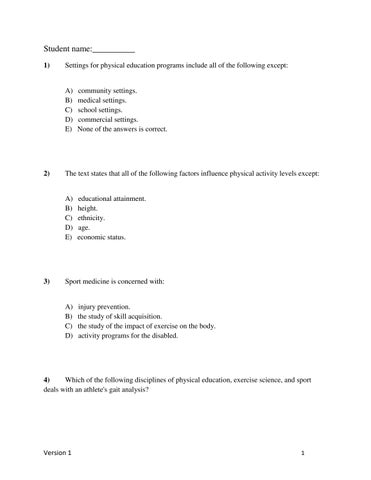
Settings for physical education programs include all of the following except:
A) community settings. B) medical settings. C) school settings. D) commercial settings. E) None of the answers is correct.
2)
The text states that all of the following factors influence physical activity levels except:
A) educational attainment. B) height. C) ethnicity. D) age. E) economic status.
3)
Sport medicine is concerned with:
A) injury prevention. B) the study of skill acquisition. C) the study of the impact of exercise on the body. D) activity programs for the disabled.
4) Which of the following disciplines of physical education, exercise science, and sport deals with an athlete's gait analysis?
Version 1
1
A) Motor learning B) Exercise physiology C) Sport biomechanics D) Health psychology
5) _____ is the study of the role of sport in society, its impact on participants in sport, and the relationship between sport and other societal institutions.
A) Sport philosophy B) Sport psychology C) Sport sociology D) Sport pedagogy
6) _____ refers to well-established, officially governed competitive physical activities in which participants are motivated by internal and external rewards.
A) Sport B) Physical education C) Exercise D) Physical fitness
7)
Exercise physiology is the study of:
A) the methods of physics and mechanics used in human motion and the motion of sport objects. B) the effects of various physical demands on the structure and function of the body. C) activity programs for the disabled. D) the mechanical analysis of skill.
Version 1
2
8) _____ studies the factors that influence the development of abilities essential to movement.
A) Motor development B) Adapted physical activity C) Sport pedagogy D) Biomechanics
9) _____ include self-chosen activities that provide a means of revitalizing and refreshing one's body and spirit.
A) Recreation and leisure B) Wellness C) Dance D) Physical education pedagogy
10)
Identify a true statement about exercise physiologists.
A) Clinical exercise testing is not an area of responsibility of exercise physiologists. B) Exercise physiologists focus exclusively on the mechanisms that can reduce disease progression in athletes. C) Exercise physiologists are concerned with both acute and chronic adaptations of the various systems of the body to exercise. D) Design of rehabilitation programs for postcardiac patients is not one of the responsibility areas of exercise physiologists.
11)
Which of the following is true of physical fitness?
Version 1
3
A) It requires participants to be motivated by internal and external rewards. B) It is a measure of the application of science to the study of physical activity. C) It helps measure the duration, frequency, and intensity of an exercise being performed. D) It is a state of well-being associated with low risk of premature health problems.
12)
Unlike quantitative research, qualitative research _____.
A) is based exclusively on frequency counts B) describes, correlates, predicts, or explains a hypothesis posed at the beginning of a study C) answers questions through words, images, and sounds D) is based on numbers, primarily the statistical analysis of the gathered numeric data
13) In this text, physical education, exercise science, and sport are defined as one field. In today's society, should they be collectively considered as one field or separately as multiple fields? Explain. What factors can you use to support your stance?
14) Compare and contrast the definitions of exercise, physical activity, physical education, physical fitness, and sport. Describe how they are interrelated and examine whether one supersedes the others.
Version 1
4
15) Discuss why it is important to grow as a professional once you obtain your degree. Describe the different types of research reports and their application to physical education, exercise science, and sport. Identify the role played by social media in the field of physical education, exercise science, and sport.
16)
What are the accrued benefits of regular physical activity?
17) Health, recreation, and dance are subdisciplines of physical education, exercise science, and sport. ⊚ ⊚
true false
18) Physical activity psychology is concerned with exercise addiction, adherence, and other psychological issues affecting the well-being of people who are physically active. ⊚ ⊚ 19)
true false
Motor learning is the study of human movement. ⊚ ⊚
Version 1
true false
5