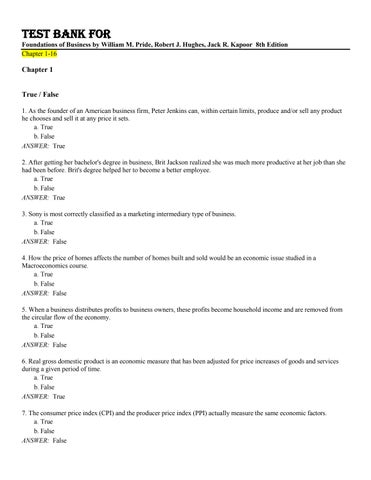
Test Bank For Foundations of Business by William M. Pride, Robert J. Hughes, Jack R. Kapoor 8th Edition Chapter 1-16
Chapter 1
True / False 1. As the founder of an American business firm, Peter Jenkins can, within certain limits, produce and/or sell any product he chooses and sell it at any price it sets. a. True b. False ANSWER: True 2. After getting her bachelor's degree in business, Brit Jackson realized she was much more productive at her job than she had been before. Brit's degree helped her to become a better employee. a. True b. False ANSWER: True 3. Sony is most correctly classified as a marketing intermediary type of business. a. True b. False ANSWER: False 4. How the price of homes affects the number of homes built and sold would be an economic issue studied in a Macroeconomics course. a. True b. False ANSWER: False 5. When a business distributes profits to business owners, these profits become household income and are removed from the circular flow of the economy. a. True b. False ANSWER: False 6. Real gross domestic product is an economic measure that has been adjusted for price increases of goods and services during a given period of time. a. True b. False ANSWER: True 7. The consumer price index (CPI) and the producer price index (PPI) actually measure the same economic factors. a. True b. False ANSWER: False
8. As the price of a product increases, the amount of the product that a producer is willing to supply increases. a. True b. False
ANSWER: True 9. As the price of a product increases, the amount of the product that consumers purchase increases. a. True b. False ANSWER: False 10. A copyright of a product exists indefinitely. a. True b. False ANSWER: False 11. A factory system of manufacturing involves the separation of a manufacturing process into separate tasks and the assignment of different tasks to different employees. a. True b. False ANSWER: False 12. Specialization is meant to increase the efficiency of industrial workers. a. True b. False ANSWER: True 13. During the 1930s, government became deeply involved in business for the first time. a. True b. False ANSWER: True 14. According to global experts, India is the fastest-growing economy in the world. a. True b. False ANSWER: False 15. In our free-enterprise system, federal and state governments decide what products and services to provide. a. True b. False ANSWER: False 16. A working knowledge of our business system combined with technical skills can give an applicant an advantage in looking for a job. a. True
b. False ANSWER: True 17. Today, managers and employees are no longer concerned about cultural diversity.
a. True b. False ANSWER: False 18. Because e-businesses use the Internet, there is no need to meet the needs of their customers. a. True b. False ANSWER: False 19. In order for a business to be successful, it must be organized, it must satisfy needs, and it must make a profit. a. True b. False ANSWER: True 20. The four resources that a business must use to operate successfully include material resources, human resources, financial resources, and operational resources. a. True b. False ANSWER: False 21. Generally there are three types of businesses: manufacturing businesses, service businesses, and marketing intermediaries. a. True b. False ANSWER: True 22. People buy goods and services simply to own them. a. True b. False ANSWER: False 23. The ultimate goal of every business firm should be to satisfy the needs of its customers. a. True b. False ANSWER: True 24. If a firm's sales revenue exceeds its expenses, the firm has earned a profit. a. True b. False ANSWER: True 25. Profit is the payment business owners receive for assuming the risks of ownership.
a. True b. False ANSWER: True
26. The term stakeholders refers only to the people who have invested money in a business. a. True b. False ANSWER: False 27. Economics is the study of how wealth is created and distributed. a. True b. False ANSWER: True 28. Macroeconomists often study the effect of taxes, government spending, interest rates, and similar factors on a nation's economy. a. True b. False ANSWER: True 29. The factors of production include natural resources, labor, government assistance, and entrepreneurship. a. True b. False ANSWER: False 30. The four basic questions in a capitalist economy are what to produce, how to produce, who should produce, and when to produce. a. True b. False ANSWER: False 31. Adam Smith is the person who actually organized American business as we know it today. a. True b. False ANSWER: False 32. According to Adam Smith, under laissez-faire capitalism, each person should be allowed to work toward his or her own economic gain without government interference. a. True b. False ANSWER: True 33. Adam Smith argued that the creation of wealth is a proper concern of government. a. True b. False
ANSWER: False 34. Adam Smith developed the concept of the invisible hand to explain how all economic activity should be based on a
nation's needs and not the individual's needs. a. True b. False ANSWER: False 35. A market economy is sometimes referred to as a command economy. a. True b. False ANSWER: False 36. The U.S. business system is commonly referred to as a mixed economy. a. True b. False ANSWER: True 37. Consumers exchange tax money to purchase goods and services. a. True b. False ANSWER: False 38. A business provides goods and services in exchange for sales revenues. a. True b. False ANSWER: True 39. The services that government provides would not be produced by private business firms or would be produced only for those who could afford them. a. True b. False ANSWER: True 40. The government uses taxes to purchase resources and products required to provide services. a. True b. False ANSWER: True 41. Command economies include capitalism, socialism, and communism. a. True b. False ANSWER: False 42. In a socialist economy, the key industries are owned and controlled by the government. a. True