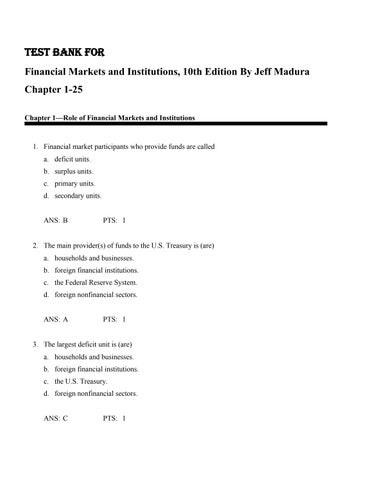
TEST BANK FOR Financial Markets and Institutions, 10th Edition By Jeff Madura Chapter 1-25 Chapter 1—Role of Financial Markets and Institutions
1. Financial market participants who provide funds are called a. deficit units. b. surplus units. c. primary units. d. secondary units. ANS: B
PTS: 1
2. The main provider(s) of funds to the U.S. Treasury is (are) a. households and businesses. b. foreign financial institutions. c. the Federal Reserve System. d. foreign nonfinancial sectors. ANS: A
PTS: 1
3. The largest deficit unit is (are) a. households and businesses. b. foreign financial institutions. c. the U.S. Treasury. d. foreign nonfinancial sectors. ANS: C
PTS: 1
4. Those financial markets that facilitate the flow of short-term funds are known as a. money markets. b. capital markets. c. primary markets. d. secondary markets. ANS: A
PTS: 1
5. Funds are provided to the initial issuer of securities in the a. secondary market. b. primary market. c. deficit market. d. surplus market. ANS: B
PTS: 1
6. Which of the following is a capital market instrument? a. a six-month CD b. a three-month Treasury bill c. a ten-year bond d. an agreement for a bank to loan funds directly to a company for nine months ANS: C
PTS: 1
7. Which of the following is a money market security? a. Treasury note b. municipal bond c. mortgage d. commercial paper ANS: D
PTS: 1
8. The creditors in the federal funds market are a. households. b. depository institutions. c. firms. d. government agencies. ANS: B
PTS: 1
9. Equity securities have a ____ expected return than most long-term debt securities, and they exhibit a ____ degree of risk. a. higher; higher b. lower; lower c. lower; higher d. higher; lower ANS: A
PTS: 1
10. Money market securities generally have ____. Capital market securities are typically expected to have a ____. a. less liquidity; higher annualized return b. more liquidity; lower annualized return c. less liquidity; lower annualized return d. more liquidity; higher annualized return ANS: D
PTS: 1
11. If security prices fully reflect all available information, the markets for these securities are a. efficient. b. primary. c. overvalued. d. undervalued. ANS: A
PTS: 1
12. If markets are ____, investors could use available information ignored by the market to earn abnormally high returns. a. perfect b. active c. inefficient d. in equilibrium ANS: C
PTS: 1
13. If financial markets are efficient, this implies that all securities should earn the same return. a. True b. False ANS: F
PTS: 1
14. The Securities Act of 1933 a. required complete disclosure of relevant financial information for publicly offered securities in the primary market. b. declared trading strategies to manipulate the prices of public secondary securities illegal. c. declared misleading financial statements for public primary securities illegal. d. required complete disclosure of relevant financial information for securities traded in the secondary market. e. all of the above ANS: A
PTS: 1
15. The Securities Exchange Commission (SEC) was established by the a. Federal Reserve Act. b. McFadden Act. c. Securities Exchange Act of 1934.
d. Glass-Steagall Act. e. none of the above ANS: C
PTS: 1
16. Common stock is an example of a(n) a. debt security. b. money market security. c. equity security. d. A and B ANS: C
PTS: 1
17. If financial markets were ____, all information about any securities for sale in primary and secondary markets would be continuously and freely available to investors. a. efficient b. inefficient c. perfect d. imperfect ANS: C
PTS: 1
18. The typical role of a securities firm in a public offering of securities is to a. purchase the entire issue for its own investment. b. place the entire issue with a single large investor. c. spread the issue across several investors until the entire issue is sold. d. provide all large investors with loans so that they can invest in the offering. ANS: C
PTS: 1
19. Without the participation of financial intermediaries in financial market transactions, a. information and transaction costs would be lower.