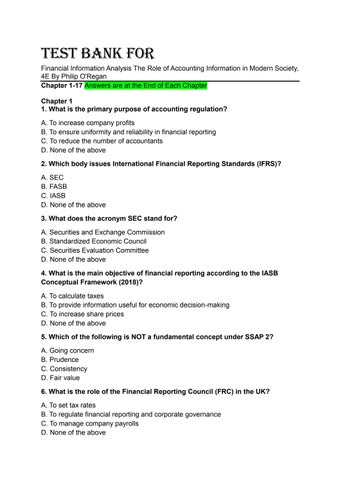
Test Bank For Financial Information Analysis The Role of Accounting Information in Modern Society, 4E By Philip O'Regan Chapter 1-17 Answers are at the End of Each Chapter Chapter 1 1. What is the primary purpose of accounting regulation? A. To increase company profits B. To ensure uniformity and reliability in financial reporting C. To reduce the number of accountants D. None of the above 2. Which body issues International Financial Reporting Standards (IFRS)? A. SEC B. FASB C. IASB D. None of the above 3. What does the acronym SEC stand for? A. Securities and Exchange Commission B. Standardized Economic Council C. Securities Evaluation Committee D. None of the above 4. What is the main objective of financial reporting according to the IASB Conceptual Framework (2018)? A. To calculate taxes B. To provide information useful for economic decision-making C. To increase share prices D. None of the above 5. Which of the following is NOT a fundamental concept under SSAP 2? A. Going concern B. Prudence C. Consistency D. Fair value 6. What is the role of the Financial Reporting Council (FRC) in the UK? A. To set tax rates B. To regulate financial reporting and corporate governance C. To manage company payrolls D. None of the above
7. What is the purpose of the Sarbanes–Oxley Act (SOX)? A. To deregulate financial markets B. To increase corporate fraud C. To improve corporate governance and accountability D. None of the above 8. What is the term for the UK‟s version of IFRS post-Brexit? A. UK Accounting Rules B. UK-IFRS C. UK-adopted international accounting standards D. None of the above 9. Which of these is a key qualitative characteristic of useful financial information? A. Complexity B. Relevance C. Ambiguity D. None of the above 10. What does the term “prudence” in accounting mean? A. Overstating profits B. Understating liabilities C. Exercising caution in financial reporting D. None of the above 11. What is the main function of the Financial Accounting Standards Board (FASB)? A. To audit companies B. To set accounting standards in the US C. To manage stock exchanges D. None of the above 12. What is the purpose of a conceptual framework in accounting? A. To replace financial statements B. To provide a foundation for developing accounting standards C. To eliminate the need for auditors D. None of the above 13. What is “fair value” in accounting? A. Historical cost B. Arbitrary value C. Conservative valuation D. None of the above
14. Which of the following is a legally required component of an annual report? A. Auditor‟s Report B. Chairman‟s Statement C. Marketing Plan D. Chief Executive‟s Report 15. What is the effect of the introduction of IFRS 13 Fair Value Measurement? A. To make accounting values more conservative B. To make accounting values more relevant C. To remove unwanted items from the balance sheet D. None of the above 16. What does the term “going concern” imply? A. The company is closing down B. The company will continue operating in the foreseeable future C. The company is being sold D. None of the above 17. What is the main criticism of annual reports mentioned in the chapter? A. They are too short B. They are too technical C. They are too long and unwieldy D. None of the above 18. What is the purpose of the Strategic Report? A. To replace the balance sheet B. To provide a comprehensive view of a company‟s financial performance C. To advertise company products D. None of the above 19. What was the significance of the Dearing Report? A. It introduced tax reforms B. It restructured the UK‟s accounting standard-setting process C. It eliminated financial reporting D. None of the above 20. What is the “substance over form” principle? A. Legal form is more important than economic reality B. Economic reality should be reflected over legal form C. Ignore both legal and economic aspects D. None of the above
Answer Key 1. B 2. C 3. A 4. B 5. D 6. B 7. C 8. C 9. B 10. C 11. B 12. B 13. D 14. A 15. B 16. B 17. C 18. D 19. B 20. B
MCQs Chapter 2: Sustainability Framework 1. What does ESG stand for in sustainability reporting? A. Environmental, Social, and Governance B. Economic, Social, and Growth C. Environmental, Strategic, and Governance D. None of the above 2. Which organization introduced the Corporate Sustainability Reporting Directive (CSRD)? A. SEC B. FRC C. European Union D. None of the above 3. What is the main purpose of sustainability reporting? A. To increase company profits B. To provide transparency and accountability on environmental and social impacts C. To replace financial statements D. None of the above 4. What is “double materiality” under CSRD? A. Reporting only on financial risks B. Reporting only on environmental risks C. Reporting on how sustainability impacts supply chains D. None of the above 5. Which body created the International Sustainability Standards Board (ISSB)? A. SEC B. IFRS Foundation C. EU Commission D. None of the above 6. What is the focus of the TCFD framework? A. Tax compliance B. Climate-related financial disclosures C. Employee benefits D. None of the above
7. What is the main criticism of sustainability reports mentioned in the chapter?