Test Bank For Finance for Executives Managing for Value Creation, 7th Edition Gabriel Hawawini, Claude Viallet Chapter 1-18
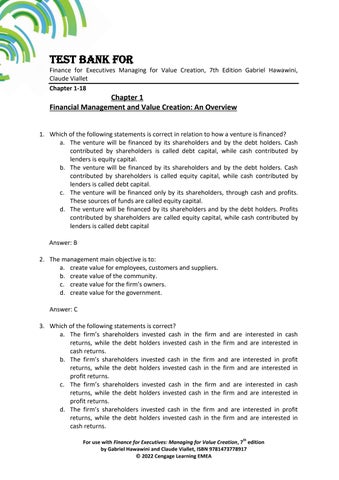
Chapter 1 Financial Management and Value Creation: An Overview 1. Which of the following statements is correct in relation to how a venture is financed? a. The venture will be financed by its shareholders and by the debt holders. Cash contributed by shareholders is called debt capital, while cash contributed by lenders is equity capital. b. The venture will be financed by its shareholders and by the debt holders. Cash contributed by shareholders is called equity capital, while cash contributed by lenders is called debt capital. c. The venture will be financed only by its shareholders, through cash and profits. These sources of funds are called equity capital. d. The venture will be financed by its shareholders and by the debt holders. Profits contributed by shareholders are called equity capital, while cash contributed by lenders is called debt capital Answer: B 2. The management main objective is to: a. create value for employees, customers and suppliers. b. create value of the community. c. create value for the firm’s owners. d. create value for the government. Answer: C 3. Which of the following statements is correct? a. The firm’s shareholders invested cash in the firm and are interested in cash returns, while the debt holders invested cash in the firm and are interested in cash returns. b. The firm’s shareholders invested cash in the firm and are interested in profit returns, while the debt holders invested cash in the firm and are interested in profit returns. c. The firm’s shareholders invested cash in the firm and are interested in cash returns, while the debt holders invested cash in the firm and are interested in profit returns. d. The firm’s shareholders invested cash in the firm and are interested in profit returns, while the debt holders invested cash in the firm and are interested in cash returns. th
For use with Finance for Executives: Managing for Value Creation, 7 edition by Gabriel Hawawini and Claude Viallet, ISBN 9781473778917 © 2022 Cengage Learning EMEA
Answer: A
4. A discount rate used to calculate the NPV of a project is: a. the cost of financing the proposal. b. the weighted average of the project’s cost of equity and its after-tax cost of debt. c. the weighted average cost of capital. d. all of the above. Answer: D 5. A project should be undertaken only if it does not destroy value. Under which circumstance should a project be accepted? a. NPV is zero. b. NPV is negative. c. NPV is positive. d. NPV is positive or zero. Answer: D 6. A project should be undertaken only if it does not destroy value. Under which circumstance should a project be accepted? a. The IRR is higher than the cost of capital. b. The IRR is equal to the cost of capital. c. The IRR is higher or equal to the cost of capital. d. The IRR is lower than the cost of capital. Answer: C 7. NPV proposals are expected to create entry barriers that are costly enough to discourage potential competitors, but not so costly as to wipe out a firm’s own positive NPV. Which of the following is not one of these entry barriers? a. Patents and trademarks b. A unique distribution channel c. Innovative products d. All of the above Answer: D 8. A firm with $65 million of cash must decide whether to use it to fund a project with an IRR of 12% or distribute the cash to is shareholders. a. If the WACC is higher than the IRR, the firm should invest in the project. b. If the WACC is lower than the IRR, the firm should pay out cash in the form of dividends. c. If the WACC is higher than the IRR, the firm should opt for share repurchases or dividends. th
For use with Finance for Executives: Managing for Value Creation, 7 edition by Gabriel Hawawini and Claude Viallet, ISBN 9781473778917 © 2022 Cengage Learning EMEA
d. All of the above. Answer: C 9. In order to determine the optimal capital structure, a firm must consider several factors. Which should be the correct decision? a. If the present value of the expected tax savings from debt financing is higher than the present value of the expected cost of financial distress, the firm should continue to increase equity. b. If the present value of the expected tax savings from debt financing is higher than the present value of the expected cost of financial distress, the firm should continue to increase debt. c. If the present value of the expected tax savings from equity financing is higher than the present value of the expected cost of financial distress, the firm should continue to increase equity. d. If the present value of the expected tax savings from equity financing is higher than the present value of the expected cost of financial distress, the firm should continue to increase debt. Answer: B, the tax savings are only related to debt financing, not related to equity. 10. What is the NPV of an acquisition? a. NPV (acquisition) = Premium paid to acquire the target company’s assets + Present value of the post-acquisition incremental net cash flows from the merged assets b. NPV (acquisition) = + Premium paid to acquire the target company’s assets Present value of the post-acquisition incremental net cash flows from the merged assets c. NPV (acquisition) = + Premium paid to acquire the target company’s assets + Present value of the post-acquisition incremental net cash flows from the merged assets d. NPV (acquisition) = Premium paid to acquire the target company’s assets Present value of the post-acquisition incremental net cash flows from the merged assets Answer: A 11. In foreign investment decisions, which of the following risks must be considered? a. Currency risk, but not country risk b. Country risk, but not currency risk c. Both country and currency risk d. None of the above Answer: C 12. Which of the following instruments can be used by managers to reduce the effect of currency movements on the cash flows generated by a foreign project? th
For use with Finance for Executives: Managing for Value Creation, 7 edition by Gabriel Hawawini and Claude Viallet, ISBN 9781473778917 © 2022 Cengage Learning EMEA
a. b. c. d.
Forward Futures Swaps All of the above
Answer: D 13. What is the main difference between primary markets and secondary markets? a. Primary markets provide financing required to fund new business ventures and sustain growth, intermediating newly issued securities, while secondary markets are the trading of outstanding securities. b. Primary markets provide financing required to fund new business ventures and sustain growth, intermediating outstanding securities, while secondary markets are the trading of newly issued securities. c. Secondary markets provide financing required to fund new business ventures and sustain growth, intermediating newly issued securities, while secondary markets are the trading of outstanding securities. d. Secondary markets provide financing required to fund new business ventures and sustain growth, intermediating outstanding securities, while secondary markets are the trading of newly issued securities. Answer: A 14. Which of the following statements is true? a. Long-term funds can be raised by issuing commercial paper (CP) in the money market, while short-term funds can be raised by issuing bonds in the corporate bond market. b. Short-term funds can be raised by issuing commercial paper (CP) in the money market, while long-term funds can be raised by issuing bonds in the corporate bond market. c. Short-term funds can be raised by issuing commercial paper (CP) in the corporate bond market, while long-term funds can be raised by issuing bonds in the money market. d. Long-term funds can be raised by issuing commercial paper (CP) in the corporate bond market, while short-term funds can be raised by issuing bonds in the money market. Answer: B 15. What is the sequence of events in a business cycle? a. Initial capital, Assets, Net Profit, Sales b. Initial capital, Sales, Assets, Net Profit c. Initial capital, Assets, Sales, Net Profit d. Initial capital, Sales, Net Profit, Assets Answer: C th
For use with Finance for Executives: Managing for Value Creation, 7 edition by Gabriel Hawawini and Claude Viallet, ISBN 9781473778917 © 2022 Cengage Learning EMEA
16. What is the correct order of the different levels of earnings in an Income Statement? a. Sales, EBIT, EAT, EBT b. Sales, EBIT, EBT, EAT c. Sales, EAT, EBIT, EBT d. Sales, EBT, EAT, EBIT Answer: B 17. EBIT is NOT defined as: a. earnings before interest and tax. b. pre-tax operating profit. c. trading profit. d. earnings before tax. Answer: D 18. EBIT will be shared by three categories of claimants in accordance with a legally established order: a. the tax authorities, then the debt holders, and finally the owners. b. the tax authorities, then the owners, and finally the debt holders. c. debt holders, then tax authorities, and finally the owners. d. the owners, then the tax authorities, and finally the debt holders. Answer: C 19. Capital expenditures falls into which source of cash? a. Operating b. Investing c. Financing d. None of the above Answer: B 20. Which of the following is part of business risk? a. Economic conditions b. Market structure c. Firm’s competitive position d. All of the above Answer: D
th
For use with Finance for Executives: Managing for Value Creation, 7 edition by Gabriel Hawawini and Claude Viallet, ISBN 9781473778917 © 2022 Cengage Learning EMEA