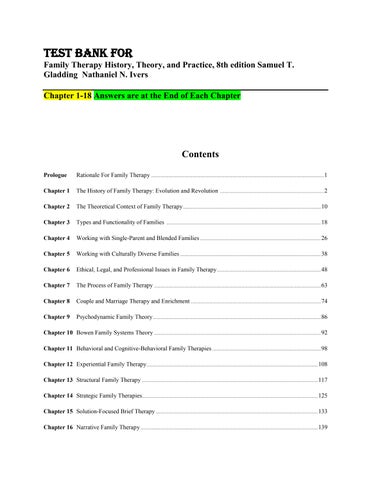
Test Bank For Family Therapy History, Theory, and Practice, 8th edition Samuel T. Gladding Nathaniel N. Ivers Chapter 1-18 Answers are at the End of Each Chapter
Contents Prologue
Rationale For Family Therapy ................................................................................................................. 1
Chapter 1
The History of Family Therapy: Evolution and Revolution .................................................................... 2
Chapter 2
The Theoretical Context of Family Therapy .......................................................................................... 10
Chapter 3
Types and Functionality of Families ..................................................................................................... 18
Chapter 4
Working with Single-Parent and Blended Families ............................................................................... 26
Chapter 5
Working with Culturally Diverse Families ............................................................................................ 38
Chapter 6
Ethical, Legal, and Professional Issues in Family Therapy .................................................................... 48
Chapter 7
The Process of Family Therapy ............................................................................................................. 63
Chapter 8
Couple and Marriage Therapy and Enrichment ..................................................................................... 74
Chapter 9
Psychodynamic Family Theory .............................................................................................................. 86
Chapter 10 Bowen Family Systems Theory ............................................................................................................. 92 Chapter 11 Behavioral and Cognitive-Behavioral Family Therapies ....................................................................... 98 Chapter 12 Experiential Family Therapy ................................................................................................................ 108 Chapter 13 Structural Family Therapy ................................................................................................................... 117 Chapter 14 Strategic Family Therapies................................................................................................................... 125 Chapter 15 Solution-Focused Brief Therapy .......................................................................................................... 133 Chapter 16 Narrative Family Therapy .................................................................................................................... 139
Chapter 17 Research and Assessment in Family Therapy ...................................................................................... 144 Chapter 18 Working with Substance-Related Disorders, Domestic Violence, and Child Abuse ........................... 153 Answer Key .............................................................................................................................................................. 163
Prologue
Approximately 19% of the U.S. population is seen by marriage and family therapists each year at a cost of more than $300 million Despite these statistics, marriage and family therapy is relatively new with its theoretical and clinical beginnings starting in the 1940s and its real growth occurring from the 1970s until today Family therapy differs from individual and group counseling in its emphasis and clientele Individual counseling is more intrapersonal Group counseling is more interpersonal Family therapy for the most part focuses on making changes in the family system Family therapy is connected to the influence of creative, innovative, and assertive mental health practitioners who devised and advocated new ways of providing services to clients
The Rationale for Family Therapy
Family therapists believe that most life difficulties stem from and can best be addressed within the family system Family therapy is an effective treatment approach, particularly in cases of: adolescent anorexia nervosa adolescent drug abuse adult alcoholism and drug abuse adult hypertension adult obesity adult schizophrenia aggression and noncompliance in children with ADD and ADHD childhood and adolescent anxiety disorders childhood autism childhood conduct disorders chronic physical illness in adults and children couple distress and conflict dementia depression in women in distressed marriages Client satisfaction is high, with 97% satisfaction rates and high percentages of clients stating they received the help they wanted from marriage and family therapists
Reasons for Working with Families as Opposed to Working with Individuals
Provides flexibility in conceptualizing cases from both linear and circular causality perspectives Provides for increased complexity and treatment options for clients Involves other real, significant people in the treatment process and brings the action into the room All family members receive treatment interventions simultaneously Family therapy tends to be briefer than individual counseling Family therapy focuses on the interpersonal rather than the intrapersonal which creates new and unique ways of resolving problems
Chapter 1 The History of Family Therapy: Evolution and Revolution Chapter Overview Family Therapy Through the Decades
Prior to the development of marriage and family therapy as a profession, older family members assisted younger members and adult family members cared for the very young and the very old Before 1940 focus in the United States was on the individual society utilized clergy, lawyers, and doctors for advice and counsel prevailing individual theories were psychoanalysis and behaviorism Catalysts for the growth of family therapy courses in family life education became popular establishment of marriage and family training programs (e.g., Marriage Council of Philadelphia in 1932) founding of the National Council on Family Relations in 1938 and the journal Marriage and Family Living in 1939 county home extension agents educated and promoted understanding family dynamics Family therapy: 1940 to 1949 establishment of the American Association of Marriage Counselors in 1942 first account of concurrent marital counseling published in 1948 by Bela Mittleman research on families with a schizophrenic member by Theodore Litz National Mental Health Act of 1946 funded research on prevention, diagnosis, and treatment of mental health disorders Family therapy: 1950 to 1959 individual leaders dominated the profession Nathan Ackerman used a psychoanalytical approach to understand and treat families Gregory Bateson studied communication patterns in families with a schizophrenic member and developed the double bind theory double bind theory - two seemingly contradictory messages may exist simultaneously and lead to confusion Mental Research Institute was created by Don Jackson in Palo Alto, CA changed problem conceptualization from a pathology oriented individual perspective to a more relationship based orientation brief therapy developed at MRI as one of the first new approaches to family therapy Carl Whitaker pushed the conventional envelope by seeing spouses and children in therapy set up the first family therapy conference at Sea Island, GA Murray Bowen studied families with schizophrenic members held therapy sessions with all family members present pioneered theoretical thinking on the influence of previous generations on the mental health of families Ivan Boszormenyi-Nagy developed contextual therapy focusing on the healing of human relationships through trust and commitment Family therapy: 1960 to 1969 An era of rapid growth in family therapy Increase in training centers and academic programs in family therapy Jay Haley, expanding on the work of Milton Erikson, developed strategic family therapy emphasis on the therapist gaining and maintaining power during treatment strategic therapy uses directives to assist clients to go beyond gaining insight edited Family Process from 1961 to 1969, providing a means for to keep professions linked and informed Haley joined with Salvador Minuchin at the Philadelphia Child Guidance Clinic in the late 1960's
Salvador Minuchin developed structural family therapy, based on his work with the Wiltwyck School for Boys utilized minority community members as paraprofessionals to better relate to urban blacks and Hispanics Virginia Satir was the only woman among the family therapy pioneers started seeing family members as a group in the 1950's utilized touch and nurtured her clients, emphasizing self-esteem, compassion, and affective congruence published Conjoint Family Therapy in 1964 which stressed the importance of seeing distressed couples together at the same time Virginia Satir was an influential, charismatic leader Carl Whitaker pioneered unconventional, spontaneous, sometimes outrageous appearing approaches, designed to help families achieve freedom and growth Family Process co-founded in 1961 by Don Jackson and Nathan Ackerman Nathan Ackerman published Treating the Troubled Family in 1966, advocating closer therapist involvement with families during treatment, being confrontive, and making covert issues overt John Bell developed a family group therapy model, advocated that children 9 years and older should participate in family therapy, and offered one of the first graduate family therapy courses in the United States Murray Bowen discovered that emotional reactivity in many families created undifferentiated family ego mass (i.e., family members have difficulty maintaining their individual identities and actions) Systems theory developed by Ludwig Von Bertalanffy in 1968 a way of looking at all parts of an organism simultaneously a set of elements standing in interaction with one another each element of a system is affected by what happens to any other element the whole is greater than the sum of its parts became the basis for most family therapy less reliance on linear causality (direct cause and effect) increased emphasis on circular causality (events are related through a series of repeating cycles or loops) family therapists seen as a specialists within the field first license regulating family therapists granted in California in 1963 Institutes and training centers Mental Research Institute continues its work in training and research Family Therapy Institute of New York established with Nathan Ackerman as director Philadelphia Child Guidance Clinic developed innovative supervision techniques such as the 'bug in the ear" Family Therapy Institute of Philadelphia founded in 1964, merging the Eastern Pennsylvania Psychiatric Institute and the Family Institute of Philadelphia Boston Family Institute founded by Fred Duhl and David Kantor, focusing on expressive and dramatic interventions and originating the family sculpting technique Institute for Family Studies in Milan, Italy formed in 1967 an MRI based model that developed many innovative short term approaches Family therapy: 1970 to 1979 rapid growth in AAMFT based partly on recognition as an accrediting body for marriage and family training programs The American Association of Marriage and Family Counselors (AAMFC) changed its name to the American Association for Marriage and Family Therapy (AAMFT) in 1977 Journal of Marital and Family Therapy founded by AAMFT in 1974 American Family Therapy Academy (AFTA) founded in 1977 to address clinical, research, and teaching issues AAMFT and AFTA agreed on distinct roles within the profession AFTA concentrated on the exchange of ideas among advanced professionals AAMFT focused on accreditation of training programs family therapy continued to growth and become more refined outside of psychoanalytical traditions Nathan Ackerman died in 1971
the approaches of Carl Whitaker (experiential family therapy), Salvador Minuchin (structural family therapy), and Jay Haley (strategic family therapy) gained in popularity and influence Families and Family Therapy published in 1974 by Minuchin, serving as a practical training guide for structural family therapy Psychosomatic Families: Anorexia Nervosa in Context published by Minuchin and associates in 1978, highlighting the power of the structural family therapy approach in working with this disorder Influence of foreign therapies and therapists family therapy grew rapidly in Europe, particularly in Milan, Italy Milan associates developed circular questioning (asking questions that highlight differences among family members) developed triadic questioning (asking a third member how two other members of the family relate) emphasis on developing hypotheses about the family before treatment begins utilized outside of session homework assignments that were often difficult and ritualistic R.D. Laing, a British professional, created the term mystification to describe how some families mask interactions between family members by giving contradictory or confusing explanations Robin Skynner, from Great Britain, developed a brief psychoanalytic family therapy which complemented the earlier work of Nathan Ackerman and Ivan Boszormenyi-Nagy Feminist theory and family therapy feminists began to question whether or not some concepts of family therapy were oppressive to women A Feminist Approach to Family Therapy was published in Family Process by Rachel Hare-Mustin in 1978 belief that sexism limits the psychological well-being of women and men and must not be tolerated Family therapy: 1980 to 1989 marked by the retirement or death of many family therapy founders and leaders and the emergence of new leaders increase numbers of women leaders who created new theories which challenged older ones Women's Project in Family Therapy in 1988 focused on gender free approaches to family therapy increased numbers of individuals and associations devoted to family therapy, including the International Association for Marriage and Family Counseling (IAMFC) of the American Counseling Association and Division 43 (Family Psychology) of the American Psychological Association increased levels of research in family therapy to provide evidence of the effectiveness of family therapy increased numbers of publication in the family therapy field, including the Family Therapy Networker Creation of multisystemic therapy, an intensive family- and community-based approach for working with juvenile offenders recognition of family therapy as one of four core mental health providers eligible for federal training grants Family therapy: 1990 to 1999 family therapy became a more worldwide phenomenon, with associations, research, and training institutes established across the globe new theories were developed or refined feminist family therapy examined gender sensitive issues in therapy rather than masculine or feminine issues, per se the reflecting team approach of Tom Anderson used clinical observers to discuss their impressions with the therapist and the family, thus becoming a part of the therapeutic team the therapeutic conversations model of Harlene Anderson and Harry Goolishian used a postmodern approach in which the therapist relates to the family in a more collaborative, egalitarian partnership the psychoeducational model of Carol Anderson emphasized teaching family members about multiple aspects of mental illness, focusing on boundaries, hierarchy, and the integrity of subsystems the internal family systems model of Richard Schwartz looks at both individual intrapsychic dynamics and family systems social constructionism based models were radically different than systems based models in that they are based on the belief that our experiences are a function of how we think about them rather than objective truths