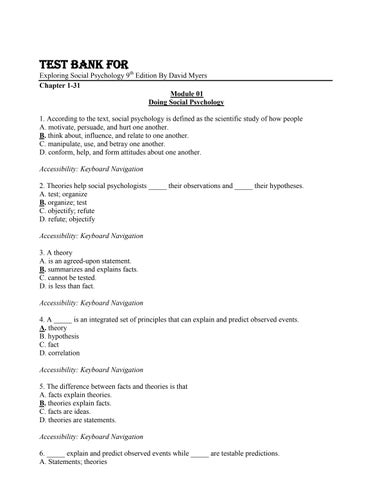
Test Bank For th
Exploring Social Psychology 9 Edition By David Myers Chapter 1-31 Module 01 Doing Social Psychology 1. According to the text, social psychology is defined as the scientific study of how people A. motivate, persuade, and hurt one another. B. think about, influence, and relate to one another. C. manipulate, use, and betray one another. D. conform, help, and form attitudes about one another. Accessibility: Keyboard Navigation 2. Theories help social psychologists _____ their observations and _____ their hypotheses. A. test; organize B. organize; test C. objectify; refute D. refute; objectify Accessibility: Keyboard Navigation 3. A theory A. is an agreed-upon statement. B. summarizes and explains facts. C. cannot be tested. D. is less than fact. Accessibility: Keyboard Navigation 4. A _____ is an integrated set of principles that can explain and predict observed events. A. theory B. hypothesis C. fact D. correlation Accessibility: Keyboard Navigation 5. The difference between facts and theories is that A. facts explain theories. B. theories explain facts. C. facts are ideas. D. theories are statements. Accessibility: Keyboard Navigation 6. _____ explain and predict observed events while _____ are testable predictions. A. Statements; theories
B. Theories; hypotheses C. Hypotheses; theories D. Correlations; experiments Accessibility: Keyboard Navigation 7. According to the text, which of the following is one of the purposes of a hypothesis? A. Hypotheses allow us to test a theory. B. Hypotheses provide explanations for research results. C. Hypotheses prove theories. D. Hypotheses communicate the results of research studies. Accessibility: Keyboard Navigation 8. Which of the following is an example of field research? A. taking opinion polls of people in an amusement park about its hygiene and cleanliness B. flashing different color lights on players on the pitch during a soccer game C. testing the effects of chemicals on animals in an industrial lab D. observing changes in the moods of people in a laboratory when they are exposed to violent movies Accessibility: Keyboard Navigation 9. Which of the following best defines informed consent in an experiment? A. informing the research participants about the results of the experiment B. telling the research participants about the content of the experiment so as to help them choose whether they wish to participate in the experiment C. communicating to the research participants about the deception used in the experiment D. informing the research participants about the feedback received from other participants about the effectiveness of the experiment Accessibility: Keyboard Navigation 10. Research done in natural, real-life settings outside the laboratory is referred to as A. correlational research. B. experimental research. C. laboratory research. D. field research. Accessibility: Keyboard Navigation 11. Which of the following is an example of a laboratory research? A. noting behaviors of random people in a park B. discussing different ways of making a vaccine in a science lab C. conducting experiments on a group of teenagers at a facility D. observing the movement of traffic in different parts of a city Accessibility: Keyboard Navigation
12. John is conducting a survey of random students outside his college library. He is interested in knowing the different types of books they borrow from the library. This is an example of A. correlational research. B. experimental research. C. laboratory research. D. field research. Accessibility: Keyboard Navigation 13. The study of naturally occurring relationships among variables is referred to as A. correlational research. B. experimental research. C. laboratory research. D. field research. Accessibility: Keyboard Navigation 14. In order to determine whether or not changing one variable (such as education) will produce changes in another variable (such as income), one needs to conduct a(n) _____ research. A. survey B. correlational C. experimental D. statistical Accessibility: Keyboard Navigation 15. Studies that seek clues to cause–effect relationships by manipulating one or more factors while controlling others describe what type of research? A. correlational research B. experimental research C. laboratory research D. field research Accessibility: Keyboard Navigation 16. A psychiatrist tells you that she is interested in determining whether the condition of individuals who are clinically depressed improves with 20 or with 40 milligrams of Prozac. She decides to administer 20 milligrams to a random half of her clients and 40 milligrams to the other half. She finds that after 6 months, the clients who took 40 milligrams of Prozac are significantly less depressed than those clients who took 20 milligrams of Prozac. Which type of study did the psychiatrist conduct? A. correlational research B. experimental research C. controlled research D. hypothetical research Accessibility: Keyboard Navigation 17. You've noticed that as the temperature drops outside, you see more students wearing sweaters
and heavy coats. Your observation is most similar to A. correlational research. B. experimental research. C. controlled research. D. hypothetical research. Accessibility: Keyboard Navigation 18. Variable X is correlated with Variable Y. Which of the following could explain this correlation? A. X causes Y. B. Y causes X. C. A third variable causes or influences both X and Y. D. All of the answers are correct. Accessibility: Keyboard Navigation 19. You are interested in finding out the effect that crowding has on people's moods. You conduct a study in a psychology research lab using two types of participants—participants who have to wait in a crowded waiting room before completing a measure of their mood and participants who wait in an empty room before completing the same measure. Which type of research did you conduct? A. correlational research B. experimental research C. laboratory research D. both experimental and laboratory research Accessibility: Keyboard Navigation 20. Your psychology professor tells you that she is collecting data on the amount that students study and their grades (i.e., she is asking each student to report how many hours he or she studies each week so that she can determine if there is a relationship between hours spent studying and grades). Which type of research is this? A. correlational research B. experimental research C. controlled research D. hypothetical research Accessibility: Keyboard Navigation 21. Which of the following is a disadvantage of correlational research? A. It involves important variables in natural settings. B. It provides ambiguous interpretations of causes and effects. C. It assists in reading newspapers and magazines. D. It takes place in a laboratory. Accessibility: Keyboard Navigation 22. Which of the following statements is true about correlational research? A. It allows researchers to predict changes in a variable that is related to another variable. B. It enables researchers to establish a cause and effect relationship between two variables.
C. It is mandatory for researchers to debrief participants when conducting a correlational research. D. It enables researchers to determine why a particular change in one variable causes a change in another variable. Accessibility: Keyboard Navigation 23. Douglas Carroll and his colleagues (1994) found that the height of graveyard markers in a Glasgow cemetery was positively correlated with A. gender. B. race. C. affluence. D. longevity. Accessibility: Keyboard Navigation 24. According to the text, the postal code areas of Scotland that have the least overcrowding and unemployment also have the A. greatest longevity. B. least longevity. C. greatest loneliness. D. least loneliness. Accessibility: Keyboard Navigation 25. A serious shortcoming of a correlational study is that it cannot A. predict one variable from another. B. determine when there is a lack of a relationship between two variables. C. identify which variable causes the other variable. D. None of the answers is correct. Accessibility: Keyboard Navigation 26. Ryan is conducting a research to study the ill effects of social media on people. He invites a group of students to a research facility and requests them to submit their laptops and phones. He requests them to terminate all forms of digital communication with their friends and peers. His participants complain that the simulated situation fails to mimic the real-world situation and most of them fail to cooperate with him for his research. Which of the following statements is true about Ryan's research? A. The research most likely has a high degree of mundane realism. B. The research fails to use random assignment. C. The research most likely has a low degree of experimental realism. D. The research fails to debrief the participants. Accessibility: Keyboard Navigation 27. A sample in which every person in the population being studied has an equal chance of inclusion is called a _____ assignment. A. mixed B. diverse