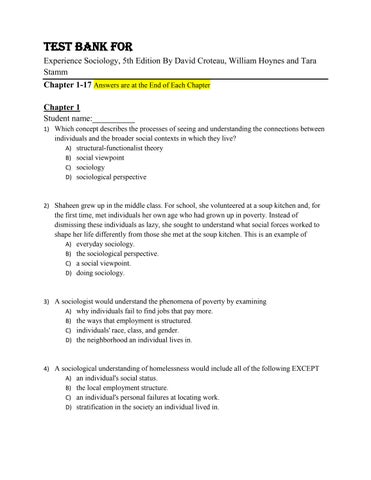
Test Bank For Experience Sociology, 5th Edition By David Croteau, William Hoynes and Tara Stamm Chapter 1-17 Answers are at the End of Each Chapter Chapter 1 Student name:__________ 1) Which concept describes the processes of seeing and understanding the connections between
individuals and the broader social contexts in which they live? A) structural-functionalist theory B) social viewpoint C) sociology D) sociological perspective
2) Shaheen grew up in the middle class. For school, she volunteered at a soup kitchen and, for
the first time, met individuals her own age who had grown up in poverty. Instead of dismissing these individuals as lazy, she sought to understand what social forces worked to shape her life differently from those she met at the soup kitchen. This is an example of A) everyday sociology. B) the sociological perspective. C) a social viewpoint. D) doing sociology.
3) A sociologist would understand the phenomena of poverty by examining A) why individuals fail to find jobs that pay more. B) the ways that employment is structured. C) individuals' race, class, and gender. D) the neighborhood an individual lives in.
4) A sociological understanding of homelessness would include all of the following EXCEPT A) an individual's social status. B) the local employment structure. C) an individual's personal failures at locating work. D) stratification in the society an individual lived in.
5) Who used the term "sociological imagination" to describe a way of viewing the connections
individuals have to their social worlds? A) Karl Marx B) Max Weber C) Emile Durkheim D) C. Wright Mills
6) The systematic study of the relationship between individuals and society is called A) psychology. B) anthropology. C) sociology. D) political science.
7) Which of the following statements regarding sociology is false? A) We need a systematic way to comprehend the processes that make up social life. B) We need to understand not only how we make sense of the world but how other
people do so as well. C) The idea that people must play the cards they are dealt in life is consistent with a sociological perspective. D) You have to be a professional sociologist to look at the world from a sociological perspective.
8) In order to understand our lives, sociologists would argue that we need to A) examine the contexts in which we live. B) explore the motives behind our actions. C) examine the way we interact with others. D) explore the ways in which other people live.
9) Sociologists would study all of these topics EXCEPT for A) why people commit crimes. B) how children learn about gender. C) how personality develops. D) why homelessness exists.
10) Julian and his friends like to watch movies together. One movie focused on a young Black
man who rose out of poverty by playing basketball. His friend N'Cola commented that there would be no poverty if poor people simply tried to find employment. Julian said that the solution to poverty was not that simple and that N'Cola's understanding of how poverty worked was mistaken. What is the problem with N'Cola's argument? A) It ignores the context of broader social conditions. B) It uses the sociological perspective. C) It ignores the rules of sociology as a discipline. D) It views an individual problem as a social problem.
11) Maria wants to write a paper for her college class that explores how married couples divide
household chores. She wants to argue that gender shapes how couples share housework. Given her topic and argument, her class is a part of what discipline? A) psychology B) sociology C) statistics D) economics
12) To what group of research-based disciplines does sociology belong? A) the research sciences B) the humanities C) the hard sciences D) the social sciences
13) Which of the following questions would a sociologist ask? A) How does collecting government assistance impact future employment? B) How can politicians use government assistance policies in their campaigns? C) What are the personalities of individuals on public assistance? D) How do different societies define and respond to crime?
14) Which of the following was NOT identified in the text as a key advantage to majoring in
sociology? A) A sociology degree is flexible. B) Sociology focuses on the study of people. C) Sociology provides insights into diversity. D) Sociology explores the source of social problems.
15) Which of the following research questions would a sociologist ask? A) How does being homeless impact people's ability to find work? B) Does being homeless change someone's personality? C) How do anti-poverty policies influence voting behaviors? D) Is gender related to homelessness?
16) All of the following are parts of the move toward modernity EXCEPT for A) the growth of democracy. B) the shift to an urban industrial economy. C) an increased reliance on science and reasons to explain the natural and social worlds. D) an increased confidence in religion.
17) The historical period marked by a shift to urban industrial economies and increased faith in
science and reason is known as A) modernity. B) postmodernity. C) industrialization. D) the Renaissance.
18) Marina lives in a society where physical illness is viewed as being caused by germs and
unsanitary conditions and does not occur as the product of a curse or spell. In what historical context is she living? A) modernity B) capitalism C) the early modern period D) the Middle Ages
19) Which concept describes how logic and the systematic collection of evidence are used to
support theories about the natural and social world? A) sociology B) science C) common sense D) logic
20) During the Middle Ages, who or what dominated European intellectual life? A) enlightened monarchs B) the Church and its clergy C) science D) philosophers
21) The rise in scientific thought, the Age of Enlightenment, and the declining influence of
religion in everyday life are associated with the________ revolution. A) social B) economic C) political D) cultural
22) What is industrialization? A) the creation of jobs that pay workers by the hour B) the shift from living on farms to living in cities C) the use of products in farming to increase crop yield D) the use of machines to mass produce items for purchase
23) Which term refers to the use of large-scale machinery to mass manufacturing of goods for
sale? A) B) C) D)
urbanization capitalism modernity industrialization