Test Bank for Essentials of Human Anatomy & Physiology 13th Edition Marieb Chapter 1-16
Chapter 1
1.1
The Human Body: An Orientation
Multiple Choice Part I Questions
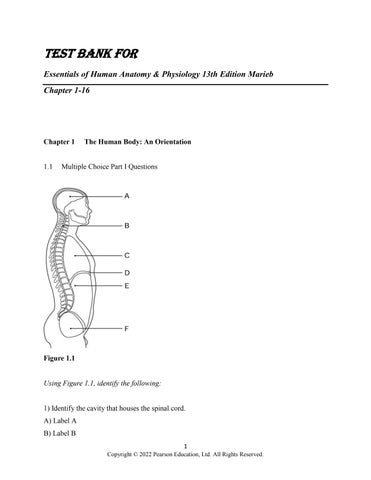
Figure 1.1
Using Figure 1.1, identify the following:
1) Identify the cavity that houses the spinal cord. A) Label A B) Label B 1 Copyright © 2022 Pearson Education, Ltd. All Rights Reserved.
C) Label C D) Label D E) Label E F) Label F Answer: B Page Ref: 38 Bloom's: 1-2: Remembering/Understanding
2) Label E points to the ________ cavity. A) thoracic B) pelvic C) cranial D) abdominal Answer: D Page Ref: 38 Bloom's: 1-2: Remembering/Understanding
3) Identify the cavity that houses the heart and lungs (and other organs). A) Label A B) Label B C) Label C D) Label D E) Label E F) Label F Answer: C Page Ref: 38 Bloom's: 1-2: Remembering/Understanding
4) Identify the structure that separates the thoracic cavity from the rest of the ventral cavity. A) Label A B) Label B C) Label C 2 Copyright © 2022 Pearson Education, Ltd. All Rights Reserved.
D) Label D E) Label E F) Label F Answer: D Page Ref: 38 Bloom's: 1-2: Remembering/Understanding
5) Label F points to the ________ cavity. A) thoracic B) pelvic C) cranial D) abdominal Answer: B Page Ref: 38 Bloom's: 1-2: Remembering/Understanding
6) Identify the cavity that houses the stomach, liver, and other digestive organs. A) Label A B) Label B C) Label C D) Label D E) Label E F) Label F Answer: E Page Ref: 38 Bloom's: 1-2: Remembering/Understanding
7) Which of the following is the smallest unit of all living things? A) Organ B) Tissue C) Cell D) Organ system 3 Copyright © 2022 Pearson Education, Ltd. All Rights Reserved.
Answer: C Page Ref: 24 Bloom's: 1-2: Remembering/Understanding
8) The heart and blood vessels are the primary organs of the ________ system. A) lymphatic B) integumentary C) cardiovascular D) muscular Answer: C Page Ref: 26 Bloom's: 1-2: Remembering/Understanding
9) The skeletal muscles that contract and shorten to move the bones form the ________ system. A) skeletal B) muscular C) endocrine D) reproductive Answer: B Page Ref: 26 Bloom's: 1-2: Remembering/Understanding
10) The ________ system rids the body of indigestible food residue in feces while the ________ system removes nitrogen-containing metabolic waste in urine. A) urinary; digestive B) cardiovascular; urinary C) digestive; urinary D) reproductive; digestive Answer: C Page Ref: 26, 29 Bloom's: 1-2: Remembering/Understanding 4 Copyright © 2022 Pearson Education, Ltd. All Rights Reserved.
11) The ability to sense a mosquito landing on your arm and swat it away is described as ________. A) metabolism B) homeostasis C) excretion D) responsiveness (irritability) Answer: D Page Ref: 29-30 Bloom's: 1-2: Remembering/Understanding
12) What accounts for 60 to 80 percent of the body's weight, depending on the age of the individual? A) Water B) Carbon C) Carbohydrates D) Minerals Answer: A Page Ref: 31 Bloom's: 1-2: Remembering/Understanding
13) When our body temperature rises above 37°C or 98.6°F, a negative feedback mechanism will be triggered to lower the body temperature. As a result, our sweat glands release sweat to cool the body temperature. What part of the negative feedback mechanism is the sweat gland? A) Stimulus B) Effector C) Receptor D) Control center Answer: B Page Ref: 41 Bloom's: 1-2: Remembering/Understanding
14) What type of sensor monitors and responds to changes in the environment in a negative 5 Copyright © 2022 Pearson Education, Ltd. All Rights Reserved.