Environment: The Science Behind the Stories, 7e, Global Edition (Withgott) Chapter 1 Science and Sustainability: An Introduction to Environmental Science 1.1 Graph and Figure Interpretation Questions
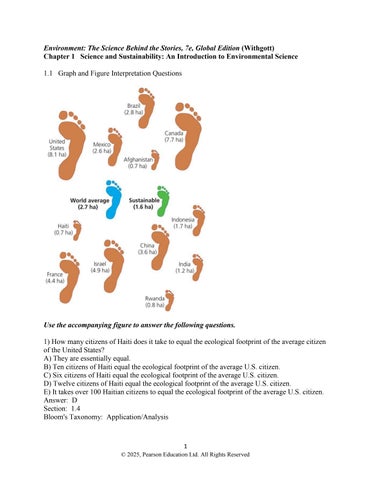
Use the accompanying figure to answer the following questions. 1) How many citizens of Haiti does it take to equal the ecological footprint of the average citizen of the United States? A) They are essentially equal. B) Ten citizens of Haiti equal the ecological footprint of the average U.S. citizen. C) Six citizens of Haiti equal the ecological footprint of the average U.S. citizen. D) Twelve citizens of Haiti equal the ecological footprint of the average U.S. citizen. E) It takes over 100 Haitian citizens to equal the ecological footprint of the average U.S. citizen. Answer: D Section: 1.4 Bloom's Taxonomy: Application/Analysis
1 © 2025, Pearson Education Ltd. All Rights Reserved
2) Nearly 50% of the land on our planet is currently used for agriculture; very little more agriculturally usable land is available. If everyone on the planet had an ecological footprint the size of the average citizen of the United States, then ________. A) we would have 50% more food to go around B) we would be able to provide for everyone without much difficulty, using the 50% of the land currently not being used C) we would need at least two more planet Earths to feed and support everyone D) we could support 50% more people on our planet E) about 50% of the people would starve Answer: C Section: 1.4 Bloom's Taxonomy: Application/Analysis 3) The U.S. average footprint is ________ times larger than the world average footprint. A) 2 B) 2.7 C) 3.3 D) 5 E) 6.7 Answer: B Section: 1.4 Bloom's Taxonomy: Application/Analysis 4) The global average footprint per person has increased from 2.2 to 2.7 hectares since 2008, including the footprints of many developing nations such as India and China. This means that ________. A) our collective lifestyle is even more unsustainable than before B) our collective lifestyle is slightly more sustainable than before C) the ability of the planet to sustain human beings has increased D) some nations no longer have a measurable footprint E) the populations of both India and China have decreased since 2008 Answer: A Section: 1.4 Bloom's Taxonomy: Application/Analysis
2 © 2025, Pearson Education Ltd. All Rights Reserved
1.2 Matching Questions Match the following. A) ecology B) environmentalism C) qualitative data D) prediction E) hypothesis F) independent variable G) paradigm H) interdisciplinary science I) quantitative data J) dependent variable K) social science L) theory 1) One of many scientific fields of study within the broad scope of environmental science Section: 1.2, 1.3 Bloom's Taxonomy: Knowledge/Comprehension 2) Information expressed with numbers Section: 1.2, 1.3 Bloom's Taxonomy: Knowledge/Comprehension 3) The variable that is manipulated Section: 1.2, 1.3 Bloom's Taxonomy: Knowledge/Comprehension 4) Expectation of experimental outcome Section: 1.2, 1.3 Bloom's Taxonomy: Knowledge/Comprehension 5) Widely accepted, well-tested explanation of one or more cause-and-effect relationships Section: 1.2, 1.3 Bloom's Taxonomy: Knowledge/Comprehension 6) Statement that attempts to explain a phenomenon or answer a scientific question Section: 1.2, 1.3 Bloom's Taxonomy: Knowledge/Comprehension 7) The study of human interactions and institutions Section: 1.2, 1.3 Bloom's Taxonomy: Knowledge/Comprehension Answers: 1) A 2) I 3) F 4) D 5) L 6) E 7) K 3 © 2025, Pearson Education Ltd. All Rights Reserved
1.3 Multiple Choice Questions 1) Which of the following discoveries would be most likely to cause a scientific paradigm shift? A) the discovery that excess heat is radiating from the center of Earth and causing global climate change B) the discovery of a new species of salamander in the Amazon rainforest C) the discovery of more rings around Uranus D) the discovery of a new pathogenic virus transmitted by mosquitoes E) the discovery that a dormant volcano is showing signs of activity Answer: A Section: 1.3 Bloom's Taxonomy: Synthesis/Evaluation 2) The global population is projected to be about ________ in 2050. A) 7 billion B) 8 billion C) 9 billion D) 11 billion E) 13 billion Answer: C Section: 1.1 Bloom's Taxonomy: Knowledge/Comprehension 3) The scientific method ________. A) results in conclusions based on speculation B) cannot prove a hypothesis to be true C) results in the proving of a theory D) has been replaced by a widely accepted shortcut that is less time-consuming and less expensive E) if done correctly does not require replication Answer: B Section: 1.3 Bloom's Taxonomy: Knowledge/Comprehension 4) To determine your specific impacts on the environment, you can ________. A) measure local air pollution and its impacts on your health B) calculate the biodiversity of your local community C) determine your community's impact on water quality in a nearby river D) calculate your ecological footprint E) determine your environmental handprint Answer: D Section: 1.4 Bloom's Taxonomy: Knowledge/Comprehension
4 © 2025, Pearson Education Ltd. All Rights Reserved
5) A hypothesis is ________. A) a prediction about something that has not yet been observed B) a statement that explains an observed phenomenon or answers a scientific question C) an instrument that is used to examine environmental conditions D) the design of an experiment that can be used in scientific inquiry E) a proven scientific fact Answer: B Section: 1.3 Bloom's Taxonomy: Knowledge/Comprehension 6) Roberto lives near a wind farm and is wondering about the environmental effects of the wind turbines. He ________ that the turbines make a sound like faint airplane engines and also that there are far fewer meadowlarks living near the wind farm than lived there before the wind farm was built. A) hypothesizes B) predicts C) observes D) theorizes E) guesses Answer: C Section: 1.3 Bloom's Taxonomy: Application/Analysis 7) Roberto lives near a wind farm and is wondering about the environmental effects of the wind turbines. He ________ that the turbines, which sound like faint airplane engines, are scaring off meadowlarks that used to nest in the area. A) hypothesizes B) predicts C) observes D) theorizes E) hopes Answer: A Section: 1.3 Bloom's Taxonomy: Application/Analysis 8) In a manipulative experiment, ________. A) researchers manipulate the independent variable B) researchers manipulate as many variables as possible C) replication of the experiment is not necessary D) a scientist has been caught manipulating the data for economic gain E) the peer review process is bypassed Answer: A Section: 1.3 Bloom's Taxonomy: Knowledge/Comprehension
5 © 2025, Pearson Education Ltd. All Rights Reserved