Test Bank For Elementary Differential Equations and Boundary Value Problems, 12th Edition William E. Boyce, Richard C. Di Prima, Douglas B. Meade Chapter 1-11
Chapter 1
Introduction
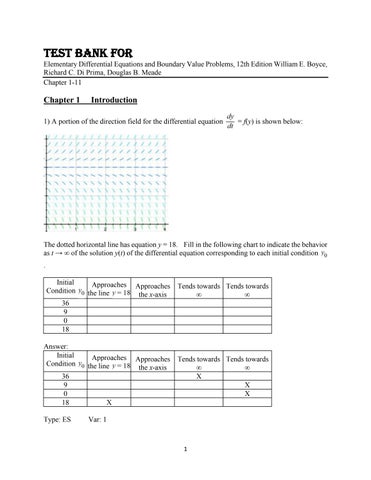
1) A portion of the direction field for the differential equation
= f(y) is shown below:
The dotted horizontal line has equation y = 18. Fill in the following chart to indicate the behavior as t → ∞ of the solution y(t) of the differential equation corresponding to each initial condition . Initial Condition
Approaches the line
Approaches the x-axis
Tends towards Tends towards ∞ ∞
Approaches the line
Approaches the x-axis
Tends towards Tends towards ∞ ∞ X X X
36 9 0 18 Answer: Initial Condition 36 9 0 18
X
Type: ES
Var: 1
1
2) A portion of the direction field for the differential equation
= f(y) is shown below:
The dotted horizontal line has equation y = -7. Which of the following statements are true? Select all that apply. A) y(t) = 0 is the solution to the initial-value problem
= f(y), y(0) = 0.
B) y(t) = -7 is the only equilibrium solution. C) There is no solution of the initial-value problem
= f(y), y(0) =
when
= -7.
D) Every solution curve y(t) is increasing toward a negative limit as t → ∞. E) Every solution curve y(t) tends towards -7 as t → ∞. F) F(y) cannot be a linear function of y. Answer: B, E, F Type: MC Var: 1 3) Which of the following pairs of values of A and B are such that all solutions of the differential equation
= Ay + B are such that
y(t) = 7? Select all that apply.
A) A = -2, B = 14 B) A = -7, B = 1 C) A = -1, B = 7 D) A = 1, B = -7 E) A = -3, B = 21 F) A = -2, B = -14 G) A = 2, B = -14 Answer: A, C, E Type: MC Var: 1
2
4) Which of the following pairs of values of A and B are such that all solutions of the differential equation
= Ay + B diverge away from the line y = 10 as t → ∞? Select all that apply.
A) A = -2, B = 20 B) A = 3, B = -30 C) A = 1, B = -10 D) A = -1, B = 10 E) A = -2, B = -20 F) A = 10, B = -1 G) A = 2, B = -20 Answer: B, C, G Type: MC Var: 1 5) Eight differential equations and four slope fields are given below. (A) (D) (G)
(i)
=1=1-t =1+y
(B) (E) (H)
=t-1 = = -1
(C) (F)
(ii)
3
=1-y = -
(iii)
(iv)
Which of the following are the zero isoclines for the differential equation in (A)? Select all that apply. A) y = 0 B) y = 1 C) y = -1 D) y = t E) y = -t Answer: B, C Type: MC Var: 1 6) Eight differential equations and four slope fields are given below. (A) (D) (G)
(i)
=1=1-t =1+y
(B) (E) (H)
=t-1 = = -1
(C) (F)
(ii) 4
=1-y = -
(iii)
(iv)
Determine the differential equation that corresponds to each slope field. Fill in the correct letter next to each number below: Slope Field (i) (ii) (iii) (iv)
Differential Equation
Answer: Slope Field (i) (ii) (iii) (iv) Type: ES
Differential Equation B C H F Var: 1
7) A pond initially contains 70,000 gallons of water and an unknown amount of pesticide. Water containing 0.07 grams of pesticide per gallon flows into the pond at a rate of 360 gallons per hour. The mixture flows out of the pond at the same rate, so the amount of water in the pond remains constant. Assume the pesticide is uniformly mixed throughout the pond. Which of these is the differential equation for the amount of pesticide, P(t), in the pond at any time t? A)
= 0.07 -
B)
= 25.2 -
P(t) P(t) 5