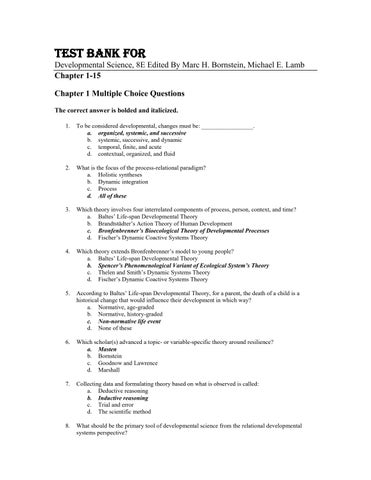
Test Bank For Developmental Science, 8E Edited By Marc H. Bornstein, Michael E. Lamb Chapter 1-15 Chapter 1 Multiple Choice Questions The correct answer is bolded and italicized. 1.
To be considered developmental, changes must be: _________________. a. organized, systemic, and successive b. systemic, successive, and dynamic c. temporal, finite, and acute d. contextual, organized, and fluid
2.
What is the focus of the process-relational paradigm? a. Holistic syntheses b. Dynamic integration c. Process d. All of these
3.
Which theory involves four interrelated components of process, person, context, and time? a. Baltes’ Life-span Developmental Theory b. Brandtstädter’s Action Theory of Human Development c. Bronfenbrenner’s Bioecological Theory of Developmental Processes d. Fischer’s Dynamic Coactive Systems Theory
4.
Which theory extends Bronfenbrenner’s model to young people? a. Baltes’ Life-span Developmental Theory b. Spencer’s Phenomenological Variant of Ecological System’s Theory c. Thelen and Smith’s Dynamic Systems Theory d. Fischer’s Dynamic Coactive Systems Theory
5.
According to Baltes’ Life-span Developmental Theory, for a parent, the death of a child is a historical change that would influence their development in which way? a. Normative, age-graded b. Normative, history-graded c. Non-normative life event d. None of these
6.
Which scholar(s) advanced a topic- or variable-specific theory around resilience? a. Masten b. Bornstein c. Goodnow and Lawrence d. Marshall
7.
Collecting data and formulating theory based on what is observed is called: a. Deductive reasoning b. Inductive reasoning c. Trial and error d. The scientific method
8.
What should be the primary tool of developmental science from the relational developmental systems perspective?
e. f. g. h.
Nomothetic Group differential Ideographic None of these
Chapter 2 Multiple Choice Questions The correct answer is bolded and italicized. 2.
Which of the following is NOT a characteristic feature of human culture? a. Eusociality b. Symbolic communication c. Cultural diversity d. Social norms
3.
The word for “angry” directly translates to “enojado” in Spanish, but may not capture the exact same underlying concept. This as a clear example of _____ but presents a problem with _______. a. Linguistic equivalence, functional equivalence b. Functional equivalence, external validity c. Cultural equivalence, ecological validity d. External validity, linguistic equivalence
4.
What are some of the key challenges involved in studying cultural differences in human development? a. Conceptualizing culture and measuring cultural differences b. Finding participants from different cultural backgrounds c. Developing culturally sensitive research methods d. All of the above
5.
What is the definition of construct validity? a. The assessment of how well a measurement tool or instrument accurately measures the underlying concept it is intended to assess b. An insider’s perspective on and experiences of their own culture c. The extent to which the findings of a study accurately represent real-world situations, behaviors, or phenomena d. The degree to which indirect or similar translations of words or expressions in different languages convey the same concepts
6.
What has cross-cultural research taught us about the timing and development of children’s learning of number words? a. Children across all cultures learn number words in the same order, but different timing b. Children across all cultures learn number words in the same order and the same timing c. Children learn number words in different orders across cultures, but with the same timing d. Children learn number words in different orders across cultures, and with different timing
7.
What are ways in which developmental science can benefit from greater engagement with cultural diversity? a. Better capturing the full breadth of human diversity b. Establishing more accurate developmental norms c. Informing policies and interventions
d.
All of the above
8.
Which is NOT a defining characteristic of ethnographic work? a. Conjoint analyses b. Participant observation c. Qualitative data collection d. Fieldwork
9.
The assumption that the use of identical research methods will necessarily yield comparable and externally valid data across contexts is also known as what? a. The equivalency assumption b. The deficit assumption c. The universality assumption d. The minority world centrality assumption
10. Malinowski’s assessment of Freudian theories in Melanesia suggested: a. That Freudian principles were culturally shaped and unlikely to be universal b. That Melanesians experienced the Oedipus Complex, just as Europeans c. That the psychosexual stages of development are consistent across cultures d. That Melanesian traditional practices were very similar to practices from psychoanalysis 11. ________ famously posited that children went through four stages of cognitive development: the sensorimotor stage, the preoperational stage, the concrete operational stage, and the formal operational stages a. Jean Piaget b. Lev Vygotsky c. Sigmund Freud d. Bronislaw Malinowski
Multiple Choice Questions for Chapter 3
Note: The correct answer for each question is the first one. The multiplechoice question test banks are also available here as downloadable interactive MCQs that you can integrate into your university's own copies of Moodle or Blackboard. Statistical conclusion validity refers to the _____: Appropriateness of inferences made from statistical tests. Inferences about the causal connections of independent and dependent variables. Degree to which variables represent intended constructs. Generalizability of study results to other settings, populations, and contexts. Internal validity refers to the _____: Ability of a study to determine if one or more independent variables causes one or more dependent variables. Appropriateness of inferences made from statistical tests. Degree to which variables represent intended constructs. Generalizability of study results to other settings, populations, and contexts. Construct validity refers to the _____: How well the measures in a study accurately reflect the constructs that they are measuring. Appropriateness of inferences made from statistical tests.