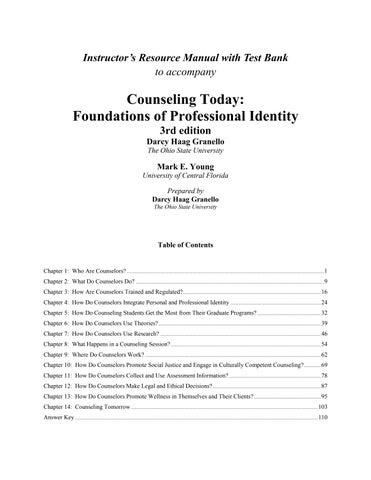
Instructor’s Resource Manual with Test Bank to accompany
Counseling Today: Foundations of Professional Identity 3rd edition Darcy Haag Granello The Ohio State University
Mark E. Young University of Central Florida Prepared by Darcy Haag Granello The Ohio State University
Table of Contents
Chapter 1: Who Are Counselors? ................................................................................................................................. 1 Chapter 2: What Do Counselors Do? ........................................................................................................................... 9 Chapter 3: How Are Counselors Trained and Regulated? .......................................................................................... 16 Chapter 4: How Do Counselors Integrate Personal and Professional Identity ........................................................... 24 Chapter 5: How Do Counseling Students Get the Most from Their Graduate Programs?.......................................... 32 Chapter 6: How Do Counselors Use Theories? .......................................................................................................... 39 Chapter 7: How Do Counselors Use Research? ......................................................................................................... 46 Chapter 8: What Happens in a Counseling Session? .................................................................................................. 54 Chapter 9: Where Do Counselors Work? ................................................................................................................... 62 Chapter 10: How Do Counselors Promote Social Justice and Engage in Culturally Competent Counseling? ........... 69 Chapter 11: How Do Counselors Collect and Use Assessment Information? ............................................................ 78 Chapter 12: How Do Counselors Make Legal and Ethical Decisions?....................................................................... 87 Chapter 13: How Do Counselors Promote Wellness in Themselves and Their Clients? ............................................ 95 Chapter 14: Counseling Tomorrow .......................................................................................................................... 103 Answer Key ............................................................................................................................................................... 110
TEST QUESTIONS
Multiple Choice Questions 1.
The term “psychotherapy” is today used to describe _____ a. Freudian psychoanalysis b. A specific type of intervention that involves hypnotherapy c. A generic term for the entire spectrum of change theories & techniques d. A psychologist‟s protected scope of practice
2.
Which of the following is/are common specialties within the field of counseling? _____ a. School counseling b. Mental health counseling c. Rehabilitation counseling d. All of the above
3.
The helping specialty that refers to medical doctors (MDs) who diagnose mental disorders and prescribe appropriate medications is _____ a. Psychiatry b. Psychology c. Social Work d. Counseling
4.
All of the following statements about developmental guidance models for K-12 schools are true EXCEPT _____ a. They are based on stage models of human development b. They are primarily focused on teaching school children life skills to improve academics and bolster selfesteem c. They are generally more preventative and growth-oriented, rather than problem-focused d. They are incompatible with the role of the school counselor, who typically spends most of his/her time in crisis intervention mode
5.
The helping profession that has the longest history of licensure and regulation in the U.S. is _____ a. Counseling b. Social Work c. Marriage & Family Therapy d. Life Coaching
6.
Recent changes in healthcare mean that counselors _____ a. Cannot work in private practice, or at least cannot get reimbursed for their services by Managed Care companies, since counselors are not recognized as providers in this model b. Are free to provide the type of services they believe are best for the client, since Managed Care companies are not legally allowed to get involved with treatment decisions c. Must follow mandates regarding length and type of treatment they use, if they wish to get reimbursed by Managed Care companies for their work d. Have far fewer clients than in previous years, since Managed Care companies tend to pay higher rates for care, so counselors can have fewer clients but still make the same amount of money
7.
Which of the following is/are true about the profession of psychology? _____ a. Psychologists typically obtain a master‟s degree, practice for a few years, and then return to school to complete their Ph.D. b. There are three major types of psychologists: counseling psychologists, research psychologists, and practice psychologists c. Psychology requires a doctoral degree to practice independently d. All of the above
8.
All of the following statements are true about Social Workers EXCEPT _____ a. Social workers advocate on behalf of clients b. To practice independently, Social Workers must have a master‟s degree c. Social workers are typically better trained than counselors to understand the environmental, social, and economic forces that impact clients d. Social workers are typically better trained than counselors in individual and group therapy and techniques
9.
All of the following statements are true about the role of Progressivism in education EXCEPT _____ a. It was an impetus to education reform that focused on democratization of education b. Because it was primarily concerned with students‟ self-actualization, it de-emphasized career selection and vocational education c. It encouraged students to follow their own interests while respecting the rights of others d. It emphasized character education and expanded traditional education to include physical education, industrial arts, and extracurricular activities
10.
Career counseling is considered a fundamental component of counseling because _____ a. Career choice and career satisfaction are frequently tied to self-esteem and overall wellness b. Job stress and dissatisfaction can lead to significant mental health problems c. A person‟s mental health problems can have a significant impact on his/her job and career performance d. All of the above
11.
All of the following statements are true about the Humanistic Movement in counseling EXCEPT _____ a. Helping clients recognize their faculty thinking and change the thinking patterns that contribute to their unhappiness is a fundamental component of a Humanistic approach b. The work of Rogers, including the core conditions for counseling, was based in Humanistic ideals c. The idea that people are constantly in the process of changing and growing is a foundational component of a Humanistic approach d. The focus on the therapeutic relationship in counseling is based on Humanistic principles
12.
Group counseling _____ a. Rose dramatically in popularity in the 1930s when the Great Depression made the cost effective nature of groups particularly appealing b. Rose dramatically in popularity in the 1960s and 1970s, when people were feeling increasingly alienated from society and yearned for interpersonal connections c. Is a separate counseling specialty that requires advanced training and certification d. Is most effective when done as a “marathon group” that lasts between 24-48 hours
13.
A major impetus for the proliferation of tests and the status of the testing movement was _____ a. World War I, and the development of the Army Alpha & Army Beta b. The desire of psychologists to have a scope of practice that was different than that of counselors c. The ability of tests to compensate for the cultural bias that was often a part of the counseling relationship d. All of the above
14.
Which of the following statements is/are true about achievement tests? _____ a. A national achievement test is used to demonstrate the effectiveness of K-12 schools and the merits of individual teachers b. School counselors typically have little to do with achievement test administration or interpretation because testing is not usually part of their scope of practice c. The use of achievement test as “high-stakes” tests in K-12 education is extremely controversial d. All of the above
15.
Behaviorism _____ a. Was a natural outgrowth of the existing models of psychotherapy b. Has been almost completely eclipsed by cognitive therapy, making it rather obsolete in the field of counseling c. Is only useful for making behavior changes in children, as adults can “see through” the attempts to make changes in behavior and thwart them quite easily d. Appeals to many because of its data-driven approach that makes behavioral change quantifiable and helps counselors and clients select and implement specific goals
16.
The reason that Sputnik represented an important milestone in the counseling profession is because _____ a. Sputnik was launched by the Soviets, and it became clear that counselors would be needed to help negotiate peace between the Soviet Union and the U.S. b. When Sputnik was launched by the Soviets, more people began to investigate communism and its emphasis on communal support and caring, which are foundational principles of counseling c. When Sputnik was launched by the Soviets, it sparked the U.S. to respond by training guidance counselors who could identify students who had potential in math and science d. Sputnik was launched by the U.S., representing a major turning point in the U.S. Cold War Defense Strategy and triggering the National Defense Education Act
17.
Deinstitutionalization was sparked by, among other reasons, _____ a. The rise in the use and efficacy of antipsychotic and antidepressant medications b. The desire to hospitalize severely ill mental patients in regular medical hospitals where they could be more carefully monitored than in psychiatric asylums c. The understanding the Community Mental Health Centers, although an good idea, could never provide the intensity of treatment necessary for extremely ill clients d. All of the above
18.
Stage models of development are based on all of the following EXCEPT _____ a. In general, conquering each stage of development is a prerequisite for moving to the next b. The models provide general understanding of development, but may not be quite as tidy as they appear on paper when applied to individuals c. Understanding someone within the context of their current developmental stage is necessary to get a complete understanding of who they are d. All developmental models end at adulthood, when primary development stops and people move from a regular growth trajectory to a much more diffuse approach that is unique to each person
19.
The first counseling licensure law in the country was in Virginia in _____ a. The 1880s (around the time of Freud) b. The 1940s (right after World War II) c. The 1970s (around the time that the American Mental Health Counselors Association joined the American Personnel & Guidance Association) d. The 1990s (around the time when the name of the national association became the American Counseling Association)
20.
Counselors use developmental models in their work because _____ a. These models tend to have a growth orientation that fits with the overall philosophical approach that counselors tend to have b. They provide a structure for how to meet clients where they are developmentally and provide appropriate interventions and strategies c. By providing an overall model, they help give ideas and strategies to assist the counselor in selecting interventions that will help move clients to the next developmental stage d. All of the above
TRUE/FALSE 1.
Compared with social work training, counselors have more training in individual and group therapy techniques and interventions. ____ True ____ False
2.
Mental health/Community Counselors are currently licensed in 36 of the 50 states. ____ True ____ False
3.
Multicultural counseling and career counseling are both modern day counseling practices that have their roots in the ideals of Progressivism. ____ True ____ False
4.
At least one-quarter of the homeless population has a mental illness. ____ True ____ False
5.
The American Counseling Association originally began as a division of the American Psychological Association. ____ True ____ False
6.
Approximately two-thirds of all visits to family doctors are prompted by stress-related symptoms. ____ True ____ False
ESSAY QUESTIONS 1.
Compare and contrast the training and philosophical approach to mental health of counselors, social workers, and psychiatrists.
2.
How have the ideas of Progressivism influenced the counseling profession, both in the past and in the present?
3.
How have the ideas of science and the medical model approach to mental health influenced the profession of counseling, both in the past and in the present?
4.
Why is it important for counselors to have a developmental perspective of their clients before developing treatment interventions for them?
5.
Compare and contrast the arguments of those who believe that coaching is a distinct profession from counseling and does not require licensure or regulation versus those who believe that the practice of coaching often overlaps with the practice of professional counseling.