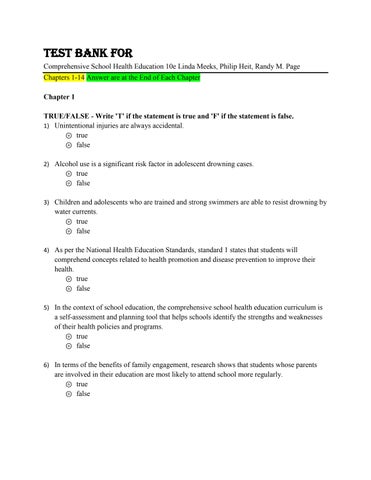
Test Bank For Comprehensive School Health Education 10e Linda Meeks, Philip Heit, Randy M. Page Chapters 1-14 Answer are at the End of Each Chapter Chapter 1 TRUE/FALSE - Write 'T' if the statement is true and 'F' if the statement is false. 1) Unintentional injuries are always accidental. ⊚ true ⊚ false 2) Alcohol use is a significant risk factor in adolescent drowning cases. ⊚ true ⊚ false 3) Children and adolescents who are trained and strong swimmers are able to resist drowning by
water currents. ⊚ true ⊚ false 4) As per the National Health Education Standards, standard 1 states that students will
comprehend concepts related to health promotion and disease prevention to improve their health. ⊚ true ⊚ false 5) In the context of school education, the comprehensive school health education curriculum is
a self-assessment and planning tool that helps schools identify the strengths and weaknesses of their health policies and programs. ⊚ true ⊚ false 6) In terms of the benefits of family engagement, research shows that students whose parents
are involved in their education are most likely to attend school more regularly. ⊚ true ⊚ false
7) Adolescents who smoke cigarettes and drink alcohol are more likely than nonsmokers and
nondrinkers to use illicit drugs. ⊚ true ⊚ false 8) Early sexual experience has no effect on the risk of contracting a sexually transmitted
disease. ⊚ true ⊚ false 9) In the United States, teen mothers often have a second child within two years of the first. ⊚ true ⊚ false 10) At present, no clear evidence links poor diet to the three leading causes of death in the United
States. ⊚ true ⊚ false 11) More than half of all high school students engage in vigorous physical activity at least five
days each week. ⊚ true ⊚ false 12) The Whole School, Whole Community, Whole Child (WSCC) model places the child center
place in school health efforts. ⊚ true ⊚ false 13) One of the main goals of a physical education curriculum is to teach competence in a variety
of competitive sports. ⊚ true ⊚ false 14) In the Meeks Heit Umbrella of Comprehensive School Health Education, health literacy is
the same as health knowledge. ⊚ true ⊚ false
MULTIPLE CHOICE - Choose the one alternative that best completes the statement or answers the question. 15) A risk behavior is best defined as any action you choose that A) is not part of the health education curriculum. B) forces you to increase physical activity. C) threatens your health. D) is not preventable. 16) Teenagers are at high risk of sustaining motor vehicle accident injuries because they A) lack muscular coordination. B) tend to have a fast metabolism. C) drive too slowly. D) tend to take risks. 17) One of the most effective way ways to reduce fire injuries to children is to A) teach the stop, drop, and roll method. B) teach the proper disposal of smoking materials. C) discourage children from playing with matches and lighters. D) increase the use of properly functioning smoke and heat detectors. 18) Most spinal cord injuries are the result of_________. A) fires B) drowning incidents C) traumatic brain injury (TBI) D) falls 19) Which of the following statements is true regarding the use of weapons in the United States? A) Guns are bought by students from drug dealers and pawnshops. B) Many students are allowed to carry a weapon from their homes for safety. C) Some schools allow students with licensed guns to enter school premises for personal
safety. D) Most students carry weapons, or have access to them. 20) Identify a true statement about suicide among young children. A) Feelings of sadness, confusion, and anger lead to suicide. B) Suicide is the leading cause of death among this age group. C) In this age group, suicide is associated with drug addiction. D) Most suicides among young children are pre-planned.
21) Which of the following is true of smokeless tobacco? A) It causes more deaths each year than car accidents do. B) It leads to rates of lung cancer and emphysema similar to smoking. C) It causes nicotine dependence and increased cancer risk. D) It is a safe alternative to cigarette smoking. 22) Among all U.S. high school students,_________ percent report having had sexual
intercourse. A) over 75 B) between 50 and 60 C) between 35 and 45 D) between 10 and 20 23) Infection with human immunodeficiency virus (HIV) endangers health by A) destroying the body's immune system. B) deactivating the body's cooling-down mechanism. C) deactivating coagulation in the body. D) causing purging to the point of malnourishment. 24) The most common sexually transmitted disease (STD) in the United States is_________. A) chlamydia B) gonorrhea C) genital warts D) genital herpes 25) An unhealthful diet is a known risk factor in A) poor coordination. B) accidental injuries. C) high-risk behavior. D) coronary heart disease. 26) An eating disorder is a type of_________ disorder. A) mental B) appetite C) digestive D) metabolic
27) Which of the following activities contributes to a general pattern of physical inactivity
among children and adolescents? A) a vegan diet B) playing table tennis C) alcohol D) use of a computer 28) Of the following, which is not a tenet of the Whole School, Whole Community, Whole Child
(WSCC) model? A) Each student enters school healthy and learns about and practices a healthy lifestyle. B) Each student is actively engaged in learning and is connected to the school and broader community. C) Each student is happy and productive in the school community. D) Each student is challenged academically and prepared for success in college or further study and for employment and participation in a global environment. 29) About_________ of the traumatic brain injuries that occur each year are concussions. A) half B) three-quarters C) one-third D) forty percent
ESSAY. Write your answer in the space provided or on a separate sheet of paper. 30) How does being overweight negatively impact an adolescent's health and social settings? 31) What is the Whole School, Whole Community, Whole Child (WSCC) model and why is it so
important? 32) Define a life skill. Explain how they relate to health goals.