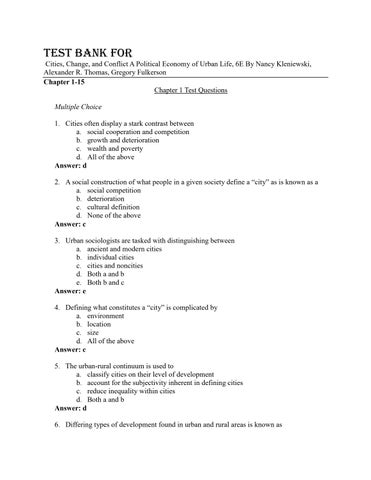
Test Bank For Cities, Change, and Conflict A Political Economy of Urban Life, 6E By Nancy Kleniewski, Alexander R. Thomas, Gregory Fulkerson Chapter 1-15 Chapter 1 Test Questions Multiple Choice 1. Cities often display a stark contrast between a. social cooperation and competition b. growth and deterioration c. wealth and poverty d. All of the above Answer: d 2. A social construction of what people in a given society define a “city” as is known as a a. social competition b. deterioration c. cultural definition d. None of the above Answer: c 3. Urban sociologists are tasked with distinguishing between a. ancient and modern cities b. individual cities c. cities and noncities d. Both a and b e. Both b and c Answer: e 4. Defining what constitutes a “city” is complicated by a. environment b. location c. size d. All of the above Answer: c 5. The urban-rural continuum is used to a. classify cities on their level of development b. account for the subjectivity inherent in defining cities c. reduce inequality within cities d. Both a and b Answer: d 6. Differing types of development found in urban and rural areas is known as
a. the urban-rural continuum b. urban sociology c. economies of scale d. combined and uneven development Answer: d 7. Individual cities are interconnected globally in which of the following ways? a. Culturally b. Spatially c. Financially d. Both a and c Answer: d 8. The idea that certain places provide services important to the overall functioning of a system is known as a. rank-size order b. economies of agglomeration c. central place functions d. Zipf’s law Answer: c 9. From the perspective of ___ residents, residents of ___ areas tend to have impersonal and transitory interactions. a. Northern; Southern b. European; American c. urban; rural d. rural; urban Answer: d 10. Core-based statistical areas are divided into ___ and ___ areas by the U.S. Office of Management and Budget (OMB). a. city; noncity b. metropolitan; micropolitan c. urban; rural d. urbanized; nonurbanized Answer: b 11. Which of the following is an example of a “megalopolis”? a. Toronto, Canada to Buffalo, New York b. Tokyo to Osaka, Japan c. Sao Paulo to Rio de Janeiro, Brazil d. None of the above e. All of the above Answer: e 12. A city’s “built environment” relates to the ways in which people use that city and consists of all of the following except
a. buildings b. food c. roads d. bridges Answer: b 13. When environmental policies disadvantage marginalized racial groups, this is known as a. environmental racism b. intersectional racism c. structural racism d. financial racism Answer: a 14. A real-world example of environmental racism is a. the polluted water crisis from lead plumbing in Flint, Michigan b. the COVID-19 pandemic c. the 2020 California wildfires d. All of the above Answer: a 15. Efforts to fight environmental racism combine the approaches of the ___ and ___ movements. a. urban; rural b. environmental; feminist c. environmental; urbanism d. environmental; civil rights Answer: d 16. As the size of a place, just as the size of a company or other economic unit, increases, the cost per unit of providing services decreases. This refers to: a. Economies of agglomeration b. Economies of scale c. Economies of marginalization d. Urbanization
Answer: b 17. The historical concentration of the automobile industry in Detroit, Michigan, is an example of: a. Economies of agglomeration b. Economies of scale c. Economies of marginalization d. Urbanization Answer: a 18. The population of a town multiplied by its rank will be equal to the population of the largest city in a nation or territory is: a. Urbanization Ratio b. Economies of scale
c. Zipf’s Law d. Caloric well Answer: c 19. The provision of goods and services to a rural hinterland refers to: a. Zipf’s Law b. Urbanization c. Caloric Well d. Central Place Functions Answer: d 20. Core-based statistical areas are defined by county except in: a. California b. The deep South c. New England d. Pacific Northwest Answer: c True/False 21. City smokestacks and plumes were seen as a symbol of environmental degradation in the 19th century but are seen as features of industrial and urban progress today. a. True b. False Answer: b 22. Densely settled areas are considered “urbanized areas” only if they have a population of at least 5,000 residents. a. True b. False Answer: b 23. “Primate cities” are typically a feature of developing nations. a. True b. False Answer: a 24. Residents of rural areas view urban social life from the perspective of urbanormativity. a. True b. False Answer: b 25. U.S. policy has historically criminalized homeless people themselves as opposed to the causes of homelessness. a. True b. False Answer: a
26. The “Forbidden City” of Los Angeles accidentally separated the less affluent from the more affluent. a. True b. False Answer: b 27. Conducing “police sweeps” to clear homeless people from urban areas targets the root causes of homelessness. a. True b. False Answer: b 28. The American automobile industry being concentrated near Detroit, Michigan is an example of an economy of agglomeration. a. True b. False Answer: a 29. “Economies of scale” refers to the idea that as the size of a city increases, the cost per unit of providing services in that city also increases. a. True b. False Answer: b 30. The political and economic climate of a city can influence the local laws and public policies that are designed and implemented. a. True b. False Answer: a
Chapter 2 Test Questions Multiple Choice 1. Human ecology, political economy, and critical approaches are all examples of a. Theories b. Research questions c. Paradigms d. Research methods e. All of the above Answer: c
2. Ferdinand Tönnies referred to life in traditional small communities as ___, and life in modern urban society as ___. a. gesellschaft; gemeinschaft b. gemeinschaft; gesellschaft c. urban; rural d. rural; urban e. None of the above Answer: b 3. Some early social critics believed that as the close ties of village-based societies dissolved, a. cities would flourish b. rural areas would flourish c. society itself would dissolve d. society itself would flourish e. None of the above Answer: c 4. Émile Durkheim argued that the social solidarity of the modern city is born of the social and occupational differences among people as opposed to similarities, this is known as a. organic solidarity b. mechanical solidarity c. gemeinschaft d. gesellschaft Answer: a 5. Émile Durkheim’s concept of organic solidarity is associated with ___ areas, and mechanical solidarity is associated with ___ areas. a. Suburban; rural b. Urban; suburban c. Rural; urban d. Urban; rural Answer: d 6. Which of the following theorists is known for classifying urban social interactions as cold and blasé? a. Robert Park b. Ferdinand Tönnies c. Émile Durkheim d. Georg Simmel Answer: d 7. Georg Simmel felt that rural, village life represented close ties and a. a lack of privacy b. an abundance of privacy c. rationality and objectification d. independence
e. All of the above Answer: a 8. The Chicago School is known as the birthplace of urban sociology in the U.S., and the theorists of the Chicago School were concerned mainly with a. order b. cohesion c. social relationships d. All of the above e. None of the above Answer: d 9. Robert Park, founder of the Chicago School of urban sociology, emphasized ___ in addition to theory when studying urban sociology. a. direct observation b. paradigms c. surveys d. research methods e. All of the above Answer: a 10. Robert Park’s approach to studying urban sociology is known as human ecology and emphasizes the ___ between city populations and environments. a. organic solidarity b. mechanical solidarity c. interdependence d. distance e. None of the above Answer: c 11. Ernest Burgess referred to which of the following as the “zone of transition”? a. The center city business district b. The outskirt residential districts of the city c. The middle- and working-class residential districts d. The area between the center city and residential districts Answer: d 12. To most people, their home represents safety and comfort as well as a financial investment. Thus, it has a. use value b. exchange value c. urban value d. Both a and b e. None of the above Answer: d
13. Friedrich Engels studied England’s booming industrial cities and found that workers’ resided in ___ whereas the industrialists’ resided in ___. a. poorly located units; centrally located units b. centrally located units; poorly located units c. city outskirts; center cities d. center cities; city outskirts Answer: a 14. Which of the following theorists emphasized the roles of economic and political institutions in shaping urban social life? a. Max Weber b. Georg Simmel c. Robert Park d. Friedrich Engels e. Ernest Burgess Answer: a 15. The approach emphasizing physical space and how it can be manipulated to impact urban life is known as a. political economy b. sociospatial perspective c. concentric zone model d. human ecology e. None of the above Answer: b 16. The particular point of view of an individual as shaped by their social and political experiences refers to: a. Standpoint b. Subjective positioning c. Global Latifundia d. Critical Theory Answer: a 17. Which of the following are not associated with the Los Angeles school? a. Cognitive maps b. Multiculturalism c. Multiple Nuclei Theory d. Economic Restructuring and Globalization Answer: c 18. Which paradigm attempts to build a picture of society by building up “standpoints” in a manner similar to an MRI machine? a. Marxism b. Human Ecology c. Political Economy d. Critical Theory
Answer: d 19. “Real estate development and government intervention are the most important influences in metropolitan areas” is a statement associated with: a. Multiple Nuclei Theory b. Sector Theory c. Sociospatial Perspective d. Los Angeles School Answer: c 20. Cities maintain parks as a public good instead of selling the land because parks have: a. use value b. exchange value c. urban value d. Both a and b e. None of the above Answer: a True/False 21. An assumption that guides the research objects and methods of urban sociologists’ centers around whether they view society as either orderly or driven by conflict. a. True b. False Answer: a 22. The view of an individual person as shaped by their social and political experiences is known as their viewpoint. a. True b. False Answer: b 23. Postmodern urbanism largely shares the same goal as earlier paradigms in urban sociology. a. True b. False Answer: b 24. The commonality between the concentric zone model, sector theory, and multiple nuclei is that the central business district is located in the center. a. True b. False Answer: a 25. Louis Wirth is credited with attributing “impersonal” urban relations to social and ecological causes, rather than psychological causes.