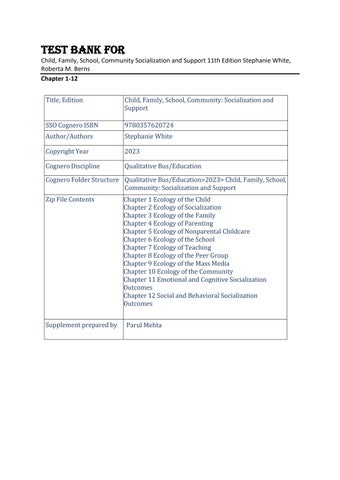
Test Bank For Child, Family, School, Community Socialization and Support 11th Edition Stephanie White, Roberta M. Berns Chapter 1-12 Title, Edition
Child, Family, School, Community: Socialization and Support
SSO Cognero ISBN
9780357620724
Author/Authors
Stephanie White
Copyright Year
2023
Cognero Discipline
Qualitative Bus/Education
Cognero Folder Structure Qualitative Bus/Education>2023> Child, Family, School, Community: Socialization and Support Zip File Contents
Chapter 1 Ecology of the Child Chapter 2 Ecology of Socialization Chapter 3 Ecology of the Family Chapter 4 Ecology of Parenting Chapter 5 Ecology of Nonparental Childcare Chapter 6 Ecology of the School Chapter 7 Ecology of Teaching Chapter 8 Ecology of the Peer Group Chapter 9 Ecology of the Mass Media Chapter 10 Ecology of the Community Chapter 11 Emotional and Cognitive Socialization Outcomes Chapter 12 Social and Behavioral Socialization Outcomes
Supplement prepared by
Parul Mehta
Chapter 01: Ecology of the Child
1. Forces affecting how children are socialized include which of the following? a. Demographics b. Parental age c. Inflation d. Friendships ANSWER: a RATIONALE: Forces affecting how children are socialized include demographics. QUESTION TYPE: Multiple Choice LEARNING OBJECTIVES: 1-2 - Examine elements of socialization as related to child development. KEYWORDS: Bloom's: Understand 2. The process by which individuals acquire the knowledge, skills, and character traits that enable them to participate as effective members of groups and society is called: a. socialization. b. maturation. c. temperament. d. revolution. ANSWER: a RATIONALE: The process by which individuals acquire the knowledge, skills, and character traits that enable them to participate as effective members of groups and society is called socialization. QUESTION TYPE: Multiple Choice LEARNING OBJECTIVES: 1-2 - Examine elements of socialization as related to child development. KEYWORDS: Bloom's: Remember 3. According to Handel, Cahill, and Elkin (2007), socialization occurs: a. by means of political action. b. through interactions with strangers. c. in emotionally significant contexts. d. only in the home. ANSWER: c RATIONALE: According to Handel, Cahill, and Elkin (2007), socialization occurs in emotionally significant contexts. QUESTION TYPE: Multiple Choice LEARNING OBJECTIVES: 1-2 - Examine elements of socialization as related to child development. KEYWORDS: Bloom's: Remember 4. The process by which externally controlled behavior shifts to internally controlled, or selfcontrolled, behavior is: a. internalization. b. socialization. c. reciprocal connection. d. cultural change.
ANSWER: RATIONALE:
a The process by which externally controlled behavior shifts to internally controlled, or self-controlled, behavior is internalization. QUESTION TYPE: Multiple Choice LEARNING OBJECTIVES: 1-4 - List the reciprocal factors (biological and socialization) related to developmental outcomes. KEYWORDS: Bloom's: Remember 5. ―Socialization as a reciprocal process‖ refers to which of the following ideas? a. When individuals interact, a response in one individual usually elicits a response in the other. b. Both mothers and fathers are important in the lives of children. c. Children are socialized by many people; many people are important in their lives. d. Human interactions change over time. ANSWER: a RATIONALE: ―Socialization as a reciprocal process‖ refers to the idea that when individuals interact, a response in one individual usually elicits a response in the other. QUESTION TYPE: Multiple Choice LEARNING OBJECTIVES: 1-2 - Examine elements of socialization as related to child development. KEYWORDS: Bloom's: Understand 6. The process of socialization begins: a. at birth. b. before birth. c. at school-age. d. after birth. ANSWER: a RATIONALE: The process of socialization begins at birth. QUESTION TYPE: Multiple Choice LEARNING OBJECTIVES: 1-2 - Examine elements of socialization as related to child development. KEYWORDS: Bloom's: Remember 7. The total composite of hereditary instructions coded in the genes at the moment of conception is one’s: a. identity. b. genotype. c. exosystem. d. chronosystem. ANSWER: b RATIONALE: The total composite of hereditary instructions coded in the genes at the moment of conception is one’s genotype. QUESTION TYPE: Multiple Choice LEARNING OBJECTIVES: 1-3 - Discuss two characteristics of the brain that make socialization unique to humans. KEYWORDS: Bloom's: Remember
8. Genetic prewiring that motivates a person to seek out compatible environments is called: a. active. b. passive. c. language-rich. d. responsive. ANSWER: a RATIONALE: Genetic prewiring that motivates a person to seek out compatible environments is called active. QUESTION TYPE: Multiple Choice LEARNING OBJECTIVES: 1-2 - Examine elements of socialization as related to child development. KEYWORDS: Bloom's: Remember 9. A happy, sociable child is more likely to engage others in social activities than a moody, shy child. This is an example of a(n): a. passive genotype–environment interaction. b. active genotype–environment interaction. c. evocative genotype–environment interaction. d. inborn genotype-environment interaction. ANSWER: c RATIONALE: This is an example of an evocative genotype-environment interaction. QUESTION TYPE: Multiple Choice LEARNING OBJECTIVES: 1-2 - Examine elements of socialization as related to child development. KEYWORDS: Bloom's: Understand 10. The difficult child has what kind of response? a. Intense b. Mild c. Indifferent d. Adaptable ANSWER: a RATIONALE: The difficult child has an intense response. QUESTION TYPE: Multiple Choice LEARNING OBJECTIVES: 1-2 - Examine elements of socialization as related to child development. KEYWORDS: Bloom's: Understand 11. Samantha is generally in a positive mood, has regular rhythms, and can adapt to change with ease. Which temperament style does Samantha exhibit? a. Easy b. Difficult c. Slow to warm up d. Unclassified ANSWER: a RATIONALE: Samantha exhibits the easy temperament style. QUESTION TYPE: Multiple Choice
LEARNING OBJECTIVES: 1-3 - Discuss two characteristics of the brain that make socialization unique to humans. KEYWORDS: Bloom's: Apply 12. Kochanska (1995, 1997) found that gentle parenting techniques were: a. less effective in getting timid children to comply compared to assertive children. b. more effective in getting timid children to comply compared to assertive children. c. equally effective in getting timid children and assertive children to comply. d. not effective in gaining compliance in any children. ANSWER: b RATIONALE: Kochanska (1995, 1997) found that gentle parenting techniques were more effective in getting timid children to comply compared to assertive children. QUESTION TYPE: Multiple Choice LEARNING OBJECTIVES: 1-2 - Examine elements of socialization as related to child development. KEYWORDS: Bloom's: Remember 13. An adult tells a 6-year old to share a toy with a 4-year-old sibling. This is an example of what kind of socialization? a. Intentional b. Unintentional c. Private d. Challenging ANSWER: a RATIONALE: This is an example of intentional socialization. QUESTION TYPE: Multiple Choice LEARNING OBJECTIVES: 1-5 - Compare and contrast intentional and unintentional socialization. KEYWORDS: Bloom's: Apply 14. Which of the following is true? a. Children absorb only the verbal cues of others. b. Intentional socialization can end up being unintentional. c. Much of socialization takes place during carefully structured interactions. d. Children are unable to pick up on the nonverbal cues of others. ANSWER: b RATIONALE: It is true that intentional socialization can end up being unintentional. QUESTION TYPE: Multiple Choice LEARNING OBJECTIVES: 1-5 - Compare and contrast intentional and unintentional socialization. KEYWORDS: Bloom's: Understand 15. Children are socialized by: a. strangers. b. socioeconomic status. c. characters in movies and books. d. politics.