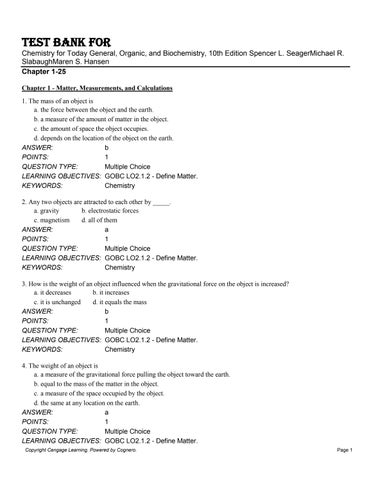
Test Bank For Chemistry for Today General, Organic, and Biochemistry, 10th Edition Spencer L. SeagerMichael R. SlabaughMaren S. Hansen Chapter 1-25 Chapter 1 - Matter, Measurements, and Calculations 1. The mass of an object is a. the force between the object and the earth. b. a measure of the amount of matter in the object. c. the amount of space the object occupies. d. depends on the location of the object on the earth. ANSWER: b POINTS: 1 QUESTION TYPE: Multiple Choice LEARNING OBJECTIVES: GOBC LO2.1.2 - Define Matter. KEYWORDS: Chemistry 2. Any two objects are attracted to each other by _____. a. gravity b. electrostatic forces c. magnetism d. all of them ANSWER: a POINTS: 1 QUESTION TYPE: Multiple Choice LEARNING OBJECTIVES: GOBC LO2.1.2 - Define Matter. KEYWORDS: Chemistry 3. How is the weight of an object influenced when the gravitational force on the object is increased? a. it decreases b. it increases c. it is unchanged d. it equals the mass ANSWER: b POINTS: 1 QUESTION TYPE: Multiple Choice LEARNING OBJECTIVES: GOBC LO2.1.2 - Define Matter. KEYWORDS: Chemistry 4. The weight of an object is a. a measure of the gravitational force pulling the object toward the earth. b. equal to the mass of the matter in the object. c. a measure of the space occupied by the object. d. the same at any location on the earth. ANSWER: a POINTS: 1 QUESTION TYPE: Multiple Choice LEARNING OBJECTIVES: GOBC LO2.1.2 - Define Matter. Copyright Cengage Learning. Powered by Cognero.
Page 1
KEYWORDS:
Chemistry
5. The fact that gold does not corrode is a ______ property a. physical b. personal c. real d. chemical ANSWER: d POINTS: 1 QUESTION TYPE: Multiple Choice LEARNING OBJECTIVES: GOBC LO2.1.3 - Differentiate between physical and chemical properties of matter. KEYWORDS: Chemistry 6. Which of the following represents a physical change in matter? a. A substance solidifies at 443 K. b. A substance produces a gas and a solid when heated. c. A substance burns when heated. d. A substance changes color when exposed to air. ANSWER: a POINTS: 1 QUESTION TYPE: Multiple Choice LEARNING OBJECTIVES: GOBC LO2.1.4 - Differentiate between physical and chemical changes in matter. KEYWORDS: Chemistry 7. The melting of ice to liquid water is correctly classified as a. a chemical change. b. a physical change. c. both a chemical and a physical change. d. neither a chemical nor physical change. ANSWER: b POINTS: 1 QUESTION TYPE: Multiple Choice LEARNING OBJECTIVES: GOBC LO2.1.4 - Differentiate between physical and chemical changes in matter. KEYWORDS: Chemistry 8. Which of the following is a physical property of matter? a. it does not burn b. produces a gas when placed in an acid c. freezes at −10°F d. the surface turns black in air ANSWER: c POINTS: 1 QUESTION TYPE: Multiple Choice LEARNING OBJECTIVES: GOBC LO2.1.3 - Differentiate between physical and chemical properties of matter. KEYWORDS: Chemistry 9. Which of the following is a chemical property of matter? a. color b. density Copyright Cengage Learning. Powered by Cognero.
Page 2
c. freezing point d. flammability ANSWER: d POINTS: 1 QUESTION TYPE: Multiple Choice LEARNING OBJECTIVES: GOBC LO2.1.3 - Differentiate between physical and chemical properties of matter. KEYWORDS: Chemistry 10. As two clear liquid solutions are thoroughly mixed, a red solid forms. This change is most likely _____. a. physical. b. chemical. c. neither chemical nor physical. d. both chemical and physical. ANSWER: b POINTS: 1 QUESTION TYPE: Multiple Choice LEARNING OBJECTIVES: GOBC LO2.1.4 - Differentiate between physical and chemical changes in matter. KEYWORDS: Chemistry 11. The limit of chemical subdivision of an element is the _____. a. atom b. molecule c. proton d. compound ANSWER: a POINTS: 1 QUESTION TYPE: Multiple Choice LEARNING OBJECTIVES: GOBC LO3.2.1 - Describe Democritus' original idea of an atom. KEYWORDS: Chemistry 12. Which of the following substances are composed of heteroatomic molecules? a. an iron nail b. oxygen c. copper wire d. water ANSWER: d POINTS: 1 QUESTION TYPE: Multiple Choice LEARNING OBJECTIVES: GOBC LO3.1.2 - Differentiate between compounds, molecules, and elements. KEYWORDS: Chemistry 13. A molecule represented by O-O-O must be classified as a. homoatomic and polyatomic. b. homoatomic and monoatomic. c. heteroatomic and polyatomic. d. heteroatomic and monoatomic. ANSWER: a POINTS: 1 QUESTION TYPE: Multiple Choice LEARNING OBJECTIVES: GOBC LO3.1.2 - Differentiate between compounds, molecules, and elements. KEYWORDS: Chemistry 14. Which of the following terms correctly applies to a molecule of CO2? a. triatomic, heteroatomic b. polyatomic, diatomic c. triatomic, homoatomic d. diatomic, heteroatomic ANSWER: a Copyright Cengage Learning. Powered by Cognero.
Page 3
POINTS: 1 QUESTION TYPE: Multiple Choice LEARNING OBJECTIVES: GOBC LO3.1.2 - Differentiate between compounds, molecules, and elements. KEYWORDS: Chemistry 15. Table salt, NaCl is best classified as a(n) _____ . a. compound b. element c. homogeneous mixture d. heterogeneous mixture ANSWER: a POINTS: 1 QUESTION TYPE: Multiple Choice LEARNING OBJECTIVES: GOBC LO3.1.5 - Classify matter as a compound, element, heterogenous mixture, or homogenous mixture. KEYWORDS: Chemistry 16. The limit of physical subdivision of pure H2O is _____ . a. the atom b. the molecule c. the element d. a proton ANSWER: b POINTS: 1 QUESTION TYPE: Multiple Choice LEARNING OBJECTIVES: GOBC LO3.2.2 - Explain Dalton's theory of the atom. KEYWORDS: Chemistry 17. Homoatomic pure substances are known as _____ . a. protons b. elements c. compound d. molecules ANSWER: b POINTS: 1 QUESTION TYPE: Multiple Choice LEARNING OBJECTIVES: GOBC LO3.1.5 - Classify matter as a compound, element, heterogenous mixture, or homogenous mixture. KEYWORDS: Chemistry 18. After heating, a pure substance, A, is found to produce both B and C. What can be said about the substance A? a. It is an element b. It is a compound c. It is either an element or compound d. Impossible to predict ANSWER: b POINTS: 1 QUESTION TYPE: Multiple Choice LEARNING OBJECTIVES: GOBC LO3.1.5 - Classify matter as a compound, element, heterogenous mixture, or homogenous mixture. KEYWORDS: Chemistry 19. Two pure substances A and B react to form a new pure substance C. From this, we may conclude that a. A and B are both elements b. C is a compound, A and B may or may not be elements Copyright Cengage Learning. Powered by Cognero.
Page 4
c. C is an element, A and B are compounds d. A, B, and C are all compounds ANSWER: b POINTS: 1 QUESTION TYPE: Multiple Choice LEARNING OBJECTIVES: GOBC LO3.1.5 - Classify matter as a compound, element, heterogenous mixture, or homogenous mixture. KEYWORDS: Chemistry 20. Which of the following is an example of a homogeneous mixture? a. NaOH solution b. mortar (mixture of water, sand and cement) c. vinegar and oil salad dressing d. more than one response is correct ANSWER: a POINTS: 1 QUESTION TYPE: Multiple Choice LEARNING OBJECTIVES: GOBC LO3.1.3 - Differentiate between homogenous and heterogenous mixtures. KEYWORDS: Chemistry 21. Which of the following consists of a single chemical species? a. solution b. homogeneous mixture c. heterogeneous mixture d. compound ANSWER: d POINTS: 1 QUESTION TYPE: Multiple Choice LEARNING OBJECTIVES: GOBC LO3.1.5 - Classify matter as a compound, element, heterogenous mixture, or homogenous mixture. KEYWORDS: Chemistry 22. Early measurements of length were based on a. dimensions of astronomical bodies. b. dimensions of the human body. c. dimensions of bodies of water. d. distances between cities. ANSWER: b POINTS: 1 QUESTION TYPE: Multiple Choice LEARNING OBJECTIVES: GOBC LO1.4.3 - Identify standard units of measurement for length, volume, mass, time, and temperature. KEYWORDS: Chemistry 23. The metric system is a measurement system that is a. the official system for all nations of the world. b. only used by a few of the nations of the world. c. commonly used by U.S. physical scientists. d. used exclusively in chemical calculations. Copyright Cengage Learning. Powered by Cognero.
Page 5