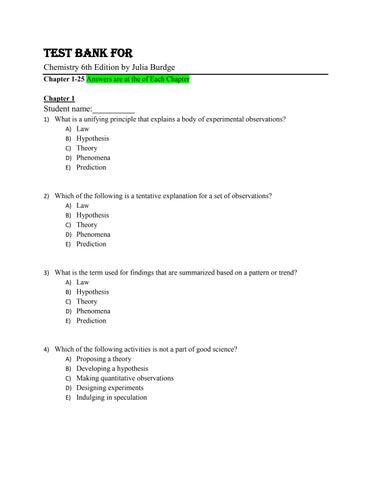
Test Bank For Chemistry 6th Edition by Julia Burdge Chapter 1-25 Answers are at the of Each Chapter Chapter 1
Student name:__________ 1) What is a unifying principle that explains a body of experimental observations? A) Law B) Hypothesis C) Theory D) Phenomena E) Prediction
2) Which of the following is a tentative explanation for a set of observations? A) Law B) Hypothesis C) Theory D) Phenomena E) Prediction
3) What is the term used for findings that are summarized based on a pattern or trend? A) Law B) Hypothesis C) Theory D) Phenomena E) Prediction
4) Which of the following activities is not a part of good science? A) Proposing a theory B) Developing a hypothesis C) Making quantitative observations D) Designing experiments E) Indulging in speculation
5) Which of the following is a ‘substance’ according to the definition given in your textbook? A) Air B) Tap water C) Sea water D) Water E) Toothpaste
6) Which of the following cannot be separated into simpler substances by chemical means? A) Element B) Emulsion C) Compound D) Homogeneous mixture E) Heterogeneous mixture
7) If a liquid contains 60% sugar and 40% water throughout its composition then what is it
called? A) B) C) D) E)
Solute Compound Homogeneous mixture Heterogeneous mixture Solvent
8) Which of the following does not have a uniform composition throughout? A) Element B) Compound C) Homogeneous mixture D) Heterogeneous mixture E) Solvent
9) Which of the following is not an SI base unit? A) Meter B) Ampere C) Second D) Gram E) Kelvin
10) The SI base unit of mass is A) mg. B) g. C) kg. D) metric ton. E) lb.
11) The SI prefix mega- (M) means A) 10–6. B) C) D) E)
10–3. 103. 106. 109.
12) The SI prefixes milli- and mega- represent, respectively: A) 106 and 10–6 –3
and 106 3 –6 C) 10 and 10 D) 10–3 and 109 –6 –3 E) 10 and 10 B) 10
13) How many micrograms are in 65.3 kg? A) 0.653 μg B) 6.53 × 10⁷ μg C) 6.53 × 10⁴ μg D) 6.53 × 10⁻⁸ μg E) 6.53 × 10¹⁰ μg
14) A dose of medication was prescribed to be 35 microliters. Which of the following expresses
that volume in centiliters? A) 3.5 × 10⁵ cL B) 3.5 × 10⁴ cL C) 3.5 cL D) 3.5 × 10⁻⁴ cL E) 3.5 × 10⁻³ cL
15) How many milliliters is 0.0055 L? A) 0.55 mL B) 5.5 mL C) 0.5 mL D) 0.0000055 mL E) 182 mL
16) How many hertz is 600.11 MHz? –4 A) 6.0011 × 10 Hz B) 60.011 Hz C) 6.0011 × 10⁶ Hz –2
D) 6.0011 × 10
Hz E) 6.0011 × 10 Hz 8
17) The distance between carbon atoms in ethylene is 134 picometers. Which of the following
expresses that distance in meters? A) 1.34 × 10⁻¹³ m B) 1.34 × 10⁻¹² m –10 C) 1.34 × 10 m D) 1.34 × 10⁻⁷ m E) 1.34 × 10⁻⁶ m
18) Which of these quantities represents the largest mass? A) 2.0 × 10² mg B) 0.0010 kg C) 1.0 × 10⁵ μg D) 2.0 × 10² cg E) 10.0 dg
19) The mass of a sample is 550 milligrams. Which of the following expresses that mass in
kilograms? A) 5.5 × 10⁸ kg B) 5.5 × 10⁵ kg C) 5.5 × 10⁻⁴ kg D) 5.5 × 10⁻⁶ kg E) 5.5 × 10⁻¹ kg
20) The average distance between the Earth and the Moon is 240,000 miles. Express this distance
in kilometers. (1 mi = 1609 m) 5 A) 6.1 × 10 km 5 B) 5.3 × 10 km C) 3.9 × 10⁵ km 5 D) 1.5 × 10 km E) 9.4 × 10⁴ km
21) How many inches are in 382.5 cm? (1 in = 2.54 cm)? A) 150.6 in B) 6.641 × 10⁻³ in C) 151 in D) 971.6 in E) 972 in