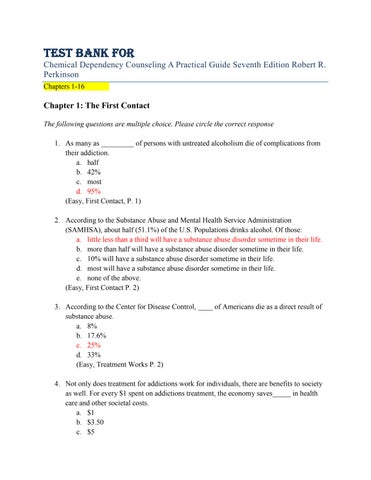
Test Bank For Chemical Dependency Counseling A Practical Guide Seventh Edition Robert R. Perkinson Chapters 1-16
Chapter 1: The First Contact The following questions are multiple choice. Please circle the correct response 1. As many as _________ of persons with untreated alcoholism die of complications from their addiction. a. half b. 42% c. most d. 95% (Easy, First Contact, P. 1) 2. According to the Substance Abuse and Mental Health Service Administration (SAMHSA), about half (51.1%) of the U.S. Populations drinks alcohol. Of those: a. little less than a third will have a substance abuse disorder sometime in their life. b. more than half will have a substance abuse disorder sometime in their life. c. 10% will have a substance abuse disorder sometime in their life. d. most will have a substance abuse disorder sometime in their life. e. none of the above. (Easy, First Contact P. 2) 3. According to the Center for Disease Control, ____ of Americans die as a direct result of substance abuse. a. 8% b. 17.6% c. 25% d. 33% (Easy, Treatment Works P. 2) 4. Not only does treatment for addictions work for individuals, there are benefits to society as well. For every $1 spent on addictions treatment, the economy saves_____ in health care and other societal costs. a. $1 b. $3.50 c. $5
d. $7 e. None of the above. Although treatment does save lives, there is no real cost benefit. (Easy, Treatment Works, P. 2) 5. Trust is paramount in establishing a therapeutic alliance. To establish trust, the therapist must be both ____________ and ______________. a. honest and assertive b. direct and impartial c. consistent and honest d. engaging and direct e. transparent and professional (Medium, Therapeutic Alliance, P. 5) 6. A client must trust the clinician to be open, honest, and keep promises. When working in a group practice or facility, it is imperative the client is aware that: a. you will keep their secrets from co-workers. b. the clinical staff works as a team. c. each clinician in the facility is fully autonomous. d. you are willing to share a personal secret with the client to establish trust. (Medium, Therapeutic Alliance, P. 5) 7. The National Institute of Alcohol Abuse and Alcoholism (NIAAA) and the American Society of Addiction Medicine (ASAM) developed screening questions to identify possible indicators of addiction. The author suggests: a. you only ask the client these questions. Otherwise you sacrifice rapport. b. have a colleague ask the client these questions a second time to help expose inconsistency. c. have the client identify someone else who can verify their story. d. ask family members, friends, or anyone else who can offer collateral information. (Medium, Motivational interview, P. 9) 8. Which of the following is not a risk factor for addiction? a. Availability of or access to the substance. b. Family history of an addictive disorder. c. A youth being away at college and unsupervised. d. Presence of a mental health disorder. (Easy, Natural History of Addiction, P. 11)
9. The author finds it important to use standardized instruments in diagnosing substance disorders: a. for the benefit of third-party payers. b. to best partner with researchers. c. as an instrument must be incorporated into the medical record. d. to prove to the client they have a problem. (Medium, How to Diagnose, P. 11) 10. Which of the following is untrue? a. 10% of clients can abstain on their own. b. 50% of addicted clients can quit if they complete treatment. c. 70% of clients can quit if they complete treatment and go to AA. d. 90% of clients can quite if they complete treatment, go to AA, and attend aftercare weekly. (Medium, How to Intervene, P. 13) 11. Which of the following is not recognized as a stage of change? a. Contemplation b. Preparation c. Precontemplation d. Action e. Relapse f. Maintenance (Easy, How to Assess Motivation, P. 14) 12. The motivational interview should incorporate all but one of the following elements: a. provide hope. b. meet the client expectations. c. assess barriers and strengths. d. offer sound advice. e. all of the above. (Easy, Motivational Interview, P. 6) 13. Incidence of use increases when the addictive substance is: a. readily available, cheap, and rapid acting. b. tastes good and has no identifiable odor. c. cannot be readily detected on toxicology screens. d. non-prescribed. (Medium, Natural History of Addiction, P. 11)
14. During the action stage, a client often: a. comes to the assessment. b. quits using. c. implements a recovery plan and takes steps to change. d. makes a commitment to take action and develops a plan. (Easy, how to Assess Motivation, P. 14) 15. During the maintenance stage, the client will: a. examine their current behavior and potential for change. b. sustain the new behavior for an extended period of time. c. identifies their “sobriety date.” d. integrates a new behavior. (Easy, How to Assess Motivation, P. 15) 16. During the precontemplative stage, the client will: a. ask for help. b. begin to consider how they will change. c. established s target date for sobriety. d. not yet recognize they have a problem. (Easy, How to Assess Motivation, P. 14)
The following Questions are True or False. Circle the correct response. 1. More High School students have tried tobacco than alcohol, OR illegal drugs. T F 2. Most Addicts die of their addiction. T F 3. According to SAMHSA its ok form pregnant women to have 1 drink a day. T F 4. Depression and/or suicide attempts may be an indicator of addiction. T F 5. The following are all red flags for adolescent substance abuse: engaging in risky behavior, marked fall in academic performance, unexplained weight loss, and rebellion against parental authority. T F The following are all short answer questions: 1. You have just encountered a client who has presented two red flags for substance abuse/addiction in their first session. What are some actions, next steps you should take? Why?
2.
3.
4.
5.
a. (P. 10, Figure 1.2) If the red flags are from laboratory tests, the results should be explained in a way the client fully understands, as many people do not understand the complexities of lab results. b. (P. 11, What to Do If Red Flags) The client should always be advised on the risks and guided to abstinence or moderation (depending on their results). A follow up should be scheduled to monitor progress. Not everyone you assess will have a substance related problem. How would you proceed with someone who does not present as substance abusing but does have a family history of addiction? a. (P. 12, How to Intervene) Remember, addiction can begin at any age. A person with a positive family history should be given a positive “prevention” message and warned of their increased vulnerability to addiction. Often you may have heard of someone being in denial. Where does this fall in the stages of change model? Explain. a. (P. 14, Stages of Motivation) Denial is often looked at as being interchangeable with the precontemplation stage; i.e., not being ready/willing to take action on their substance use problem. The light goes on! Your client definitively recognizes having a substance addiction. Where does this fall on the stages of change model? Explain. a. (P. 14, Stages of Motivation) Often times the light gets brighter gradually. This occurs in the contemplation stage—a client “begins” to openly investigate the pros and cons of their behavior. Eventually, the need for change becomes clear enough where they prepare (preparation stage) to take Action (action stage). A client may vacillate between different stages of change. It is important to know some motivational strategies to ensure they do not get complacent or stuck. What are some processes that can be applied when a client is precontemplative? a. (P. 3, Motivational Interview) Using motivational interviewing techniques the therapist begins to listen for and seek out ambivalence about negative consequences. Illuminate discrepancy in these mixed feelings.