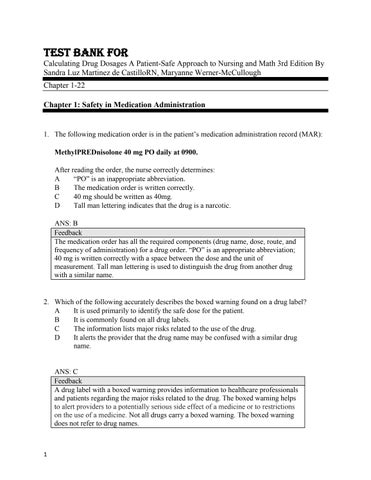
Test Bank For Calculating Drug Dosages A Patient-Safe Approach to Nursing and Math 3rd Edition By Sandra Luz Martinez de CastilloRN, Maryanne Werner-McCullough Chapter 1-22 Chapter 1: Safety in Medication Administration
1. The following medication order is in the patient’s medication administration record (MAR): MethylPREDnisolone 40 mg PO daily at 0900. After reading the order, the nurse correctly determines: A ―PO‖ is an inappropriate abbreviation. B The medication order is written correctly. C 40 mg should be written as 40mg. D Tall man lettering indicates that the drug is a narcotic. ANS: B Feedback The medication order has all the required components (drug name, dose, route, and frequency of administration) for a drug order. ―PO‖ is an appropriate abbreviation; 40 mg is written correctly with a space between the dose and the unit of measurement. Tall man lettering is used to distinguish the drug from another drug with a similar name.
2. Which of the following accurately describes the boxed warning found on a drug label? A It is used primarily to identify the safe dose for the patient. B It is commonly found on all drug labels. C The information lists major risks related to the use of the drug. D It alerts the provider that the drug name may be confused with a similar drug name.
ANS: C Feedback A drug label with a boxed warning provides information to healthcare professionals and patients regarding the major risks related to the drug. The boxed warning helps to alert providers to a potentially serious side effect of a medicine or to restrictions on the use of a medicine. Not all drugs carry a boxed warning. The boxed warning does not refer to drug names.
1
3. When practicing safety in the administration of medication, the nurse is correct to seek clarification prior to the administration of which of the following medication orders? A Regular insulin 5 u SUBQ now B Enoxaparin 80 mg SUBQ every 12 hours C Benadryl 50 mg PO PRN every 6 hr for itching D Ondansetron 4 mg IVP stat ANS: A Feedback The ―u‖ should never be used in a medication order; rather, for safety, the word ―units‖ should be spelled out. The other answers have the required components needed to safely carry out the medication order.
4. The nurse is reviewing a drug label with a drug name written with tall man lettering. Which statement indicates that the nurse has a correct understanding of tall man lettering on a drug label? A The tall man lettering means this is a high-alert drug. B The tall man lettering helps to distinguish this drug from other drugs that have similar names. C The tall man lettering means that this drug contains a boxed warning. D The tall man lettering helps to quickly identify that the drug is an injectable drug. ANS: B Feedback Tall man lettering highlights a portion of the drug name to help distinguish the name from other similar drug names. It is not used to identify high-alert drugs, highlight a boxed warning, or identify injectable drugs.
5. The following medication orders are found in the patient’s MAR: Metformin HCl 500 mg PO daily at 0900. Hydrochlorothiazide 25 mg PO every 12 hr at 0900 and 2100. Digoxin .25 mg PO daily at 0900. In reading the medication orders for the 0700–1500 shift, the nurse determines that the priority intervention is to: A Question the metformin HCl order. B Clarify the hydrochlorothiazide order. C Clarify the digoxin order. D Prepare to administer the 0900 medications. 2
ANS: C Feedback The digoxin medication order requires a zero before the decimal fraction (.25). Safe practice recommends using a leading zero before a decimal point when the dose is less than one. The metformin HCl and the hydrochlorothiazide orders are written correctly. 6. In the administration of medications, the nurse is correct to document the administration of medications: A 30 minutes before administering to the patient B Immediately before administering to the patient C At the end of the shift D Immediately after administering to the patient ANS: D Feedback The last Right of Medication Administration is the documentation of medications. The documentation is done immediately after administering the medications to the patient.
7. The following medication is ordered for the patient: Calcitriol Oral Solution 2 µg PO Daily After reading the order, the nurse initially demonstrates safe practice by A Clarifying the written medication order of 2 µg B Looking up the dose in a drug reference book C Identifying the written components of the medication order D Asking the patient about the daily dose taken at home ANS: A Feedback The initial action is for the nurse to clarify the drug dose because it is written with the error-prone letter/symbol ―µ.‖ To avoid medication errors, it is recommended that the ―µ‖ not be used in medication orders. The abbreviation ―mcg‖ is to be used for microgram.
8. The day shift nurse is preparing to administer a medication to a newly admitted patient. When taking the medication to the patient, the patient tells the nurse that she has never taken this medication and asks why the drug was ordered. The nurse demonstrates safe practice behavior(s) by: (Select all that apply.)
3
A B C D E F
Addressing the patient’s concern before giving the medication Using a drug reference to gather information about the medication Encouraging the patient to take the medication as ordered Reviewing the provider’s medication orders Instructing the patient that the medication needs to be taken on time Informing the patient that the provider will be called after she takes the medication
ANS: A, B, D Feedback Safe practice includes addressing the patient’s concerns, verifying the ordered drug, and for the nurse to be knowledgeable about the indications and actions of the ordered drug.
9. The nurse receives a new medication order. After reading the provider’s order and the MAR, the nurse correctly applies safe practice behavior(s) in medication administration by: (Select all that apply.)
A B C D E
Placing the medication at the bedside and asking the patient to take the tablet at 0900 Verifying the drug and dose using the provider’s order and the MAR Documenting the administration of the dose before entering the patient’s room Using two patient identifiers prior to the administration of the drug Instructing the patient on the new medication order
ANS: B, D, E Feedback Safe practice includes verifying the drug and dose using the provider’s order and the MAR (including patient name) and using two patient identifiers prior to the administration of the drug. Patient education is an important component of collaborating and involving the patient in their care.
4
10. All of the following medication orders are found in a patient’s MAR. Select the medication order that requires clarification prior to administration. A Captopril 12.5 mg PO at 0700 and 1700 B Regular insulin 7 units SUBQ 30 minutes before breakfast C Ketorolac 15 mg IM stat D Morphine sulfate 45.0 mg PO once a day for pain ANS: D Feedback The ordered dose of morphine sulfate, 45.0 mg, has a trailing zero, which may lead to an error in the administration of the ordered dose. The medication orders for captopril, regular insulin, and ketorolac contain the required components of a medication order.
Chapter 2: The Drug Label 1. A student nurse makes the following statements regarding the units of measurements commonly found on drug labels. Which statement indicates a need for further clarification? A The mL, L, and meter are units of measurement found in the metric system. B The unit of measurement labeled ―unit‖ expresses the biological activity of the drug. C The mEq unit of measurement has the same concentration of solution as the mcg. D The units of measurement on drug labels help to identify the strength of the drug. ANS: C Feedback The mEq (milliequivalent) is a unit of measurement that indicates the concentration of an electrolyte per liter of solution. The mcg (microgram) is a unit of measurement found in the metric system and refers to the weight of the drug.
2. The nurse is reading the diltiazem hydrochloride drug label: Diltiazem Hydrochloride Tablets, USP 120 mg Tablets may be swallowed whole, crushed, or chewed. Which statement indicates an understanding of the information on the drug label? (Select all that apply.) A The dosage strength is 120 mg per tablet. 5