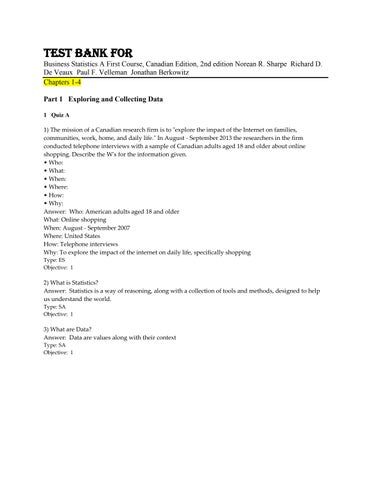
Test Bank For Business Statistics A First Course, Canadian Edition, 2nd edition Norean R. Sharpe Richard D. De Veaux Paul F. Velleman Jonathan Berkowitz Chapters 1-4 Part 1 Exploring and Collecting Data 1 Quiz A 1) The mission of a Canadian research firm is to "explore the impact of the Internet on families, communities, work, home, and daily life." In August - September 2013 the researchers in the firm conducted telephone interviews with a sample of Canadian adults aged 18 and older about online shopping. Describe the W's for the information given. • Who: • What: • When: • Where: • How: • Why: Answer: Who: American adults aged 18 and older What: Online shopping When: August - September 2007 Where: United States How: Telephone interviews Why: To explore the impact of the internet on daily life, specifically shopping Type: ES Objective: 1
2) What is Statistics? Answer: Statistics is a way of reasoning, along with a collection of tools and methods, designed to help us understand the world. Type: SA Objective: 1
3) What are Data? Answer: Data are values along with their context Type: SA Objective: 1
4) The following data table displays some of the data collected by a Canadian research firm about online shopping. List the variables in the data set and indicate whether each variable is categorical or quantitative. If the variable is quantitative, give its unit of measurement.
Age 25 47 38 30
Gender Male Female Female Male
Household Income $55 000 $60 000 $110 000 $62 000
Participated in Monthly amount Time (hours) per week online auction? spent online browsing online retailers Yes $250 6 No $50 4 No $120 10 No $75 4
Answer: Categorical: Gender, Participated in online auction? Quantitative: Age (years), Household income ($), Monthly online spending ($), Browsing time per week (hours). Type: ES Objective: 1
5) In addition to the variables listed above, data were also collected on the following variables. Indicate whether each variable is nominal or ordinal. • Region (Urban, Suburban, Rural) • Education (Less than High School, High School, College, and College +) • Marital Status (Single, Widowed, Divorced, Married) Answer: Region: Nominal Education: Ordinal Marital Status: Nominal Type: ES Objective: 1
6) For each of the following data, indicate whether the data are cross-sectional or time series: • Weekly receipts at a clothing boutique • Monthly demand for an automotive part • Percentage of adults who bank online Answer: Weekly receipts at a clothing boutique: Time series Monthly demand for an automotive part: Time series Percentage of adults who bank online: Cross-sectional Type: ES Objective: 3
2 Quiz B 1) The Therapeutic Products Directorate (TPD) of Health Canada is responsible for assessing the safety, efficacy and quality of a drug entering the Canadian market (http://www.hc-sc.gc.ca/). TPD routinely compares drugs in terms of effectiveness and safety. In summer 2010, TPD scientists reviewed drugs used to treat arthritis. Information was reported on convenience of use (how many pills required each day), possible side effects (e.g., dizziness, stomach upset), cost, and ratings of effectiveness in relieving symptoms (very effective, somewhat effective, not effective). Describe the W's for the information given. • Who: • What: • When: • Where: • How: • Why: Answer: Who: Drugs to treat arthritis currently on the market What: Convenience of use, side effects, cost, effectiveness ratings When: Summer 2008 Where: Not specified, probably United States How: Testing on drugs Why: Information for potential consumers/patients Type: ES Objective: 1
2) The Therapeutic Products Directorate (TPD) of Health Canada is responsible to assess the safety, efficacy and quality of a drug to enter Canadian market (http://www.hc-sc.gc.ca/). TPD routinely compares drugs in terms of effectiveness and safety. In summer 2010, TPD scientists reviewed drugs used to treat arthritis. Information was reported on convenience of use (how many pills required each day), possible side effects (e.g., dizziness, stomach upset), cost, and ratings of effectiveness in relieving symptoms (very effective, somewhat effective, not effective). List the variables reported in assessing the safety and efficacy of drugs used to treat arthritis. If the variable is quantitative, give its unit of measurement. If the variable is categorical, indicate whether it is nominal or ordinal. Answer: Categorical: Side effect (nominal), effectiveness rating (ordinal) Quantitative: Convenience of use (number of pills), Cost ($) Type: ES Objective: 1
3) The Human Resources Department of a large Canadian corporation maintains records on its employees. The table below displays some of these data. List the variables in the data set. Indicate whether each variable is categorical or quantitative. If the variable is quantitative, give its unit of measurement. If the variable is categorical, indicate whether it is nominal or ordinal.
Age 32 52 60 28
Employment Participates in Monthly amount Category Education Wellness Program? spent online Clerical High School Yes $250 Professional College No $120 Professional Junior College Yes $0 Clerical High School No $120
Answer: Categorical: Employment Category (nominal), Education (ordinal), Participation in Wellness Program? (nominal) Quantitative: Age (years), Paycheck Benefit Deductions ($) Type: ES Objective: 1
4) For each of the following, indicate whether the data are cross-sectional or time series: • Company quarterly profits • Percentage of American adults who work full time • Historical closing stock prices Answer: Company quarterly profits: Time series Percentage of American adults who work full time: Cross-sectional Historical closing stock prices: Time series Type: ES Objective: 3
5) What is an experiment? Answer: A study in which the researcher manipulates factor levels to assess the effect of the factor on the response. Type: SA Objective: 4
6) What are cross-sectional data? Answer: Data taken from situations that vary over time but measured at a single time instant are said to be a cross-section of the time series. Type: SA Objective: 3
3 Quiz C - Multiple Choice 1) In the fall of 2013, a Canadian research firm conducted telephone interviews with a sample of Canadian adults aged 18 and older about online shopping. Canadian adults aged 18 and older constitute the ________ of the study. A) Who B) What C) When D) Where E) How Answer: A Type: MC Objective: 1
2) A few of the variables for which data were collected in a Canadian Research Project include age, gender, income, number of computers in the household, and number of hours spent shopping online per month. Which of the variables is categorical? A) Age B) Gender C) Income D) Number of hours spent shopping online E) Number of computers in the household Answer: B Type: MC Objective: 1
3) The Internet & Life Project study also asked respondents to indicate their education level on the following scale: Less than High School, High School, Some College, College, University. Which of the following statements is (are) true? A) Education level is a time series variable. B) Education level is nominal scaled. C) Education level is a quantitative variable. D) Education level is a categorical variable. E) Education level is both a time series variable and nominal scaled. Answer: D Type: MC Objective: 1