��
�� �� �
����
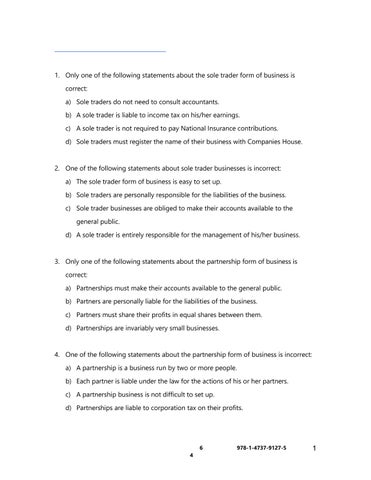
1. Only one of the following statements about the sole trader form of business is correct: a) Sole traders do not need to consult accountants. b) A sole trader is liable to income tax on his/her earnings. c) A sole trader is not required to pay National Insurance contributions. d) Sole traders must register the name of their business with Companies House.
2. One of the following statements about sole trader businesses is incorrect: a) The sole trader form of business is easy to set up. b) Sole traders are personally responsible for the liabilities of the business. c) Sole trader businesses are obliged to make their accounts available to the general public. d) A sole trader is entirely responsible for the management of his/her business.
3. Only one of the following statements about the partnership form of business is correct: a) Partnerships must make their accounts available to the general public. b) Partners are personally liable for the liabilities of the business. c) Partners must share their profits in equal shares between them. d) Partnerships are invariably very small businesses.
4. One of the following statements about the partnership form of business is incorrect: a) A partnership is a business run by two or more people. b) Each partner is liable under the law for the actions of his or her partners. c) A partnership business is not difficult to set up. d) Partnerships are liable to corporation tax on their profits.
�� ��� ��������������� 6������ 978-1-4737-9127-5 � ������������ 4����������
1
5. Only one of the following statements about the limited company form of business is correct: a) The directors of a limited company are obliged by law to hold shares in the company. b) Shareholders of a limited company share the profits equally between themselves. c) A limited company cannot itself borrow money; borrowing must be done on its behalf by its shareholders or directors. d) Members of the general public can find out about the financial affairs of the company.
6. One of the following statements about the limited company form of business is incorrect: a) Shareholders are personally liable for all the liabilities incurred by the business. b) Regular filing of information about the affairs of the company is a legal requirement. c) The limited company form of business allows ownership of the business to be spread amongst many people. d) Shareholders can appoint professional managers as directors of the company.
7. One of the following statements about financing is correct: a) Bank overdrafts are a form of long-term finance. b) A partnership wishing to raise finance can issue additional shares. c) Sole traders wishing to raise finance can sell shares in their business to their friends. d) Bank overdrafts are repayable on demand
8. One of the following statements about taxation is correct: a) Capital gains tax is levied on business gains made by sole traders, partnerships and limited companies.
�� ��� ��������������� 6������ 978-1-4737-9127-5 � ������������ 4����������
2
b) Company directors are liable to corporation tax on their salaries. c) All businesses, regardless of size, are required by law to register for VAT. d) Partners in a partnership are exempt from National Insurance contributions.
9. Bayley and Sharif Limited is a trading company which sells raincoats, umbrellas and wellies. In the VAT quarter ended 30 June 20X6, the business made sales of £150,000 on which it charged VAT totalling £30,000. In the same three-month period, it bought goods and services for £95,000, all of which are subject to VAT at the standard rate of 20 per cent. The company’s VAT liability for the quarter is: a) £30,000 b) £19,000 c) £11,000 d) £0.
10. One of the following statements about taxation is incorrect: a) HMRC is responsible for the administration of the VAT system. b) Company directors are liable to income tax on the salaries they receive from the company. c) Partners are subject to a special partnership tax on their share of profits. d) VAT is a form of indirect taxation.
11. Financial reports for external use show: a) information that can be used by, for example, potential shareholders and the general public. b) a record of amounts paid and payable to HMRC in respect of VAT. c) information about the environmental impact of a business. d) the information used by management to run the business.
12. Which of the following statements about audit and auditors is correct?
�� ��� ��������������� 6������ 978-1-4737-9127-5 � ������������ 4����������
3
a) Sole traders, partnerships and limited companies are all required by law to have an annual audit of their financial statements. b) Many companies are nowadays exempt from the requirement to have an annual audit of their financial statements. c) Very large companies are required by law to have their management accounting information audited. d) Auditors are entitled to veto directors’ remuneration packages if they feel that the amounts involved are excessive.
13. Who appoints the directors of a limited company? a) The auditors b) The shareholders c) A representative committee elected from amongst the shareholders d) A joint committee of shareholders, existing directors and the company auditors.
14. One of the following statements about management accounting is correct: Management accounting a) Management accounting helps management to make sure that shareholders are fully informed on a regular basis of all management decisions. b) Management accounting is another term for describing the annual reporting to shareholders for which directors are responsible. c) Management accounting requires that managers, especially directors, are accountable to the shareholders for their remuneration packages. d) Management accounting assists management in controlling the business and making decisions.
15. Which of the following statements is correct? The stewardship function requires directors of limited companies to: a) act promptly to fulfil all requests for information from shareholders.
�� ��� ��������������� 6������ 978-1-4737-9127-5 � ������������ 4����������
4
b) circulate minutes of directors’ meetings to shareholders on a timely basis. c) act at all times in the best interests of the company. d) meet shareholders on a regular basis to discuss major strategic decisions.
16. Which one of the following statements is correct? a) In the UK, only members of the ICAEW accounting body are required to follow a Code of Ethics. b) The Code of Ethics followed by accountants in many countries is produced by the Financial Reporting Council. c) Compliance with the Code of Ethics is optional for professionally-qualified accountants. d) The Code of Ethics which is followed by professionally-qualified accountants has five fundamental principles.
17. Which of the following is one of the fundamental principles in the Code of Ethics followed by professionally-qualified accountants? a) Confidentiality b) Prudence c) Quality Control and Due Care d) Professional Qualification.
18. The finance director of Baillie Bruton plc, Sally, has prepared annual financial statements which, in the opinion of the auditor, Philip, overstate the company’s profit for the year. Sally promises Philip a larger audit fee if he will agree to overlook the overstatement of profit for the year. This poses which one of the following threats to the fundamental principles in the Code of Ethics? a) Advocacy b) Self-interest c) Self-review
�� ��� ��������������� 6������ 978-1-4737-9127-5 � ������������ 4����������
5