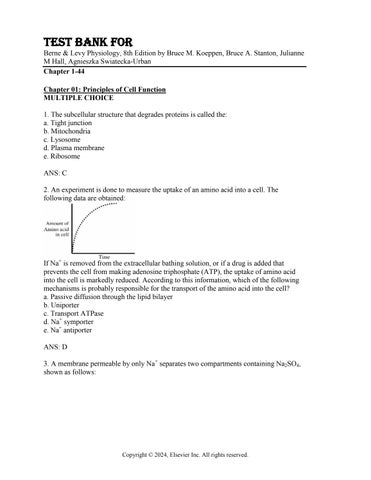
Test Bank For Berne & Levy Physiology, 8th Edition by Bruce M. Koeppen, Bruce A. Stanton, Julianne M Hall, Agnieszka Swiatecka-Urban Chapter 1-44 Chapter 01: Principles of Cell Function MULTIPLE CHOICE 1. The subcellular structure that degrades proteins is called the: a. Tight junction b. Mitochondria c. Lysosome d. Plasma membrane e. Ribosome ANS: C 2. An experiment is done to measure the uptake of an amino acid into a cell. The following data are obtained:
If Na+ is removed from the extracellular bathing solution, or if a drug is added that prevents the cell from making adenosine triphosphate (ATP), the uptake of amino acid into the cell is markedly reduced. According to this information, which of the following mechanisms is probably responsible for the transport of the amino acid into the cell? a. Passive diffusion through the lipid bilayer b. Uniporter c. Transport ATPase d. Na+ symporter e. Na+ antiporter ANS: D 3. A membrane permeable by only Na+ separates two compartments containing Na2SO4, shown as follows:
Copyright © 2024, Elsevier Inc. All rights reserved.
1-2
Electrodes are placed in both compartments, and a voltage is applied (that of compartment A is held at 0 mV). What voltage applied to compartment B would result in no net movement of Na+ across the membrane separating the compartments? a. –60 mV b. –30 mV c. 0 mV d. +30 mV e. +60 mV ANS: E 4. The resting membrane potential of a cell is –85 mV. The intracellular and extracellular concentrations of several ions are indicated in the following table, as is the calculated Nernst equilibrium potential (Ei) for each of these ions: Ion Concentration Concentration Ei Inside Cell Outside Cell Na+ 12 mEq/L 145 mEq/L 66 mV K+ 150 mEq/L 4 mEq/L –96 mV – Cl 30 mEq/L 105 mEq/L –33 mV ++ Ca 0.0001 mmol/dL 1 mmol/dL 122 mV The membrane has channels for Na+, K+, Cl–, and Ca++. The conductance of the membrane is the greatest for which ion? a. Na+ b. K+ c. Cl– d. Ca++ ANS: B 5. A cell contains the following membrane transporters: Na+ channel K+ channel Na+,K+-ATPase The resting membrane voltage of the cell is –80 mV, and the intracellular and extracellular ion concentrations are as follows: Ion Intracellular Extracellular Concentration Concentration Na+ 10 mEq/L 145 mEq/L + K 120 mEq/L 4 mEq/L
Copyright © 2024, Elsevier Inc. All rights reserved.
1-3 The cell is treated with a drug to inhibit the Na+,K+-ATPase. What would be the effect of this drug on the following parameters?
a. b. c. d. e.
Intracellular [Na+] Decrease Increase Increase Decrease Increase
Intracellular [K+] Decrease Decrease Increase Increase Increase
Cell Volume Decrease Increase Increase Decrease Decrease
Membrane Voltage Depolarize Depolarize No change Hyperpolarize Hyperpolarize
a. a b. b c. c d. d e. e ANS: B 6. Which of the labeled proteins (shaded) is attached to the membrane by a glycosylphosphatidylinositol (GPI) anchor?
a. A b. B c. C d. D e. E ANS: E 7. A cell has channels for Na+, K+, and Cl– in its plasma membrane. The resting membrane potential is –60 mV (cell interior negative). The intracellular and extracellular concentrations for these ions, as well as the calculated Nernst potentials, are listed as follows: Ion Intracellular Extracellular Ei Concentration Concentration Na+ 14 mEq/L 140 mEq/L 60 mV K+ 150 mEq/L 5 mEq/L –89 mV – Cl 10 mEq/L 100 mEq/L –60 mV
Copyright © 2024, Elsevier Inc. All rights reserved.
1-4 A drug is applied to the cell that increases the permeability of the cell by Cl– (i.e., it opens Cl– channels). What effect will this drug have on the net movement of Cl– across the plasma membrane? a. Net Cl– movement out of the cell will be increased. b. Net Cl– movement into the cell will be increased. c. There will be no change in the net movement of Cl–. ANS: C 8. Reducing the extracellular [K+] would be expected to have which of the following effects on the resting membrane potential and on the excitability of ventricular myocytes? Membrane Potential Excitability a. Unchanged Unchanged b. Hyperpolarized Decreased c. Hyperpolarized Increased d. Depolarized Decreased e. Depolarized Increased a. a b. b c. c d. d e. e ANS: B 9. A cell is bathed in an isotonic NaCl solution that contains 5 mmol/L of glucose. The intracellular concentration of glucose is 10 mmol/L. What is the most likely mechanism for the transport of glucose across the plasma membrane into this cell? a. Glucose uniporter b. Na+-glucose symporter c. Na+-glucose antiporter d. Diffusion of glucose through the lipid bilayer of the membrane ANS: B 10. A blood sample is taken from an individual whose blood osmolality is 295 mOsm per kilogram of water. Red blood cells from this sample are then placed in the following solutions: Solution Osmolality (mOsm/kg H2O) Reflection Coefficient ( of Solute 1. NaCl 300 1 2. Fructose 300 0.5 3. Urea 300 0 4. CaCl2 100 1 5. KCl 150 1
Copyright © 2024, Elsevier Inc. All rights reserved.
1-5 The red blood cells in which of these solutions will swell to the greatest degree? a. 1 b. 2 c. 3 d. 4 e. 5 ANS: C 11. A solution that causes a cell to shrink is: a. Isotonic b. Hypotonic c. Hypertonic ANS: C 12. Osmosis is: a. The active transport of water b. The number of solute particles in 1 kg of water c. The diffusion of water across cell membranes d. The defined as the weight of a volume of a solution divided by the weight of an equivalent volume of distilled water e. The amount of a substance relative to its molecular weight ANS: C
Copyright © 2024, Elsevier Inc. All rights reserved.