lOMoAR cPSD| 11700591
Bates' Nursing Guide to Physical Examination and History Taking / Edition 3 Testbank lOMoAR cPSD| 11700591
TEST Ans: A BANK FOR Chapter:Nursing 01 Bates' Guide to Physical Examination and History Taking 3rd third Edition
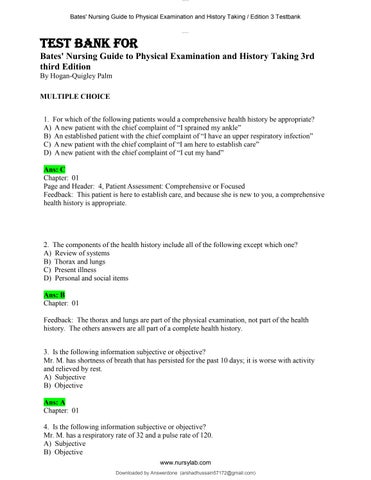
Feedback: This is information about a significant hospitalization and should be placed in the By Hogan-Quigley Palm adult illnesses section. If the patient is being seen for an asthma exacerbation, you may consider MULTIPLE CHOICE 1. For which of the following patients would a comprehensive health history be appropriate? A) A new patient with the chief complaint of ―I sprained my ankle‖ B) An established patient with the chief complaint of ―I have an upper respiratory infection‖ C) A new patient with the chief complaint of ―I am here to establish care‖ D) A new patient with the chief complaint of ―I cut my hand‖ Ans: C Chapter: 01 Page and Header: 4, Patient Assessment: Comprehensive or Focused Feedback: This patient is here to establish care, and because she is new to you, a comprehensive health history is appropriate.
2. The components of the health history include all of the following except which one? A) Review of systems B) Thorax and lungs C) Present illness D) Personal and social items Ans: B Chapter: 01 Feedback: The thorax and lungs are part of the physical examination, not part of the health history. The others answers are all part of a complete health history. 3. Is the following information subjective or objective? Mr. M. has shortness of breath that has persisted for the past 10 days; it is worse with activity and relieved by rest. A) Subjective B) Objective Ans: A Chapter: 01 4. Is the following information subjective or objective? Mr. M. has a respiratory rate of 32 and a pulse rate of 120. A) Subjective B) Objective www.nursylab.com Downloaded by Answerdone (arshadhussain57172@gmail.com)
lOMoAR cPSD| 11700591
Bates' Nursing Guide to Physical Examination and History Taking / Edition 3 Testbank
Ans: B Ans: A Chapter: Chapter: 01 01 Feedback: This isis information a measurement obtained by thehospitalization examiner, so itand is considered Feedback: This about a significant should be objective placed in data. the The is unlikely to give this information to the examiner. adultpatient illnesses section. to If be theable patient is being seen for an asthma exacerbation, you may consider 5. The following information is recorded in the health history: ―The patient has had abdominal pain for 1 week. The pain lasts for 30 minutes at a time; it comes and goes. The severity is 7 to 9 on a scale of 1 to 10. It is accompanied by nausea and vomiting. It is located in the midepigastric area.‖ Which of these categories does it belong to? A) Chief complaint B) Present illness C) Personal and social history D) Review of systems Ans: B Chapter: 01 Feedback: This information describes the problem of abdominal pain, which is the present illness. The interviewer has obtained the location, timing, severity, and associated manifestations of the pain. The interviewer will still need to obtain information concerning the quality of the pain, the setting in which it occurred, and the factors that aggravate and alleviate the pain. You will notice that it does include portions of the pertinent review of systems, but because it relates directly to the complaint, it is included in the history of present illness. 6. The following information is recorded in the health history: ―The patient completed 8th grade. He currently lives with his wife and two children. He works on old cars on the weekend. He works in a glass factory during the week.‖ Ans: C Chapter: 01 Feedback: Personal and social history information includes educational level, family of origin, current household status, personal interests, employment, religious beliefs, military history, and lifestyle (including diet and exercise habits; use of alcohol, tobacco, and/or drugs; and sexual preferences and history). All of this information is documented in this example.
7. The following information is recorded in the health history: ―I feel really tired.‖ Which category does it belong to? A) Chief complaint B) Present illness C) Personal and social history D) Review of systems www.nursylab.com Downloaded by Answerdone (arshadhussain57172@gmail.com)
lOMoAR cPSD| 11700591
Bates' Nursing Guide to Physical Examination and History Taking / Edition 3 Testbank
Ans: A Chapter: Ans: A 01 Chapter: 01 Feedback: The chief complaint is an attempt to quote the patient's own words, as long as they are suitableThis to print. It is brief, about like a aheadline, andhospitalization further details and should be sought in the Feedback: is information significant should be placed in present the illness section. The above information is a chief complaint. adult illnesses section. If the patient is being seen for an asthma exacerbation, you may consider 8. The following information is recorded in the health history: ―Patient denies chest pain, palpitations, orthopnea, and paroxysmal nocturnal dyspnea.‖ Which category does it belong to? A) Chief complaint B) Present illness C) Personal and social history D) Review of systems Ans: D Chapter: 01 Feedback: Review of systems documents the presence or absence of common symptoms related 9. The following information is best placed in which category? ―The patient has had three cesarean sections.‖ A) Adult illnesses B) Surgeries C) Obstetrics/gynecology D) Psychiatric Ans: B Chapter: 01 Feedback: A cesarean section is a surgical procedure. Approximate dates or the age of the patient at the time of the surgery should also be recorded.
10. The following information is best placed in which category? ―The patient had a stent placed in the left anterior descending artery (LAD) in 1999.‖ A) Adult illnesses B) Surgeries C) Obstetrics/gynecology D) Psychiatric Ans: A Chapter: 01 Feedback: The adult illnesses category is reserved for chronic illnesses, significant hospitalizations, significant injuries, and significant procedures. A stent is a major procedure but does not involve a surgeon.
www.nursylab.com Downloaded by Answerdone (arshadhussain57172@gmail.com)
lOMoAR cPSD| 11700591
Bates' Nursing Guide to Physical Examination and History Taking / Edition 3 Testbank
Ans: A 11. The following information is best placed in which category? Chapter: 01 ―The patient was treated for an asthma exacerbation in the hospital last year; the patient has never been intubated.‖ Feedback: This is information about a significant hospitalization and should be placed in the A) Adult illnesses adult illnesses section. If the patient is being seen for an asthma exacerbation, you may consider B) Surgeries C) Obstetrics/gynecology D) Psychiatric placing this information in the present illness section, because it relates to the chief complaint at that visit.
Chapter 2 Critical Thinking in Health Assessment
MULTIPLE CHOICE 1. When performing a physical assessment, the first technique the nurse will always use is: a. Palpation. b. Inspection. c. Percussion. d. Auscultation. ANS: B The skills requisite for the physical examination are inspection, palpation, percussion, and auscultation. The skills are performed one at a time and in this order (with the exception of the abdominal assessment, during which auscultation takes place before palpation and percussion). The assessment of each body system begins with inspection. A focused inspection takes time and yields a surprising amount of information. 2. The nurse is preparing to perform a physical assessment. Which statement is true about the physical assessment? The inspection phase: a. Usually yields little information. b. Takes time and reveals a surprising amount of information. c. May be somewhat uncomfortable for the expert practitioner.
www.nursylab.com Downloaded by Answerdone (arshadhussain57172@gmail.com)
lOMoAR cPSD| 11700591
Bates' Nursing Guide to Physical Examination and History Taking / Edition 3 Testbank
a. Turgor b. Texture c. Density A focused inspection takes time and yields a surprising amount of information. Initially, the examiner may feel uncomfortable, staring at the person without also doing something. A focused assessment is significantly more than a quick glance. 3. The nurse is assessing a patients skin during an office visit. What part of the hand and technique should be used to best assess the patients skin temperature? a. Fingertips; they are more sensitive to small changes in temperature. b. Dorsal surface of the hand; the skin is thinner on this surface than on the palms. c. Ulnar portion of the hand; increased blood supply in this area enhances temperature sensitivity. d. Palmar surface of the hand; this surface is the most sensitive to temperature variations because of its increased nerve supply in this area. ANS: B The dorsa (backs) of the hands and fingers are best for determining temperature because the skin is thinner on the dorsal surfaces than on the palms. Fingertips are best for fine, tactile discrimination. The other responses are not useful for palpation. 4. Which of these techniques uses the sense of touch to assess texture, temperature, moisture, and swelling when the nurse is assessing a patient? a. Palpation b. Inspection c. Percussion d. Auscultation ANS: A
5. The nurse is preparing to assess a patients abdomen by palpation. How should the nurse proceed?