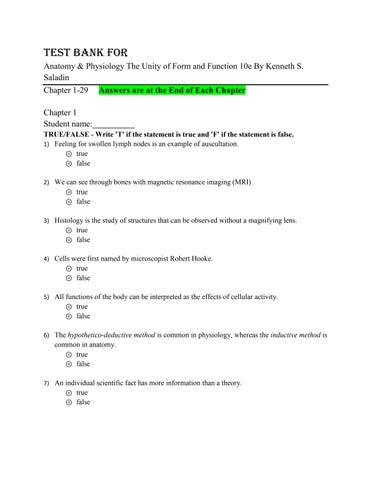
Test Bank for Anatomy & Physiology The Unity of Form and Function 10e By Kenneth S. Saladin Chapter 1-29 Answers are at the End of Each Chapter Chapter 1 Student name:__________ TRUE/FALSE - Write 'T' if the statement is true and 'F' if the statement is false. 1) Feeling for swollen lymph nodes is an example of auscultation. ⊚ true ⊚ false 2) We can see through bones with magnetic resonance imaging (MRI). ⊚ true ⊚ false 3) Histology is the study of structures that can be observed without a magnifying lens. ⊚ true ⊚ false 4) Cells were first named by microscopist Robert Hooke. ⊚ true ⊚ false 5) All functions of the body can be interpreted as the effects of cellular activity. ⊚ true ⊚ false 6) The hypothetico-deductive method is common in physiology, whereas the inductive method is
common in anatomy. ⊚ true ⊚ false 7) An individual scientific fact has more information than a theory. ⊚ true ⊚ false
8) Evolutionary (Darwinian) medicine traces some of our diseases to our evolutionary past. ⊚ true ⊚ false 9) The terms development and evolution have the same meaning in physiology. ⊚ true ⊚ false 10) Organs are made of tissues. ⊚ true ⊚ false 11) A molecule of water is more complex than a mitochondrion (organelle). ⊚ true ⊚ false 12) Homeostasis and occupying space are both unique characteristics of living things. ⊚ true ⊚ false 13) Negative feedback is a self-amplifying chain of events that tends to produce rapid change in
the body. ⊚ true ⊚ false 14) Positive feedback helps to restore normal function when one of the body's physiological
variables gets out of balance. ⊚ true ⊚ false 15) Anatomists around the world adhere to a lexicon of standard international terms which
stipulates both Latin names and accepted English equivalents. ⊚ true ⊚ false 16) Lou Gehrig disease is the eponym for Amyotropic Lateral Sclerosis, made famous by the "ice
bucket challege." ⊚ true ⊚ false
17) Sometimes anatomical terms come from origins that do not lend any insight into their
meaning. ⊚ true ⊚ false MULTIPLE CHOICE - Choose the one alternative that best completes the statement or answers the question. 18) The study of normal body structures is called_________. A) physiology
B) anatomy
C) pathology
D) microscopy
E) biology
19) The study of how the body functions is called_________. A) neuroanatomy B) anatomy C) chemistry D) histology
E) physiology
20) Feeling structures with your fingertips is called_________, whereas tapping on the body and
listening for sounds of abnormalities is called_________. A) palpation; auscultation
B) auscultation; percussion
C) percussion; auscultation
D) palpation; percussion
E) percussion; palpation
21) Which of these is the best imaging technique for routinely examining the anatomical
development of a fetus? A) Auscultation
B) PET scan
C) MRI
D) Sonography
E) Radiography
22) The study of the structure and function of cells is called_________. A) cytology B) gross C) exploratory D) comparative anatomy physiology physiology 23) Ultrastructure refers to the detailed structure to the level of the _________. A) molecule B) cell C) organelle D) tissue
E) radiology
E) organ
24) The study of how hormones function is called_________. A) neuroanatomy B) neurophysiology C) endocrinology D) histology E) pathophysiology 25) The study of mechanism of disease is called_________. A) neuroanatomy B) neurophysiology C) endocrinology D) histology E) pathophysiology 26) The terms physics, physiology, and physician come from a term_________ proposed to
distinguish natural causes from supernatural causes. A) Hippocrates
B) Plato
C) Schwann
D) Aristotle
E) Avicenna
27) Who was a physician to the Roman gladiators, learned by dissection of animals, and saw
science as a method of discovery? A) Hippocrates
B) Plato
C) Schwann
D) Aristotle
E) Galen
28) Known as "the father of modern anatomy,"_________ was the first to publish accurate
drawings of the body. A) Vesalius
B) Maimonides
C) Harvey
D) Aristotle
E) van Leeuwenhoek
29) The most influential medical textbook of the ancient era was written by_________. A) Hippocrates B) Aristotle C) Galen D) Vesalius E) Avicenna 30) Who established a code of ethics for physicians and is considered the "father of medicine"? A) Aristotle B) Hippocrates C) Galen D) Vesalius E) Hooke 31) What is the process of using numerous observations to develop general principles and
predictions about a specific subject called? A) Experimental design
B) The deductive method
C) The inductive method
D) A hypothesis
E) Statistical testing
32) Most people think that ulcers are caused by psychological stress. It was discovered that an
acid-resistant bacterium, Heliobacter pylori, lives in the lining of the stomach. If these bacteria cause ulcers, then treatment with an antibiotic should reduce ulcers. This line of investigation is an example of_________. A) hypothetical reasoning
B) hypotheticodeductive reasoning
C) the inductive D) experimental method design
E) statistical analysis
33) The use of controls and statistical testing are two aspects of experimental design that help to
ensure_________. A) an adequate sample size
B) objective and reliable results
C) experimental D) psychosomatic bias effects
E) treatment groups
34) Which process submits a scientist's ideas to the critical judgment of other specialists in the
field before the research is funded or published? A) Adjudication B) Statistical testing
C) Falsification D) Peer review
E) Hypothetico-deductive testing
35) A new drug apparently increases short-term memory. Students were divided randomly into
two groups at the beginning of the semester. One group was given the memory pill once a day for the semester, and the other group was given a same-looking pill, but it was just sugar. The sugar pill is termed a(n)_________. A) controlled pill
B) placebo
C) treatment pill
D) variable
E) effective dose
36) Two groups of people were tested to determine whether garlic lowers blood cholesterol
levels. One group was given 800 mg of garlic powder daily for four months and exhibited an average 12% reduction in the blood cholesterol. The other group was not given any garlic and after four months averaged a 3% reduction in cholesterol. The group that was not given the garlic was the_________ group. A) peer
B) test
C) treatment
D) control
E) double-blind
37) An educated speculation or a possible answer to a question is called a(n)_________. A) scientific method B) theory C) law D) hypothesis E) fact 38) Which of the following would contain the greatest amount of information that scientists
consider to be true to the best of their knowledge? A) A fact
B) A law of nature
C) A hypothesis
D) An equation
E) A theory
39) If a species of animal evolves over generations to grow a large fan-blade like growth on its
back to catch the wind and cool its body, this would be an example of responding to_________. A) selection pressure
B) adaptation
C) natural selection
D) climate change
E) positive feedback
40) What is a change in the genetic composition of a population over time called? A) Mutation B) Natural selection C) Selection pressure D) Evolution E) Adaptation 41) The constant appearance of new strains of influenza virus is an example of_________. A) a model B) evolution C) selection pressure D) survivorship E) success 42) What is the principal theory of how evolution works? A) Natural B) Selective C) Darwinian pressure pressure pressure 43) Stereoscopic vision provides_________. A) opposable B) color C) depth perception perception perception
D) Natural adaptation
E) Natural selection
D) bipedalism E) opposition of thumbs