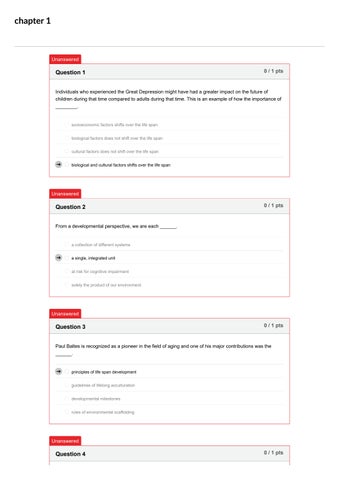
chapter 1
Unanswered
Question 1
0 / 1 pts
Individuals who experienced the Great Depression might have had a greater impact on the future of children during that time compared to adults during that time. This is an example of how the importance of ________.
socioeconomic factors shifts over the life span biological factors does not shift over the life span cultural factors does not shift over the life span
➔
biological and cultural factors shifts over the life span
Unanswered
Question 2
0 / 1 pts
From a developmental perspective, we are each ______.
a collection of different systems
➔
a single, integrated unit at risk for cognitive impairment solely the product of our environment
Unanswered
Question 3
0 / 1 pts
Paul Baltes is recognized as a pioneer in the field of aging and one of his major contributions was the ______. ➔
principles of life span development guidelines of lifelong acculturation developmental milestones rules of environmental scaffolding
Unanswered
Question 4
0 / 1 pts
The study of gerontology began in the ______.
early 1700s mid−1700s 1920s
➔
1940s
Unanswered
Question 5
0 / 1 pts
The most well−known checklist about age stereotypes was created by ______.
Paul Baltes Bernice Neugarten Daniel Levinson
➔
Erdman Palmore
Unanswered
Question 6
0 / 1 pts
Large cultural events that may influence a group of people differently are called ______. ➔
History−normative influences Nonnormative influences Age−normative influences Generational cohorts
Unanswered
Question 7 Influences that are related to a person’s chronological age are called ______.
History−normative influences Non−normative influences
➔
Age−normative influences Generational cohorts
0 / 1 pts
Question 8
0 / 1 pts
Non−normative influences might include ______. ➔
early illness becoming a parent retirement puberty
Unanswered
Question 9
0 / 1 pts
Age−normative influences might include ______.
winning the lottery the 2001 terrorist attacks experiencing a religious conversion
➔
becoming a grandmother around age 47
Unanswered
Question 10
0 / 1 pts
That we are capable of growth and change throughout our lives best describes which principle of life span development?
the allocation of biological resources
➔
development being plastic puberty being influenced by historical period life involving both losses and gains
Unanswered
Question 11
0 / 1 pts
Early in life, much of our biological reserve is used for growth and repair and as we reach midlife, our bodies begin to use more energy for maintenance. This describes which principle of life span development? ➔
Development involves a change in the allocation of biological resources. Development is plastic.
Development is influenced by historical period and culture. Development involves both losses and gains.
Unanswered
Question 12
0 / 1 pts
A group of people who are born in the same historical period and who experience many of the same cultural and historical events in similar ways, but often differently than those who are older or younger is called a(n) ________.
social age age−normative influence
➔
generational cohort history−normative influence
Unanswered
Question 13
0 / 1 pts
Which of the following generations was born between 1981 and 1996?
Gen Z the Silent Generation the Greatest Generation
➔
Millennials
Unanswered
Question 14
0 / 1 pts
Which generation might experience concerns related to Social Security and Immigration more than others? ➔
Gen Z Millennials Gen X Baby Boomers
Question 15
0 / 1 pts
Which of the following factors does not influence the numbers and proportions of older adults in a society?
Births Deaths Immigration/emigration
➔
Employment rate
Unanswered
Question 16
0 / 1 pts
Which cohort is slower to enter the workforce when compared to other generational cohorts? ➔
Gen X Gen Z Millennials Baby Boomers
Unanswered
Question 17
0 / 1 pts
The Gen X cohort has an estimated ______ million births in the United States.
47
➔
55 76 84
Unanswered
Question 18 Baby Boomers are a generational cohort that experienced ______. ➔
Vietnam War the Great Depression worldwide media increased school−related violence
0 / 1 pts