Exam Name___________________________________
SHORT ANSWER. Write the word or phrase that best completes each statement or answers the question. Provide an appropriate response. 1) At what term will the geometric sequence 1, 2, 4, 8, . . . become greater than the arithmetic sequence 0, 20, 40, 60, . . .?
1)
2) What is the sum of three consecutive integers in terms of the middle number x? What would the sum be in terms of the middle number for five and seven consecutive integers? What can you generalize about the sum of n consecutive integers where n is odd?
2)
3) Use the strategy of writing equations to justify that if y = 2x and z = y + 5, then z is greater than x.
3)
4) Which terms, n and m, in the arithmetic sequence 175, 250, 325, . . . and the geometric sequence 1, 10, 100, . . ., respectively, have the same value? What is the value?
4)
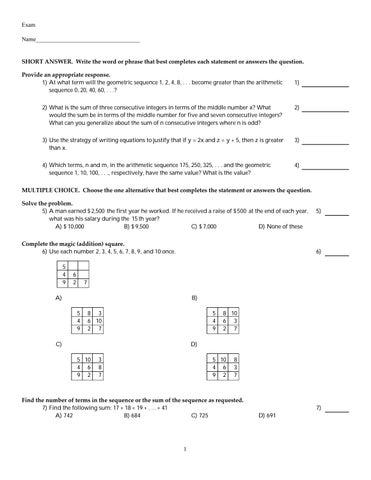
MULTIPLE CHOICE. Choose the one alternative that best completes the statement or answers the question. Solve the problem. 5) A man earned $ 2,500 the first year he worked. If he received a raise of $ 500 at the end of each year, what was his salary during the 15 th year? A) $ 10,000 B) $ 9,500 C) $ 7,000 D) None of these Complete the magic (addition) square. 6) Use each number 2, 3, 4, 5, 6, 7, 8, 9, and 10 once. 5 4 9
6 2
5)
6)
7
A)
B) 5 4 9
8 3 6 10 2 7
5 4 9
C)
8 10 6 3 2 7
D) 5 10 4 6 9 2
3 8 7
5 10 4 6 9 2
8 3 7
Find the number of terms in the sequence or the sum of the sequence as requested. 7) Find the following sum: 17 + 18 + 19 + . . . + 41 A) 742 B) 684 C) 725
1
D) 691
7)
Indicate whether the sequence is arithmetic, geometric, or neither. Give the next two terms in the sequence. 8) 3, 9, 90, 900, 9,000, . . . A) Neither; 90,000; 900,000 B) Arithmetic; 90,000; 900,000 C) Geometric; 90,000; 900,000
8)
Solve the problem. 9) How many different ways can you make change for 75 cents using quarters, dimes, and nickels? A) 18 B) 16 C) 15 D) 17
9)
Indicate whether the sequence is arithmetic, geometric, or neither. Give the next two terms in the sequence. 10) 3, 6, 9, 15, 24, . . . A) Geometric; 39; 63 B) Neither; 39; 63 C) Arithmetic; 39; 63
10)
Find the number of terms in the sequence or the sum of the sequence as requested. 11) Find the sum of the following arithmetic sequence. 1 + 2 + 3 + . . . + 700 A) 122,500 B) 245,350 C) 245,000
11) D) 491,401
Provide an appropriate response. 12) Look for a pattern in the sequence of figures shown below, and use your reasoning to draw the next figure.
A)
B)
C)
Solve the problem. 13) Which is greater, E or P, and by how much? E = 1 + 3 + 5 + 7 + . . . + 95 P = 2 + 4 + 6 + 8 + . . . + 96 A) E is greater by 47 C) P is greater by 49
12)
D)
13)
B) P is greater by 48 D) E is greater by 48
14) How many different ways can you make change for a 50-cent coin using nickels and dimes? A) 4 B) 7 C) 6 D) 5
2
14)
Complete the magic (addition) square. 15) Use each number 16, 17, 18, 19, 20, 21, 22, 23, and 24 once. 19
15)
17 20 22 16
A)
B) 19 23 17 18 20 22 21 16 24
19 24 17 18 20 22 23 16 21
C)
D) 19 24 17 18 20 22 21 16 23
19 21 17 18 20 22 23 16 24
Provide an appropriate response. 16) The first difference of a sequence is 2, 4, 6, 8, 10, . . . Find the first six terms of the original sequence if the third term of the original sequence is 54. A) 48, 50, 54, 60, 68, 78 B) 52, 50, 54, 60, 62, 64 C) 54, 56, 58, 60, 62, 64 D) 48, 50, 54, 60, 62, 64 Indicate whether the sequence is arithmetic, geometric, or neither. Give the next two terms in the sequence. 17) 5, 10, 20, 40, 80, . . . A) Geometric; 160; 320 B) Neither; 86; 90 C) Arithmetic; 83; 89 Find the number of terms in the sequence or the sum of the sequence as requested. 18) Find the number of terms in the following arithmetic sequence. 8, 11, 14, 17, . . ., 74 A) 69 B) 23 C) 25 19) Find the number of terms in the following arithmetic sequence. 1, 3, 5, 7, . . ., 49 A) 49 B) 25 C) 27
D) 66 19) D) 24
Solve the problem. 21) A drink and a sandwich together cost $4.75. The sandwich costs $1.75 more than the drink. How much does the sandwich cost? A) $3.25 B) $0.25 C) $5.00 D) $1.50
3
17)
18)
Indicate whether the sequence is arithmetic, geometric, or neither. Give the next two terms in the sequence. 20) 4, 11, 15, 19, 23, . . . A) Neither; 27; 31 B) Arithmetic; 24; 28 C) Geometric; 35; 31
Find the number of terms in the sequence or the sum of the sequence as requested. 22) How many terms are there in the sequence 4, 12, 36, 108, 324, . . ., 2,125,764? A) 13 B) 11 C) 14
16)
D) 12
20)
21)
22)
Complete the magic (addition) square. 23) Use each number 26, 27, 28, 29, 30, 31, 32, 33, and 34 once.
23)
33 29 26 30 32 27
A)
B) 33 31 29 26 30 28 34 32 27
33 28 29 26 30 34 31 32 27
C)
D) 33 28 29 26 30 31 34 32 27
33 34 29 26 30 28 31 32 27
Determine how many of the indicated shape there are in the figure. 24) Cubes (of any size)
A) 15
B) 10
C) 14
Find the requested term in the sequence. 25) The nth term in 20, 40, 60, 80, 100, . . . A) 20n + 2 B) 20n + 20
C) 20n - 20
4
24)
D) 9
D) 20n
25)
Complete the magic (addition) square. 26) Use each number 28, 29, 30, 31, 32, 33, 34, 35, and 36 once.
29 31 30
26)
33 28
A)
B) 29 35 33 36 32 28 31 30 34
29 35 33 36 34 28 31 30 32
C)
D) 29 34 33 36 32 28 31 30 35
29 34 33 35 32 28 31 30 36
Provide an appropriate response. 27) Look for a pattern in the sequence of figures shown below, and use your reasoning to draw the next figure.
A)
B)
C)
D)
Find the number of terms in the sequence or the sum of the sequence as requested. 28) Find the following sum: 3 + 9 + 15 + . . . + 87 A) 669 B) 681 C) 675
D) 678
Solve the problem. 29) A rose garden has 11 bushes in one row, 9 bushes in the next row, then 7 , and so on. If there are 36 bushes in the garden, in how many rows are they planted? A) 2 B) 7 C) 5 D) 6
5
27)
28)
29)