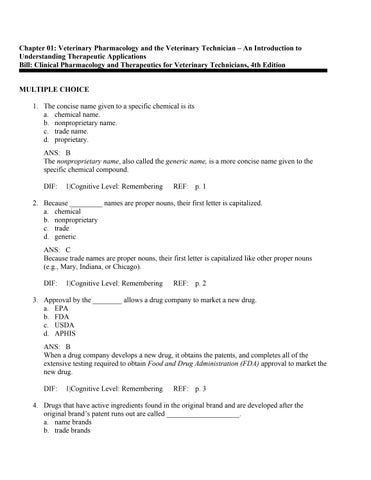
Chapter 01: Veterinary Pharmacology and the Veterinary Technician – An Introduction to Understanding Therapeutic Applications Bill: Clinical Pharmacology and Therapeutics for Veterinary Technicians, 4th Edition MULTIPLE CHOICE 1. The concise name given to a specific chemical is its a. chemical name. b. nonproprietary name. c. trade name. d. proprietary. ANS: B The nonproprietary name, also called the generic name, is a more concise name given to the specific chemical compound. DIF:
1|Cognitive Level: Remembering
REF: p. 1
2. Because _________ names are proper nouns, their first letter is capitalized. a. chemical b. nonproprietary c. trade d. generic ANS: C Because trade names are proper nouns, their first letter is capitalized like other proper nouns (e.g., Mary, Indiana, or Chicago). DIF:
1|Cognitive Level: Remembering
REF: p. 2
3. Approval by the ________ allows a drug company to market a new drug. a. EPA b. FDA c. USDA d. APHIS ANS: B When a drug company develops a new drug, it obtains the patents, and completes all of the extensive testing required to obtain Food and Drug Administration (FDA) approval to market the new drug. DIF:
1|Cognitive Level: Remembering
REF: p. 3
4. Drugs that have active ingredients found in the original brand and are developed after the original brand’s patent runs out are called ____________________. a. name brands b. trade brands
c. trademarked d. generic equivalents ANS: D Drugs produced or marketed by companies other than the original “brand” developer are called generic equivalent drugs because they have active ingredients equivalent to those of the original compound, but are not produced by the original manufacturer. DIF:
1|Cognitive Level: Remembering
REF: p. 4
5. VCPR means ___________________. a. the veterinarian has examined the patient b. the veterinarian has adequate medical knowledge of the patient c. the veterinarian can write a prescription for the patient d. B and C are true e. A, B, and C are true ANS: E A valid veterinarian–client–patient relationship (VCPR) means that the veterinarian has examined or has adequate medical knowledge of the patient and has agreed to assume responsibility for veterinary care of the patient. DIF:
1|Cognitive Level: Remembering
REF: p. 5
6. Tablets are often coated after being compressed, but this does not ________________. a. protect them from breaking apart during shipping and handling b. cover up any unpleasant taste c. make them harder to swallow d. protect them from light ANS: C Tablets are often coated after being compressed. Although sugar coating was commonly used in the past, today’s coatings are made from more sophisticated polymers and complex sugar molecules. The coatings are used to protect the tablet from breaking apart during shipping or storage, to cover up an unpleasant taste of the active ingredient, to provide a smoother finish for easier swallowing, to protect the underlying tablet from disintegration from absorption of moisture, or even to protect light-sensitive drugs from degradation caused by light. DIF:
1|Cognitive Level: Remembering
REF: p. 6
7. What is the meaning of SR when it is used in a drug name? a. Sustained release b. Stronger reaction c. The table is coated with sugar d. Sensible response ANS: A Drugs with controlled-release coatings are also referred to as sustained-release (SR) drugs.
DIF:
1|Cognitive Level: Remembering
REF: p. 7
8. ______________ are topically applied liquid dosage forms that always are administered by rubbing them into the skin. a. Ointments b. Liniments c. Emulsions d. Elixirs ANS: B Liniments are topically applied liquid dosage forms that may be an emulsion, a solution, or a suspension. The characteristic of a liniment is that it is always applied by rubbing it into the skin; by contrast, emulsions and elixirs can be administered either topically or orally, depending on the medication. Ointments are not liquid dosage forms; they are semisolid dosage forms. DIF:
1|Cognitive Level: Remembering
REF: p. 8
9. Extra-label drug use of veterinary drugs is permissible and means a drug can be used for all except which of the following: a. In a dose other than that specified on the label. b. By a route of administration other than that specified on the label. c. For a disease other than that specified on the label. d. With a pre-slaughter withdrawal time consistent with that specified on the label. ANS: D Extra-label drug use in food animals requires a longer pre-slaughter withdrawal time than that specified on the label. DIF:
1|Cognitive Level: Remembering
REF: p. 9
10. To determine whether a website is a credible source, look for all of the following except: a. a listing of the author’s name and credentials. b. Cited references. c. Websites that are .gov or .edu. d. advertisements for products not relative to the website. ANS: D Here are some “clues” that a website is likely to be authoritative and a fairly reliable resource: · The website has the author’s name listed, the author’s credentials, and ideally the means by which questions can be directed to the author or other credible authority. · The website has a recent “website was last updated” date. · The website cites references or has links for further information. · The website has a .gov or .edu extension and is a website of a recognizable government or college/university entity. Warning signs of a questionable website: · Misspellings or poor grammar
· · · · DIF:
Cheap looking (no professional logo, fuzzy photographs, poorly organized, nonstandard fonts, broken links to other web pages, or poor navigation between pages or back to home page) Website sponsored by an organization with a mission statement that advances a singular point of view that might be predisposed to bias when presenting information The use of many hyperboles (“great,” “wonderful,” “fantastic,” “world’s best”) Advertisements for products not directly related to the website 2|Cognitive Level: Interpretation
REF: p. 10
11. The Roman numeral on a controlled drug label indicates its level of abuse potential. Which label has the highest potential for abuse? a. C-I b. C-II c. C-III d. C-IV ANS: A The higher the value of the Roman numeral, the lesser the abuse potential of the drug. DIF:
1|Cognitive Level: Remembering
REF: p. 11
12. Inert ingredients include all but ________________. a. preservatives b. stabilizers c. additives d. active ingredient ANS: D The active ingredient, which is the part of the drug that produces the intended beneficial effect, is identified by the generic name of the drug. Inert ingredients include preservatives, stabilizers, liquid media, or other additives. DIF:
1|Cognitive Level: Remembering
REF: p. 12
13. The strongest warning the FDA can require is a a. black label warning. b. warning. c. precaution. d. black warning. ANS: A A “black box warning,” “black label warning,” or “boxed warning” is the strongest warning the FDA can require from a drug manufacturer. DIF:
1|Cognitive Level: Remembering
REF: p. 13
14. Drugs are produced in many ways, ranging from the harvest of tissues from living animals to growth in a laboratory as part of a chemistry synthesis process. Which of the following would be considered an extract drug? a. Insulin harvested from transgenic strains of bacteria b. Insulin harvested from a pig pancreas c. Penicillin derived from a fungal culture d. Synthetic prostaglandin used for estrus synchronization ANS: B Many medications were derived initially through the harvest of plant or animal tissues and the purification of the factor that is deficient in the host species. This “extraction” technique has been largely replaced by laboratory methods to produce a consistent and safe product. DIF:
2|Cognitive Level: Interpretation
REF: p. 14
15. What is another name for a Legend Drug? a. Generic Drug b. OTC Drug c. Supplement d. Old Drug e. Prescription Drug ANS: E The terms legend and prescription are analogous and depict a medication that requires express permission from a veterinarian (or physician in cases of human medicine) for its dispensation and utilization. Often legend drugs have the possibility of adverse side effects in excess of those expected from over-the-counter medications. DIF:
1|Cognitive Level: Remembering
REF: p. 15
16. Enteric-coated tablets are used for administering medications that are either sensitive to exposure to gastric fluids and their acidic pH, or for medications that cause stomach upset and indigestion. A client requires purchase of an oral NSAID medication for her 13-year-old dog experiencing arthritis. The dose her dog requires is one 10 mg enteric-coated tablet PO q48h prn. Due to her dog’s old age and history of gastric discomfort, the client decides to only give morning and night instead of all together. Is this a good strategy? a. Yes, this would work fine in this situation b. Yes, but only if you increase the frequency to q24h c. No, this NSAID is not meant to be split d. No, the NSAID will accumulate to toxic levels if the tablets are given BID e. There’s not enough information to make a decision
tablet both
ANS: C Enteric-coated tablets are meant to dissolve after they transmit through the stomach and reach the intestines. The enteric-coating is applied to the outside of the tablet. If the tablet is split the internal surfaces of the tablet are exposed and therefore the enteric coating is worthless. Enteric and sustained-release tablets should not be divided.