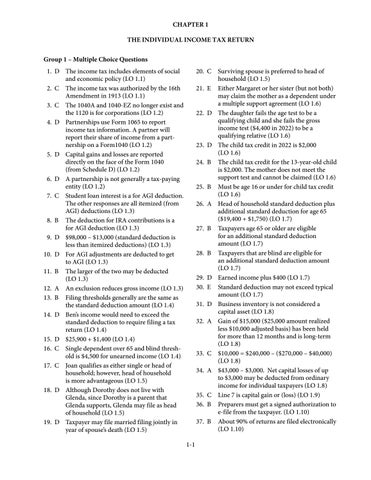
CHAPTER 1 THE INDIVIDUAL INCOME TAX RETURN Group 1 – Multiple Choice Questions 1. D The income tax includes elements of social and economic policy (LO 1.1) 2. C The income tax was authorized by the 16th Amendment in 1913 (LO 1.1) 3. C The 1040A and 1040-EZ no longer exist and the 1120 is for corporations (LO 1.2) 4. D Partnerships use Form 1065 to report income tax information. A partner will report their share of income from a partnership on a Form1040 (LO 1.2) 5. D Capital gains and losses are reported directly on the face of the Form 1040 (from Schedule D) (LO 1.2) 6. D A partnership is not generally a tax-paying entity (LO 1.2) 7. C Student loan interest is a for AGI deduction. The other responses are all itemized (from AGI) deductions (LO 1.3) 8. B The deduction for IRA contributions is a for AGI deduction (LO 1.3) 9. D $98,000 – $13,000 (standard deduction is less than itemized deductions) (LO 1.3) 10. D For AGI adjustments are deducted to get to AGI (LO 1.3) 11. B The larger of the two may be deducted (LO 1.3) 12. A An exclusion reduces gross income (LO 1.3) 13. B Filing thresholds generally are the same as the standard deduction amount (LO 1.4) 14. D Ben’s income would need to exceed the standard deduction to require filing a tax return (LO 1.4) 15. D $25,900 + $1,400 (LO 1.4) 16. C Single dependent over 65 and blind threshold is $4,500 for unearned income (LO 1.4) 17. C Joan qualifies as either single or head of household; however, head of household is more advantageous (LO 1.5) 18. D Although Dorothy does not live with Glenda, since Dorothy is a parent that Glenda supports, Glenda may file as head of household (LO 1.5) 19. D Taxpayer may file married filing jointly in year of spouse’s death (LO 1.5)
20. C Surviving spouse is preferred to head of household (LO 1.5) 21. E Either Margaret or her sister (but not both) may claim the mother as a dependent under a multiple support agreement (LO 1.6) 22. D The daughter fails the age test to be a qualifying child and she fails the gross income test ($4,400 in 2022) to be a qualifying relative (LO 1.6) 23. D The child tax credit in 2022 is $2,000 (LO 1.6) 24. B The child tax credit for the 13-year-old child is $2,000. The mother does not meet the support test and cannot be claimed (LO 1.6) 25. B Must be age 16 or under for child tax credit (LO 1.6) 26. A Head of household standard deduction plus additional standard deduction for age 65 ($19,400 + $1,750) (LO 1.7) 27. B Taxpayers age 65 or older are eligible for an additional standard deduction amount (LO 1.7) 28. B Taxpayers that are blind are eligible for an additional standard deduction amount (LO 1.7) 29. D Earned income plus $400 (LO 1.7) 30. E Standard deduction may not exceed typical amount (LO 1.7) 31. D Business inventory is not considered a capital asset (LO 1.8) 32. A Gain of $15,000 ($25,000 amount realized less $10,000 adjusted basis) has been held for more than 12 months and is long-term (LO 1.8) 33. C $10,000 = $240,000 – ($270,000 – $40,000) (LO 1.8) 34. A $43,000 – $3,000. Net capital losses of up to $3,000 may be deducted from ordinary income for individual taxpayers (LO 1.8) 35. C Line 7 is capital gain or (loss) (LO 1.9) 36. B Preparers must get a signed authorization to e-file from the taxpayer. (LO 1.10) 37. B About 90% of returns are filed electronically (LO 1.10) 1-1
1-2
Chapter 1 – The Individual Income Tax Return
Group 2 – Problems 1. a. Raising revenue to operate the government. b. Furthering economic goals such as reducing unemployment. c. Furthering social goals such as encouraging contributions to charities. (LO 1.1) 2. a. b. c. d. e. f. g. h. i.
Form 1040 Schedule B Schedule D Schedule A Schedule 2 Schedule E Schedule 3 Schedule C Schedule 1 (LO 1.2)
3. a. $36,300 = $42,000 + $300 – $6,000. b. $25,900, the greater of itemized deductions or the standard deduction of $25,900. c. $10,400 = $36,300 – $25,900. (LO 1.3) 4. a. $25,000. b. $12,950, the greater of total itemized deductions or the standard deduction amount. c. $12,050 = $25,000 – $12,950. (LO 1.3) 5. a. $53,800 = $54,000 + $2,800 – $3,000 ($7,000 capital loss limited to $3,000). b. $12,950 c. $40,850 = $53,800 – $12,950. (LO 1.3 and 1.8) 6. a. b. c. d.
$47,500 = $48,000 + $2,500 – $3,000. $25,900, the greater of itemized deductions or the standard deduction of $25,900. $21,600 = $47,500 – $25,900. $2,184 (Tax Table) (LO 1.3, 1.5, and 1.7)
7. Adjusted gross income $18,000 Less: Itemized deductions –2,400 Taxable income $15,600 Marco’s tax liability from the Tax Table is $1,670. Note: because they are married and filing separately and Marco’s spouse Tatiana itemizes her deductions, Marco must also itemize his deductions, even though the itemized deductions total is less than the standard deduction he would be otherwise entitled to. (LO 1.3, 1.5, and 1.7) 8. Adjusted gross income ($13,200 + $1,450) $ 14,650 Less: Standard deduction –12,950 Taxable income $ 1,700 (LO 1.3, 1.5, and 1.7) (Note: See Chapter 6 for the tax credit computation for dependent college students under age 24.) 9. a. $34,050 = $47,000 – $12,950. b. Tax tables. Taxpayers with income up to $100,000 must use the tax tables. c. $3,884. (LO 1.3, 1.5, and 1.7) 10. a. b. c. d. e.
$66,000 = $50,000 + $8,000 + $5,000 + $3,000. $63,500 = $66,000 – $2,500. $27,000, the greater of itemized deductions or the standard deduction of $25,900. $36,500 = $63,500 – $27,000. $3,972 (LO 1.3, 1.5, and 1.7)
Solutions for Questions and Problems – Chapter 1
1-3
11. a. $89,400 = $85,400 + $4,000. b. $0. c. $63,500 = $89,400 – $25,900 (standard deduction). (LO 1.3, 1.5, 1.6, and 1.7) 12. Taxable income is: $28,050 = $41,000 – $12,950. Tax liability from the tax tables not the tax rate schedules: $3,164. (LO 1.3, 1.5, and 1.7) 13. Yes.
Since Griffin owes Social Security taxes on the unreported tips (greater than $400), he must file an income tax return. (LO 1.4)
14. a. No. b. Yes. c. No. d. Yes. e. Yes. 15. a. b. c. d. e.
Income is less than the $19,400 standard deduction. Although not required to file, Helen is likely to be eligible for refundable credits and should. Unearned income was more than $1,150. Also, gross income is more than the larger of $1,150 or $1,950 (earned income of $1,550 plus $400). Their income is under the $27,300 standard deduction [$25,900 + $1,400 (over 65 years old)]. Gross income is greater than $25,900, the 2022 standard deduction. His earnings exceeded the $400 limit for self-employed persons. (Note: All answers can be found in the figures in LO 1.4.)
Allen Boyd Caldwell Dell Evans
$2,396. $34,600 – $12,950 = $21,650 $2,702. $37,175 – $12,950 = $24,225 $4,008. $62,710 – $25,900 = $36,810 $3,322. $49,513 – $19,400 = $30,113 $5,391. $57,397 – $12,950 = $44,447 (LO 1.5)
16. a. D b. A
The mother is a qualifying person for head of household. The significant other is not a qualifying person as this individual is not one of the relatives that can be considered a qualifying person for head of household. c. A The brother does not qualify as a dependent (support test). d. B or C MFJ can be claimed in the year of the spouse’s death and is probably preferable. e. A, D or E. Surviving spouse is likely to be preferable but single or head of household are also possible. (LO 1.5 and 1.6)
17. a. Because their income exceeds $100,000, the tax rate schedules must be used. b. $14,554 = $9,615 + 22% x ($106,000 – $83,550). (LO 1.5) 18. Jonas could qualify as either a qualifying child or qualifying relative. The qualifying child tests should be applied first: 1. Relationship test: Confirm Jonas’ relationship to Karl. 2. Domicile test: Where did Jonas live during the tax year? Was it more than one-half of the year with Karl? 3. Age test: What is Jonas’ age and is he a full-time student? 4. Joint return test: What type of tax return does Jonas file (if any)? If MFJ, is this only to obtain a refund? 5. Citizenship test: Is Jonas a US citizen or a tax resident of the US, Canada, or Mexico? 6. Support test: How much of Jonas’ support is provided by Jonas? Is it more than one-half? If Jonas is a qualifying child, then he need not meet the citizenship test to be a qualifying person for head of household filing status. If Jonas is not a qualifying child, he might be a qualifying relative which would prompt the following questions: 1. Relationship or member of household test: If Jonas is Karl’s brother, this test has been confirmed in the qualifying child questions. If Jonas is not one of the qualifying relatives, the remaining tests need not apply since a person that is a qualifying relative by living in the taxpayer’s household is not a qualifying person for purpose of the head of household test.
1-4
Chapter 1 – The Individual Income Tax Return
The following test need only be applied if Jonas is not Karl’s brother but is a qualifying relative for reasons other than living in Karl’s home. 2. Gross income test: What is Jonas’ 2022 income? Is it less than $4,400? 3. Support test: Does Karl provide more than one-half of Jonas’ support? The other two tests (joint return and citizenship) were subject to inquiry under qualifying child. Karl should also be asked if he is unmarried at year end. (LO 1.5 and 1.6) 19. Head of household. Maggie’s parents meet the tests to qualify as her dependents. Maggie is single. Additionally, she provides a home for her parents. Parents are an exception to the requirement that dependents must live in the same household as the taxpayer to qualify the taxpayer for head of household status. (LO 1.5 and 1.6) 20. Single. Unmarried with no dependent. Head of household. Single or abandoned spouse, with qualifying dependent. Surviving spouse [qualified widow(er)]. Spouse died within the past 2 years and has a qualifying dependent. (LO 1.5) 21. a. Yes, his son qualifies as a dependent, meeting the tests of a qualifying relative. b. No. To be a qualifying person, his son must live in the same household as Marquez, so Marquez cannot use the head of household filing status. (LO 1.5 and 1.6) 22. a. Yes b. No (must be below $4,400 gross income test) c. Yes d. Yes e. No
$500 other dependent credit $0 $2,000 child tax credit $500 other dependent credit $0 (LO 1.6)
23. $0. Exemptions were suspended for tax years 2018–2025. $2,500. The 11-year-old child qualifies for the $2,000 child tax credit (under age 17). The 17-year-old qualifies for the other dependent credit of $500. (LO 1.6) 24. No. Because Charles is self-supporting, his parents may not claim him as a dependent. The self-support test is applied to both children and relatives who otherwise qualify, so Charles is disqualified either way. (LO 1.6) 25. No. Phillip cannot be claimed as a dependent because he is not a U.S. citizen or a resident of the U.S., Canada, or Mexico. (LO 1.6) 26. The standard deduction is a specific dollar amount that varies with filing status, age and vision, but not by type of individual deduction. Total itemized deductions depend on the amount and type of items, with some items having limitations based on AGI. They include medical expenses, certain taxes, certain interest expenses, charitable contributions and miscellaneous deductions. A taxpayer should claim the larger of the standard deduction or the total allowed itemized deductions to reduce the taxpayer’s income subject to tax as much as possible. (LO 1.7) 27. i. The “statutory” amount of $1,150. ii. The earned income of the dependent plus $400 iii. The “typical” standard deduction for a taxpayer of that filing status (e.g., $12,950 for a single taxpayer that is under age 65 and not blind) (LO 1.7) 28. A spouse in a married filing separate situation when the other spouse is itemizing; most nonresident aliens; an individual filing a short-year return. (LO 1.7)
Solutions for Questions and Problems – Chapter 1
29. a. b. c.
Gain/(loss) Realized $5,000 ($5,000) ($7,000)
Gain/(loss) Recognized $5,000 ($3,000) ($3,000)
d.
($4,000)
$0
e.
$4,000
$4,000
1-5
Long-term/ Short-term Long-term. Short-term. The excess $2,000 loss can be carried forward. Long-term. The net capital loss deduction is $3,000 regardless of filing status. The excess $4,000 loss can be carried forward. Short-term. Losses on the sale of personal use property are not deductible. Long-term. Gains on the sale of personal use property are taxable.
(LO 1.8) 30. The answer will vary depending on the date the problem is assigned and completed. The purpose of the problem is to familiarize the student with the IRS website. (LO 1.9) 31. Form 8949 is Sales and Other Dispositions of Capital Assets. (LO 1.9) 32. A number of articles in the blog indicate the limit for student loan interest deduction is $2,500. (LO 1.9) 33. Tax returns are electronically signed through the use of a PIN. PINs can be generated by either the taxpayer or by the ERO. Self-selected PINs require the prior year AGI or PIN to authenticate the taxpayer. Before a PIN can be created by the ERO, the preparer must obtain a signed copy of an IRS E-file signature authorization (Form 8878 or 8879). (LO 1.10) 34. Form 8453, copies of Forms W-2, W-2G, and 1099-R, a copy of the consent to disclose tax information form, a copy of the electronic return that could be retransmitted, an acknowledgment file for IRS accepted returns, Forms 8878 and 8879. (LO 1.10)
Group 3 – Writing Assignments 1. Research Solution: Whittenburg and Gill, CPAs San Diego, CA February 20, 20xx Mr. and Mrs. William Carson 3276 Lakeline Drive San Diego, CA Dear William and Sheila, Thank you for requesting my advice concerning the tax treatment of your brother Jerry. I have researched your question and am sorry to say that you cannot claim Jerry as a qualifying child. Although Jerry meets the domicile, age, joint return, citizenship, and self-support test, he does not meet the relationship test. Even though he is William’s brother, in order to be your qualifying child, he must be younger than at least one of you. Although you cannot claim Jerry as a qualifying child, there is a possibility that you could claim him as a qualifying relative if he earns less than $4,400.