Chapter 2
Special Theory of Relativity
1
Chapter 2 d 2 x ˆ d 2 y ˆ d 2 z ˆ 1. For a particle Newton’s second law says F = ma = m 2 i + 2 j + 2 k . dt dt dt Take the second derivative of each of the expressions in Equation (2.1): d 2 x d 2 x d 2 y d 2 y d 2 z d 2 z = 2 = 2 = 2 . Substitution into the previous equation gives dt 2 dt dt 2 dt dt 2 dt d 2 x d 2 y d 2 z F = ma = m 2 iˆ + 2 ˆj + 2 kˆ = F . dt dt dt dx dy ˆ dz ˆ j + k . 2. From Equation (2.1) p = m iˆ + dt dt dt dx dx dy dy dz dz In a Galilean transformation = −v = = . dt dt dt dt dt dt dx ˆ dy ˆ dz ˆ + v i + j + k p . Substitution into Equation (2.1) gives p = m dt dt dt
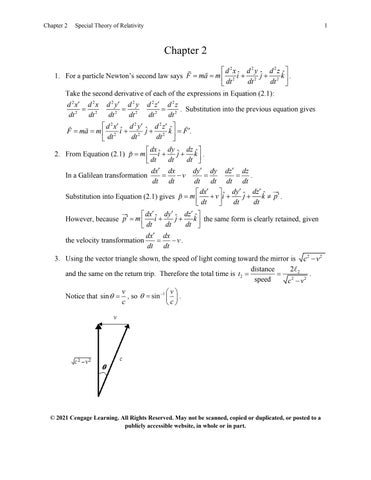
dx dy ˆ dz ˆ j + k the same form is clearly retained, given However, because p = m iˆ + dt dt dt dx dx the velocity transformation = −v. dt dt 3. Using the vector triangle shown, the speed of light coming toward the mirror is c2 − v2 2 2 distance = and the same on the return trip. Therefore the total time is t2 = . speed c2 − v2 Notice that sin =
v v , so = sin −1 . c c
© 2021 Cengage Learning. All Rights Reserved. May not be scanned, copied or duplicated, or posted to a publicly accessible website, in whole or in part.
2
Chapter 2
Special Theory of Relativity
0.350 m/s 4. As in Problem 3, sin = v1 / v2 , so = sin −1 (v1 / v2 ) = sin −1 = 16.3 and 1.25 m/s v = v22 − v12 = (1.25 m/s)2 − (0.35 m/s)2 = 1.20 m/s . 5. When the apparatus is rotated by 90°, the situation is equivalent, except that we have effectively interchanged 1 and 2 . Interchanging 1 and 2 in Equation (2.3) leads to Equation (2.4). 6. Let n = the number of fringes shifted; then n =
n=
c ( t − t )
v=c 7. Letting
. Because d = c ( t − t ) , we have
v2 ( 1 + 2 ) . Solving for v and noting that = c2
( 0.005) (589 10−9 m )
n = ( 3.00 108 m/s ) 1+ 2 1
d
22 m
1
+
2
= 22 m,
= 3.47 km/s.
→ 1 1 − 2 (where = v / c ) the text equation (not currently numbered) for
t1 becomes
t1 =
2 1 1− 2 2 1 = c (1 − ) c 1− 2
which is identical to t2 when
1
=
2
so t = 0 as required.
8. Since the Lorentz transformations depend on c (and the fact that c is the same constant for all inertial frames), different values of c would necessarily lead two observers to different conclusions about the order or positions of two spacetime events, in violation of postulate 1. 9. Let an observer in K send a light signal along the + x-axis with speed c. According to the Galilean transformations, an observer in K measures the speed of the signal to be dx dx = − v = c − v . Therefore the speed of light cannot be constant under the Galilean dt dt transformations. 10. From the Principle of Relativity, we know the correct transformation must be of the form (assuming y = y and z = z ): x = ax + bt ; x = ax − bt . The spherical wave front equations (2.9a) and (2.9b) give us: ct = (ac + b)t ; ct = (ac − b)t . Solve the second wave front equation for t and substitute into the first: © 2021 Cengage Learning. All Rights Reserved. May not be scanned, copied or duplicated, or posted to a publicly accessible website, in whole or in part.
Chapter 2
Special Theory of Relativity
(ac + b)(ac − b)t ct = or c 2 = (ac + b)(ac − b) = a 2c 2 − b 2 . c Now v is the speed of the origin of the x -axis. We can find that speed by setting x = 0 which gives 0 = ax − bt , or v = x / t = b / a , or equivalently b = av. Substituting this into
the equation above for c 2 yields c2 = a 2c2 − a 2v 2 = a 2 ( c 2 − v 2 ) . Solving for a: 1
= . / c2 This expression, along with b = av, can be substituted into the original expressions for x and x to obtain: x = ( x + vt ) ; x = ( x − vt ) a=
1− v
2
which in turn can be solved for t and t to complete the transformation. 11. When v c we find 1 − 2 → 1 , so: x = t =
x= t=
x − ct
→ x − ct = x − vt ;
1− 2
t −x/c
→t −x/c t ;
1− 2
x + ct 1− 2
→ x + ct = x + vt ;
t + x / c 1− 2
→ t + x / c t .
12. (a) First we convert to SI units: 95 km/h = 26.39 m/s, so
= v / c = (26.39 m/s) / (3.00 108 m/s ) = 8.8 10−8
(b) = v / c = (240 m/s) / ( 3.00 108 m/s ) = 8.0 10−7 (c) v = 2.3 vsound = ( 2.3 330 m/s ) so
= v / c = ( 2.3 330 m/s ) / ( 3.00 108 m/s ) = 2.5 10−6 (d) Converting to SI units, 27,000 km/h = 7500 m/s, so
= v / c = (7500 m/s) / ( 3.00 108 m/s ) = 2.5 10−5
(e) (25 cm)/(2 ns) = 1.25 108 m/s so = v / c = (1.25 108 m/s) / ( 3.00 108 m/s ) = 0.42 (f) (110−14 m ) / ( 0.35 10−22 s ) = 2.857 108 m/s , so
= v / c = (2.857 108 m/s) / ( 3.00 108 m/s ) = 0.95 © 2021 Cengage Learning. All Rights Reserved. May not be scanned, copied or duplicated, or posted to a publicly accessible website, in whole or in part.
3
4
Chapter 2
Special Theory of Relativity
13. From the Lorentz transformations t = t − vx / c 2 . But t = 0 in this case, so solving for v we find v = c 2 t / x . Inserting the values t = t2 − t1 = −a / 2c and c 2 ( − a / 2c ) = −c / 2 . We conclude that the frame K travels a at a speed c/2 in the − x -direction. Note that there is no motion in the transverse direction. 14. Try setting x = 0 = ( x − vt ) . Thus 0 = x − vt = a + va / 2c . Solving for v we find x = x2 − x1 = a , we find v =
v = −2c , which is impossible. There is no such frame K . 15. For the smaller values of β we use the binomial expansion = (1 − 2 )
−1/2
1+ 2 / 2 .
(a) 1 + 2 / 2 = 1 + 3.87 10−15 (b) 1 + 2 / 2 = 1 + 3.2 10−13 (c) 1 + 2 / 2 = 1 + 3.110−12 (d) 1 + 2 / 2 = 1 + 3.110−10 (e) = (1 − 2 )
−1/2
(f) = (1 − 2 )
−1/2
= (1 − 0.422 )
−1/2
= (1 − 0.952 )
−1/2
= 1.10 = 3.20
16. There is no motion in the transverse direction, so y = z = 3.5 m.
=
1 1− 2
=
1 1 − 0.82
x = ( x + vt ) =
= 5/3
5 ( 2m + 0.8c ( 0) ) = 10 / 3 m 3
t = ( t + vx / c 2 ) =
5 0 + ( 0.8c )( 2 m ) / c 2 ) = 8.9 10−9 s ( 3
( 3 m ) + (5 m) + (10 m) x2 + y 2 + z 2 = = 3.86 10−8 s 17. (a) t = 8 c 3.00 10 m/s (b) With = 0.8 we find = 5 / 3 . Then y = y = 5 m, z = z = 10 m, 2
2
2
5 x = ( x − vt ) = 3m − ( 2.40 108 m/s ) (3.86 10-8 s) = −10.4 m 3 2 5 t = ( t − vx / c 2 ) = ( 3.86 10−8 s ) − ( 2.40 108 m/s ) ( 3 m ) / ( 3.00 108 m/s ) = 51.0 ns 3
© 2021 Cengage Learning. All Rights Reserved. May not be scanned, copied or duplicated, or posted to a publicly accessible website, in whole or in part.
Chapter 2
Special Theory of Relativity
5
( −10.4 m ) + ( 5 m ) + (10 m ) x2 + y2 + z2 (c) = = 2.994 108 m/s which equals c −9 t 51.0 10 s to within rounding errors. 2
2
2
18. At the point of reflection the light has traveled a distance L + vt1 = ct1 . On the return
2 Lc 2L / c . = 2 c − v 1 − v2 / c2 But from time dilation we know (with t = proper time = 2 L0 / c ) that trip it travels L − vt2 = ct2 . Then the total time is t = t1 + t2 =
t = t =
2 L0 / c 1 − v2 / c2
. Comparing these two results for t we get
which reduces to L = L0 1 − v 2 / c 2 =
L0
2
2 L0 / c 2L / c = 2 v 1 − v2 / c2 1− 2 c
. This is Equation (2.21).
19. (a) With a contraction of 1%, L / L0 = 0.99 = 1 − v2 / c2 . Thus 1 − 2 = (0.99) 2 = 0.9801. Solving for , we find = 0.14 or v = 0.14c. (b) The time for the trip in the Earth-based frame is d 5.00 106 m t = = = 1.19 10−1 s . With the relativistic factor = 1.01 v 0.14 3.00 108 m/s (corresponding to a 1% shortening of the ship’s length), the elapsed time on the rocket ship is 1% less than the Earth-based time, or a difference of
( 0.01)1.2 10−1s = 1.2 10−3 s. 20. The round-trip distance is d = 40 ly. Assume the same constant speed v = c for the entire round trip. In the rocket’s reference frame the distance is only d = d 1 − 2 . Then 40ly 1 − 2 distance d = = = c 1− 2 . in the rocket’s frame of reference v = time 40 y 40 y
v = 1 − 2 . Solving for we find = 0.5 , or v = 0.5 c 0.71c . c 1 To find the elapsed time t on Earth, we know t = 40 y, so t = t = 40y = 56.6 y. 1− 2 Rearranging =
21. In the muon’s frame T0 = 2.2 μs. In the lab frame the time is longer; see Equation (2.19): T = T0 . In the lab the distance traveled is 9.5cm = vT = v T0 = c T0 , since v = c .
© 2021 Cengage Learning. All Rights Reserved. May not be scanned, copied or duplicated, or posted to a publicly accessible website, in whole or in part.