Chapter 01-1
Solution Manual For Varcarolis' Essentials of Psychiatric Mental Health Nursing, 5th Edition by Fosbre
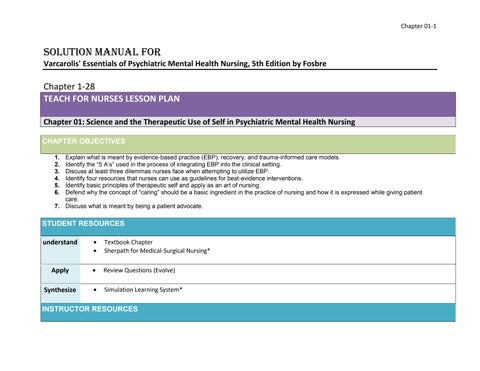
Chapter 1-28 TEACH FOR NURSES LESSON PLAN Chapter 01: Science and the Therapeutic Use of Self in Psychiatric Mental Health Nursing CHAPTER OBJECTIVES 1. 2. 3. 4. 5. 6.
Explain what is meant by evidence-based practice (EBP), recovery, and trauma-informed care models. Identify the “5 A’s” used in the process of integrating EBP into the clinical setting. Discuss at least three dilemmas nurses face when attempting to utilize EBP. Identify four resources that nurses can use as guidelines for best-evidence interventions. Identify basic principles of therapeutic self and apply as an art of nursing. Defend why the concept of “caring” should be a basic ingredient in the practice of nursing and how it is expressed while giving patient care. 7. Discuss what is meant by being a patient advocate.
STUDENT RESOURCES understand
Textbook Chapter Sherpath for Medical-Surgical Nursing*
Apply
Review Questions (Evolve)
Synthesize
Simulation Learning System*
INSTRUCTOR RESOURCES
Chapter 01-2
before class
Pre-Class Activities (below) Nursing Curriculum Standards (below)
in class
PowerPoint Presentations (Evolve) Image Collection (Evolve) Learning Activities (below) Discussion Topics (below)
after class
Test Bank (Evolve) HESI: Psychiatric/Mental Health Exams*
* Sold separately from textbook.
TEACHING STRATEGIES Content Focus INTRODUCTION EVIDENCE-BASED PRACTICE Resources for Clinical Practice The Research-Practice Gap Recovery Model Trauma-Informed Care Quality and Safety Education for Nurses (QSEN)
Content Highlights The 5 A’s process of integrating best evidence into clinical practice includes (1) asking, (2) acquiring, (3) appraising, (4) applying, and (5) assessing. The recovery model helps patients effectively manage symptoms, reduce psychosocial disability, and find a meaningful life in a community of their choosing. Trauma-informed care recognizes that various traumas contribute to mental illness and substance abuse.
Learning Activities
Pre-Class/Online Activity: Assign students to view several Internet resources or search journal articles describing evidence-based psychiatric nursing practice. Share results of research in class discussion, using this to ask students the following questions: What nursing interventions did you find in your preliminary research that would earmark them as evidence-based practice? What challenges or dilemmas do you think nurses face in attempting to take an evidencebased practice approach?” Close the discussion by pointing out that each of these issues will be addressed in the course of covering this chapter. Pre-Class Activity: Before beginning class, have students each list and then share with the class specific examples of what they think is meant by therapeutic use of self as it applies in particular to psychiatric and mental health nursing. Ask, “How do you predict this will be unique from patient advocacy?”
Resources PowerPoint Slides Concept Box: Advocacy Applying Evidence-Based Practice (EBP) Table 1-1: Hierarchy of Evidence and Grading of Recommendations Figure 1-1: Hierarchy of evidence Figure 1-2: Clinical algorithm for the suspicion of suicide risk
Chapter 01-3
TEACHING STRATEGIES Content Focus
CONCEPT-BASED NURSING EDUCATION THE ART OF NURSING Therapeutic Use of Self Attending Patient Advocacy
Content Highlights
Contemporary nursing relies on a scientific foundation and critical thinking. However, the art of nursing is equally important in delivering comprehensive and holistic care. The arts of intuition, interpersonal skills, and cultural competence are an indispensable part of effective treatment.
Learning Activities
Collaborative/Interprofessional Activity: Direct students to journal briefly on examples of therapeutic use of self, attending, and patient advocacy from his or her own clinical practice. Ask: “With what other professionals did you consult—or would you have liked to consult—in this scenario?” Call for a few volunteers to share their responses and experiences. Invite class input to promote creative ideas and solutions. Collaborative/Interprofessional Activity: Divide the class into small groups of two or three to create several new patient scenarios and make a list of what they think examples of therapeutic use of self would be for each scenario. They may draw examples from the clinical practice of team members who did not have an opportunity to share in the previous activity. As they share with the class, ask everyone to suggest what type of advocacy could be necessary for each patient.
Resources
PowerPoint Slides
PRE-CLASS ACTIVITIES Text objectives 1–4: Assign students to view several Internet resources or search journal articles describing evidence-based psychiatric nursing practice. Share results of research in class discussion, using this to ask students the following questions, “Based on the research, how would you describe evidence-based practice? What nursing interventions did you find in your preliminary research that would earmark them as evidencebased practice? What challenges or dilemmas do you think nurses face in attempting to take an evidence-based practice approach?” Close the discussion by pointing out that each of these issues will be addressed in the course of covering this chapter. Text objectives 5–7: Before beginning class, have students each come up with specific examples of what they think is meant by therapeutic use of self as it applies to nursing practice. Ask, “How do you predict this will be unique from patient advocacy?”
Chapter 01-4
IN-CLASS / ONLINE CASE STUDY None for this chapter.
NURSING CURRICULUM STANDARDS
INTERPROFESSIONAL COLLABORATIVE PRACTICE CORE COMPETENCIES
Competency Domain 1: Values/Ethics for Interprofessional Practice o Quality and Safety Education for Nurses o Patient Advocacy Competency Domain 2: Roles/Responsibilities o Evidence-Based Practice o Patient Advocacy Competency Domain 3: Interprofessional Communication o Evidence-Based Practice o Patient Advocacy Competency Domain 4: Teams and Teamwork o Evidence-Based Practice o Patient Advocacy
QSEN / NLN COMPETENCIES
Patient-Centered Care/Human Flourishing o Recovery Model o Trauma-Informed Care o The Art of Nursing Teamwork and Collaboration/Professional Identity o Evidence-Based Practice o Patient Advocacy Evidence-Based Practice/Spirit of Inquiry o Evidence-Based Practice Quality Improvement/Spirit of Inquiry o Quality and Safety Education for Nurses (QSEN) o Resources for Clinical Practice o The Research-Practice Gap
Chapter 01-5
o Recovery Model o Trauma-Informed Care Safety/Nursing Judgment o Quality and Safety Education for Nurses (QSEN) Informatics/Nursing Judgment o Quality and Safety Education for Nurses (QSEN) o Resources for Clinical Practice o The Research-Practice Gap
NURSING CONCEPTS The following conceptual themes and specific concepts match those presented in Giddens, J. R. (2017). Concepts for nursing practice (2nd ed.). St. Louis: Elsevier. The specific exemplars chosen and listed below for each concept have been tailored specifically to correspond to the Keltner textbook. A full Concept-Based Curriculum Map covering the entire book can be found in the “Download by Resource Type” folder on Evolve. HEALTH CARE RECIPIENT CONCEPTS THEME: Attributes and Resources Concept: Functional Ability o Exemplar: Recovery Model o Exemplar: Trauma-Informed Care THEME: Personal Preferences Concept: Self-Management o Exemplar: Recovery Model o Exemplar: Trauma-Informed Care PROFESSIONAL NURSING AND HEALTH CARE CONCEPTS THEME: Nursing Attributes and Roles Concept: Professional Identity o Exemplar: The Research-Practice Gap o Exemplar: Quality and Safety Education for Nurses (QSEN)