Solution Manual for The Mechanics of Biological Materials, 1E By Manuel Elices, Gustavo Guinea, John Morton
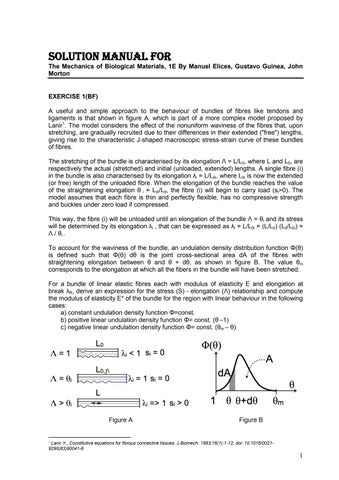
EXERCISE 1(BF) A useful and simple approach to the behaviour of bundles of fibres like tendons and ligaments is that shown in figure A, which is part of a more complex model proposed by Lanir1. The model considers the effect of the nonuniform waviness of the fibres that, upon stretching, are gradually recruited due to their differences in their extended ("free") lengths, giving rise to the characteristic J-shaped macroscopic stress-strain curve of these bundles of fibres. The stretching of the bundle is characterised by its elongation Λ = L/L0, where L and L0, are respectively the actual (stretched) and initial (unloaded, extended) lengths. A single fibre (i) in the bundle is also characterised by its elongation λi = L/L0i, where L0i is now the extended (or free) length of the unloaded fibre. When the elongation of the bundle reaches the value of the straightening elongation θ i = L0i/L0, the fibre (i) will begin to carry load (si>0). The model assumes that each fibre is thin and perfectly flexible, has no compressive strength and buckles under zero load if compressed. This way, the fibre (i) will be unloaded until an elongation of the bundle Λ = θi and its stress will be determined by its elongation λi , that can be expressed as λi = L/L0i = (L/L0) (L0/L0i) = Λ / θi . To account for the waviness of the bundle, an undulation density distribution function Φ(θ) is defined such that Φ(θ) dθ is the joint cross-sectional area dA of the fibres with straightening elongation between θ and θ + dθ, as shown in figure B. The value θm corresponds to the elongation at which all the fibers in the bundle will have been stretched. For a bundle of linear elastic fibres each with modulus of elasticity E and elongation at break λR, derive an expression for the stress (S) - elongation (Λ) relationship and compute the modulus of elasticity E* of the bundle for the region with linear behaviour in the following cases: a) constant undulation density function Φ=const. b) positive linear undulation density function Φ= const. (θ –1) c) negative linear undulation density function Φ= const. (θm – θ)
Figure A
Figure B
1
Lanir Y., Constitutive equations for fibrous connective tissues. J Biomech. 1983;16(1):1-12. doi: 10.1016/00219290(83)90041-6
1
Solution: The force in the bundle will be the sum of the contribution of all the fibres: ∫
∫
∫
where we have made use of the definition of the undulation density distribution and the relationship between the elongations in the bundle and the fibre. Considering that in a fibre = (λ –1) E >0 for 1< λ < λR, we can obtain:
and the limits of the integral can be made explicit as [
]
∫ [
]
a) In this case Φ= Φ 0 = A/(θm – 1) , since the total area of the bundle is A = Φ 0 (θm – 1) . The equation to calculate the force is: [
]
∫
( [
[ [
,
)
]
] ]
[
]
[
]-
and the stress-elongation curve for the bundle results: [ [
,
] ]
[
]
[
]-
Linear bundle behaviour is reached when all fibres have been recruited (Λ > θm) and none have broken (Λ < λR). In this case min[Λ,θm]= θm and max[1,Λ/λR]=1. The S - Λ relationship for this region is: {
}
and the slope is:
b) now the undulation density function is: And the total force on the bundle: [
]
∫
( [
{ *
)
]
+
[
]}
2
and the stress-elongation relationship for the bundle is given by: { *
[
+
]}
The linear bundle behaviour (θm < Λ < λR ; min[Λ,θm]= θm , max[1,Λ/λR]=1) is: { [
]
[
]}
and the slope is:
c) finally, in a similar manner, the undulation density function is: and the total force on the bundle: [
]
∫
( [
)
]
{ [
]
[
]
[
]}
with the stress-elongation relationship for the bundle being: { [
[
]
]
[
]}
Again, for linear bundle behaviour (θm < Λ < λR ; min[Λ,θm]= θm , max[1,Λ/λR]=1) we have: { [
]
[
]}
and the slope is:
It can be shown that for any θm > 1 is The figure shows the three curves S - Λ for a bundle of fibres with E=300MPa, λR =1.19 and θm =1.05. The respective values of E* are given by: E*a /E = 0.9758
E*b /E = 0.9679
E*c /E = 0.9837
and which lie within 4% of E. The experimental values of Huang et al.2 for the human palmarius longus tendon are also shown in the figure.
2
Huang et al. Biomechanical Properties of Knee Medial Collateral Ligament Compared to Palmaris Longus for Ulnar Collateral Ligament Reconstruction. Ann Biomed Eng. 2023 Aug;51(8):1795-1801. doi: 10.1007/s10439-023-03188-z
3
EXERCISE 2(BF) For the models described in EXERCISE 1 prove that for any θm >1
Solution:
To demonstrate the inequalities, let us consider the differences,
which will be greater that zero as long as
.
To prove this last inequality, consider the function,
whose derivative is
This last function confirms that,
and consequently,
Similar reasoning leads us to see that if
, then,
4
for any θm >1, and the inequalities are proven. EXERCISE 3(BF) To reinforce an injured ligament (I) a parallel grafting with another ligament (G) has been performed. The two ligaments can be considered as two separate bundles of collagen fibres, whose cross-sectional area and free (unloaded) extended length are provided in the table. If the repaired ligament has an initial resting length (unloaded) L0=15 mm and the modulus of the elasticity of all the collagen fibres is E=933 MPa, calculate the following: a) The stress-elongation (S – Λ) curve for the repaired ligament. b) The modulus of elasticity E* of the repaired ligament when all the fibers are subjected to tension.
bundle
cross-sectional area
free length
1.2 2.5
15 19
I G
Solution: The force in the repaired ligament will be the sum of the force of the two bundles,
where are the cross-sectional areas and their respective elongations. We have made use the linear elastic relationship between stress and elongations. We also assume that fibres have no compressive strength, and the load is zero for λ <1. When the repaired ligament has an elongation Λ = L/ L0, the elongations in the bundles are and with θI and θG being the elongations when the fibres begin to carry load. From the data we obtain: θI =15/15= 1, and θG = 19/15 = 1.267. The stress-elongation relationship becomes,
(
[
)
Inserting values [
5