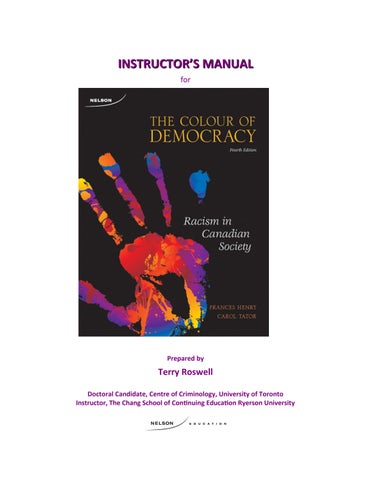
INSTRUCTOR’S MANUAL for
Prepared by
Terry Roswell Doctoral Candidate, Centre of Criminology, University of Toronto Instructor, The Chang School of Continuing Education Ryerson University
“Until the philosophy which holds one race superior and another inferior is finally and permanently discredited and abandoned, everywhere is war and until there are no longer first-class and secondclass citizens of any nation, until the color of a man’s skin is of no more significance than the color of his eyes. And until the basic human rights are equally guaranteed to all without regard to race, there is war. And until that day, the dream of lasting peace, world citizenship, rule of international morality, will remain but a fleeting illusion to be pursued, but never attained...now everywhere is war.”
- His Imperial Majesty Haile Selassie I of Ethiopia
CHAPTER ONE:
THE IDEOLOGY OF RACISM For many Canadians, the idea that racism is something that only exists in the United States is quite common. This chapter sets out to challenge such assumptions by exposing a central ideological struggle that exists in Canada – one that promotes liberal and democratic values, on the one hand, amidst a reality of persistent and pervasive inequality based on race, on the other hand. Too often, Canadians rely on the myth of multiculturalism as evidence that we are now living in a 'raceless' society and ideologies such as this have provided a comfortable space for individuals unwilling to challenge themselves to resist and discredit anti-racism initiatives. It is because of these two conflicting value systems that the authors argue allows for the retention of racist beliefs and behaviours in Canadian society. By exploring the different ways that racism manifests itself in the United Kingdom, United States, and Canada, chapter one concludes by providing students with a theoretical framework where they are able to recognize and articulate the changing nature of ‘race’ and racism over time and place. This introductory chapter is quite significant because it not only shows how racism is no longer operating in overt, but rather subtle forms, but it also provides a template for students to understand how racism operates at the individual, institutional and systemic levels.
1.1.
CHAPTER OUTLINE
What is Ideology? Defining the role and function of ideologies in contemporary societies Racist ideology The Elusive nature of racism Theoretical Perspectives of Racism in Canada, the United States and the U.K New Racism in the United Kingdom Aversive Racism in the United States Democratic Racism In Canada and related discourses of democratic racism
1.2.
LEARNING OBJECTIVES
By the end of this chapter, students should be able to: i. Recognize that racism does not have to be manifested in overt, blatant, or intentional forms, but that today it often appears in more subtle, hidden, and unintentional ways. ii. State that ‘race’ and racism continues to play a role in Canadian society. iii. Critique what we believe to be “common sense” knowledge about ‘race’ and racism. 2
Copyright © 2010 by Nelson Education Ltd.
iv. v.
Understand the various ways ideologies not only influences one’s individual thoughts and assumptions, but also serves to reinforce relations of power and dominance in the larger Canadian society. Identify how racist ideologies help to maintain structures of inequality and systems of dominance in Canadian society. Grasp the different ways that notions of ‘race’ change over time and place. Contrast the way that racism functions and operates in the UK, USA, and Canada. Differentiate between these four key concepts: ‘new racism’, ‘aversive racism’, ‘symbolic racism’, and ‘democratic racism’. Define democratic racism and the discourses associated with this concept. Cite discourses, myths, and/or explanations routinely used to deny the prevalence of racism in Canadian society and/or to resist anti-racism initiatives. Realize that tolerance and accommodation does not ensure equality and equity.
vi. vii. viii. ix. x. xi.
1.3.
KEY TERMS AND CONCEPTS
Your students will meet the following terms and concepts in this chapter: Aversive racism Discourse of reverse racism Democratic racism Discourse of white victimization Discourse of binary polarization Dominant group Discourse of blaming the victim Ideology Discourse of colour-blindness Minority group Discourse of denial New racism Discourse of equal opportunity Norms Discourse of moral panic Racist ideology Discourse of multiculturalism Symbolic racism Discourse of national identity Whiteness Discourse of political correctness
1.4.
TEACHING STRATEGIES
Lecture Topics: i. What is an ‘ideology’? How are ideologies woven into public discourse? ii. Role racist ideologies play in maintaining structures and systems of social inequality. iii. Canada’s multicultural image to repudiate and deny existence of racism. iv. Racism from a global perspective, particular emphasis on U.K. and U.S.A. v. Define central concepts of ‘new racism’, ‘aversive racism’, ‘symbolic racism’, and ‘democratic racism’. vi. Democratic racism in Canada and related discourses. Provide concrete examples to support
concepts.
Copyright © 2010 by Nelson Education Ltd.
3
Discussion Questions: i. Why is ‘race’ such a taboo topic in Canadian society? ii. Based on the analysis provided by the authors in this chapter, how would you compare the way racism appears in the UK, USA, and Canada?
iii.
iv. v. vi.
“There is no racism in Canada because we celebrate multiculturalism. Plus, it is something that I have never engaged in or experienced. Therefore, since I am not racist I don’t believe I should have to be concerned about it.” Discuss. How do notions of ‘race’ change over time and place? Can terms that we use here in Canada to identify different groups of people be used to describe individuals in other countries? “Children are not born racist” is a quote that we often hear. In your opinion, is racism a natural consequence of human interaction or is it something that is learned?
Class or Group Exercises:
i. ii. iii. iv. v.
vi.
1.5.
Ask students to think of situations, draw on personal experiences, or generally brainstorm examples that can be applied to the various terms, concepts, or discourses presented in this chapter. Has anybody lived or visited other countries where they able to articulate how ‘race’ manifests elsewhere? How does the situation there compare to the Canadian context? Have students engage in critical self-reflective assignment where they explore their own ideas about the role ‘race’ plays in Canadian society. Engage class in questionnaire/class exercise about prejudice. One such exercise is available at the following website, entitled “Project Implicit.” http://www.tolerance.org/hidden_bias/index.html Use racial ideologies that were common during different historical periods (e.g. 19 th century and scientific racism, famous quotes, or recent news articles (see below) to get students thinking about issues of ‘race’ and racism. Relevant information can be accessed from a number of internet websites, including http://www.geocities.com/ru00ru00/racismhistory/19thcent.html (scientific racism), or http://thinkexist.com/quotations/race/ where you can find famous quotes on a variety of topics. Have students write a reaction paper to a newspaper, magazine, or journal article. Encourage them to not only express their own thoughts and opinions, but to find ways where they can apply concepts and terms from the chapter into their analysis.
TEACHING RESOURCES
Supplementary Scholarly Articles, Books
Bell, Mark. (2009). “Race’, Ethnicity and Racism in Europe.” Race and Equality in the European Union. (January): 7-27. Bonilla-Silva, Eduardo. (2004). “From Bi-Racial to Tri-Racial: Towards a new system of racial stratification in the USA.” Ethnic and Racial Studies 27(6): 931-950. Boyko, John. (1995). The Last Steps to Freedom: The evolution of Canadian racism. J. Gordon Schillingford Publishing Inc.
4
Copyright © 2010 by Nelson Education Ltd.
Clare, J. (1984). “Eyewitness in Brixton.” In J. Benyon (Ed.), Scarman and After. Pergamon: Oxford. Dhruvarajan, Vanaja. (2000). “People of Colour and National Identity in Canada.” Journal of Canadian Studies, vol. 35(2): 166-75. Foster, Cecil. (1996). A Place Called Heaven: The meaning of being black in Canada. Toronto: Harper Collins Publishers Ltd. Glasgow, Joshua, Shulman, Julie L., and Covarrubias, Enrique G. (2009). “The Ordinary Conception of Race in the United States and Its Relation to Racial Attitudes: A new approach.” Journal of Cognition and Culture 9(1/2): 15-38. Itwaru, Arnold & Natasha Ksonzek. (1994). Closed Entrances: Canadian Culture and Imperialism. Toronto: TSAR Publications. James, C. (1997). “The Distorted Images of African-Canadians: Impact, Implications and Responses” in C. Green, ed., Globalization and Survival in the Black Diaspora: The New Urban Challenge. Albany: State University of New York Press, pp. 307-27. Kalunta-Crumpton, Anita. (2002). “Black and White Violence in Britain: The Articulation of Race in Popular and Criminal Justice Discourses.” The Justice Professional, vol. 15: 37-55. Lopez, Haney Ian. (1993). White by Law: The Legal Construction of Race. New York: New York University Press. Malhi, Rebecca L., and Susan P. Boon. (2007). “Discourses of ‘Democratic Racism’ in the Talk of South Asian Canadian Women.” Canadian Ethnic Studies 39(3): 125-149. McGhee, Derek. (2009). “The Paths to Citizenship: A critical examination of immigration policy in Britain since 2001.” Patterns of Prejudice 43(1): 41-64. Nelson, Camile and Charmaine. (2003). Racism Eh? A critical inter-disciplinary anthology of race in the Canadian context. Toronto: Captus Press. Satzewich, Vic. (1998). “Race, Racism and Racialization: Contested Concepts.” In V. Satzewich (ed.), Racism and Social Inequality In Canada. Toronto: Thompson Educational Publishing Ltd. Street, Joe. (2008). “Malcolm X, Smethwick, and the Influence of the African American Freedom Struggle on British Race Relations in the 1960s.” Journal of Black Studies 38(6): 932950. Vautier, Elaine. (2009). “Playing the ‘Race’ Card: White anxieties and the expression and repression of popular racisms in the 1997 UK election.” Patterns of Prejudice 43(2): 122-141. Recent Newspaper & Magazine Articles
Here are some recent stories covered in Canadian or international newspapers that can be used to stimulate class discussions. By using these case studies, students can be exposed to some real examples that can be used to identify terms, concepts, or discourses highlighted in this chapter. In other instances, these articles provide useful examples of how racism is challenged in everyday settings.
Examples of racial violence and ‘new racism’ in Europe o “Italy’s New Racism: Brava genta, good people,” January 16, 2009 accessible from http://blacknrw.wordpress.com/2009/01/16/italys-new-racism-brava-gente-goodpeople/ o “Indian Immigrant Set on Fire” in Toronto Star, February 2, 2009. Accessed from http://www.thestar.com/article/581054
Copyright © 2010 by Nelson Education Ltd.
5