Solution Manual For Supervisory Management The Art of Inspiring, Empowering and Developing 10th Edition by Donald CMosley, JrDonald CMosley, Paul HPietri
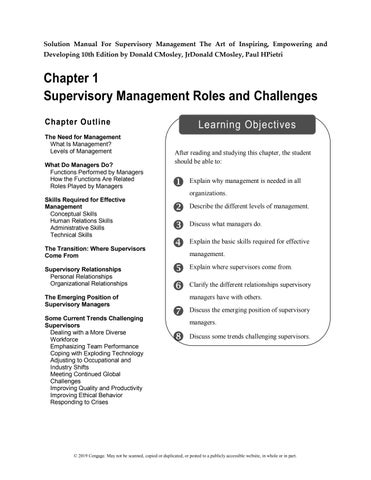
Chapter 1 Supervisory Management Roles and Challenges Chapter Outline The Need for Management What Is Management? Levels of Management What Do Managers Do? Functions Performed by Managers How the Functions Are Related Roles Played by Managers
Learning Objectives After reading and studying this chapter, the student should be able to:
Explain why management is needed in all organizations.
Skills Required for Effective Management Conceptual Skills Human Relations Skills Administrative Skills Technical Skills The Transition: Where Supervisors Come From Supervisory Relationships Personal Relationships Organizational Relationships The Emerging Position of Supervisory Managers Some Current Trends Challenging Supervisors Dealing with a More Diverse Workforce Emphasizing Team Performance Coping with Exploding Technology Adjusting to Occupational and Industry Shifts Meeting Continued Global Challenges Improving Quality and Productivity Improving Ethical Behavior Responding to Crises
Describe the different levels of management. Discuss what managers do. Explain the basic skills required for effective management.
Explain where supervisors come from. Clarify the different relationships supervisory managers have with others.
Discuss the emerging position of supervisory managers.
Discuss some trends challenging supervisors.
© 2019 Cengage. May not be scanned, copied or duplicated, or posted to a publicly accessible website, in whole or in part.
SUPERVISORY MANAGEMENT
Instructor‘s Manual
Preview Jackie Schultz, Supervisor This chapter begins with a profile of Jackie Schultz, supervisor for Panera Bread. The profile highlights several concepts that will be discussed throughout the text. Schultz joined Panera Bread while she was a high school senior. She cross-trained for multiple associate jobs and, within six months, was named an associate trainer. A year later, she was promoted to shift supervisor and training specialist. The associates in Jackie‘s store are representative of a diverse group of employees. The profile demonstrates the importance of working through associates to achieve goals. As a supervisor, the core of Jackie‘s daily job is making sure Panera‘s commitment to quality is reflected in her associates‘ job performance. The profile also lists the activities that Schultz performs and the skills she uses.
Lecture Outline I. The Need for Management
Whenever a group of people works together in a structured situation to achieve a common objective, they form an organization. The main objective of an organization is to produce a product or provide a service. To reach the objectives, management must perform three basic organizational activities: o Operations, or producing the product or service o Marketing, or selling and distributing the product o Financing, or providing and using funds
A. What is Management?
Management can be defined as the process of working with and through people to achieve objectives by means of effective decision making and coordination of available resources. The basic resources of any organization are human resources, which are the people involved; physical resources, which include buildings, furnishings, machinery, computers, equipment, materials, and supplies; and financial resources, such as money, capital, and credit.
B.
Levels of Management
Except in very small organizations, the different levels of management are usually based on the amount of responsibility and authority required to perform the job. Authority is the right to tell others to act or not act in order to reach objectives. Responsibility is the obligation that is created when an employee accepts a manager‘s delegated authority.
© 2019 Cengage. All Rights Reserved. May not be scanned, copied or duplicated, or posted to a publicly accessible website, in whole or in part.
CHAPTER NOTES
Chapter 1
Large organizations usually have at least three levels of management, plus a level of operative employees. These levels are generally referred to as: o Top management is responsible for the overall operations of the entire organization or oversees a major segment of the organization or a basic organizational activity. o Middle management is responsible for a substantial part of the organization. o Supervisory management has control over the operations of a smaller organizational unit. Supervisory managers or supervisors are the organization‘s primary link with most of its employees.
II. What Do Managers Do? A. Functions Performed by Managers
Managerial functions are the broad classifications of activities that all managers perform. The functions are planning, organizing, staffing, leading, and controlling. 1.
Planning
Planning involves selecting goals and future courses of action and deciding how to achieve the desired results. All other basic managerial functions depend on planning because it is unlikely that they will be successfully carried out without sound and continuous planning.
2.
Organizing
Deciding what activities are needed to reach goals and objectives, deciding who is to perform what task, dividing human resources into work groups, and assigning each group to a manager are tasks that make up the organizing function. Another aspect of organizing is bringing together the physical, financial, and human resources needed to achieve the organization‘s objectives.
3.
Staffing
The process of recruiting, selecting, training, developing, promoting, and paying and rewarding people to do the organization‘s work is called staffing.
4.
Leading
The leading function involves guiding, influencing, and motivating employees in the performance of their duties and responsibilities. It consists of coaching and empowering employees, facilitating their activities, communicating ideas and instructions, and motivating employees to perform their work efficiently.
© 2019 Cengage. All Rights Reserved. May not be scanned, copied or duplicated, or posted to a publicly accessible website, in whole or in part.
SUPERVISORY MANAGEMENT
Instructor‘s Manual
5.
Controlling
The controlling function involves comparing actual performance with planned actions and taking corrective action, if needed, to ensure that objectives are achieved. Control can be achieved only by setting up standards of performance, checking to see whether they have been achieved, and then doing what is necessary to bring actual performance in line with planned performance.
B.
How the Functions Are Related
Although the five management functions must be performed by managers in all types of organizations and at all management levels, they may be performed in different ways and given different emphasis by various managers. The functions are interrelated, interactive, and interdependent.
C. Roles Played by Managers
Managers play roles—parts played in the performance of their functions—as if they were actors, and these roles change rapidly and frequently. A landmark management study identifies 10 roles, grouped as follows: o Interpersonal roles o Informational roles o Decision-making roles Managers vary in how they interpret the roles, the time they devote to them, and the importance they assign to them. III. Skills Required For Effective Management
Although many basic skills are needed to perform the managerial functions and play the managerial roles most effectively, a few of the most common ones are conceptual skills, human relations skills, administrative skills, and technical skills. A. Conceptual Skills
B.
Conceptual skills involve the ability to acquire, analyze, and interpret information in a logical manner. All managers need to understand the environments in which they operate, as well as the effects of changes in those environments on their organization. Top managers particularly need strong conceptual skills because changes affecting the organization tend to be more important at their level than at other managerial levels . Human Relations Skills
© 2019 Cengage. All Rights Reserved. May not be scanned, copied or duplicated, or posted to a publicly accessible website, in whole or in part.
CHAPTER NOTES
Chapter 1
Human relations skills consist of the abilities to understand other people and to interact effectively with them. These skills are most needed in performing the leading function because they involve communicating with, motivating, leading, coaching, empowering, and facilitating employees, as well as relating to other people. These skills are important to managers at all levels, but especially to supervisory managers, who spend almost one-half of their time using human relations skills.
C. Administrative Skills
Administrative skills are the skills that permit managers to use their other skills effectively in performing the managerial functions. These skills include the ability to establish and follow policies and procedures and to process paperwork in an orderly manner. By lending coordination, order, and movement to tasks, administrative skills underlie the ability some people have to ―make things happen‖ and ―get things done.‖
D. Technical Skills
Technical skills include understanding and being able to supervise effectively the specific processes, practices, or techniques required to perform specific duties. Technical skills are more important for supervisors than for top managers, since supervisors are closer to the actual work being performed. Recently, the concept of emotional intelligence has become a popular way to view a specialized skill set involving people‘s emotions. o Emotional intelligence, or EI as it is often referred to, is the capacity to recognize and accurately perceive one‘s own and others‘ emotions, to understand the significance of these emotions, and to influence one‘s actions based on this analysis.
IV. The Transition: Where Supervisors Come From
Each year, several hundred thousand nonmanagers become supervisors or managers Most of the positions are filled by current employees. Internal promotions make sense for at least three reasons: o An inside candidate understands the organization and its culture. o Management has firsthand knowledge of the employee‘s record of accomplishment and can use this as a predictor of success. o To promote someone internally serves as a reward and as an incentive for those employees who have an interest in management and demonstrate management potential. Unfortunately, organizations commonly make two crucial mistakes when selecting supervisors: o One is to automatically select the best present performer. Although the best performer may have excellent technical skills, other skills, especially human relations skills, are also important. o Another crucial mistake made by organizations stems from inadequately preparing the
© 2019 Cengage. All Rights Reserved. May not be scanned, copied or duplicated, or posted to a publicly accessible website, in whole or in part.