SOLUTION MANUAL FOR THE EXERCISES in THE CRC BOOK: Situation Assessment in Aviation: Bayesian Networks and Fuzzy Logic Approaches. (By Jitendra, R, Raol, Sudesh K. Kashyap, and Lakshmi, S.) Chapter 2 2.1 Definition of SAW: Within the given volume of space and time, perception of environmental elements, understanding the meaning of them and projecting the status of them in the near future. The four qualitative methods of describing the SAW are: • • • •
Using a model for processing information or data to define and explain SAW; Using cycle of actions-perceptions to define and explain SAW; Comparison of SAW with the expertise; Using SAW to describe the phenomena of behaviour.
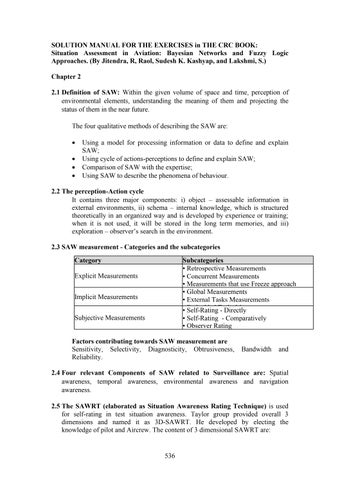
2.2 The perception-Action cycle It contains three major components: i) object – assessable information in external environments, ii) schema – internal knowledge, which is structured theoretically in an organized way and is developed by experience or training; when it is not used, it will be stored in the long term memories, and iii) exploration – observer’s search in the environment. 2.3 SAW measurement - Categories and the subcategories Category
Subcategories • Retrospective Measurements • Concurrent Measurements • Measurements that use Freeze approach • Global Measurements • External Tasks Measurements •• Embedded Measurements Self-RatingTasks - Directly
Explicit Measurements Implicit Measurements
• Self-Rating - Comparatively • Observer Rating
Subjective Measurements
Factors contributing towards SAW measurement are Sensitivity, Selectivity, Diagnosticity, Obtrusiveness, Reliability.
Bandwidth
and
2.4 Four relevant Components of SAW related to Surveillance are: Spatial awareness, temporal awareness, environmental awareness and navigation awareness. 2.5 The SAWRT (elaborated as Situation Awareness Rating Technique) is used for self-rating in test situation awareness. Taylor group provided overall 3 dimensions and named it as 3D-SAWRT. He developed by electing the knowledge of pilot and Aircrew. The content of 3 dimensional SAWRT are:
536
a. Demand on attention resources: It consists of complexity of situation, variability of situation and stability of situation. b. Supply of attentional resources: It is made up of spare mental capacity, division of attention, concentration of attention, and arousal of situation. c. Understanding of situation: This is a combination of information quality, familiarity and information quantity. Chapter 3 3.1 A situation assessment is carried out in order to understand the needs and conditions of a given scenario or mission. 3.2 Steps are: i) discuss with the expert of the field, ii) gather the details that are required, iii) make relevant observations, iv) collect the findings, v) analyse the collected information, and vi) share the results of the analysis and determine what next to do. 3.3 These are: diagnostic, formative, and summative. 3.4 Some situation analysis tools are: SWOT, PESTLE, 5C, VRIO, and Porter's Five Forces. SWOT: Strengths, Weaknesses, Opportunities, and Threats analysis. PESTLE: Political, Economic, Social, Technological, Legal and Environmental factors. 5C Analysis is a framework to analyze the environment in which a company operates, and provides insight into the key drivers of success, as well as the risk-exposure to various factors. The 5Cs are Company, Collaborators, Customers, Competitors, and Context. VRIO is an internal analysis framework that helps businesses identify the advantages and resources that give them a competitive edge. VRIO: value, rarity, imitability, and organization Porter's Five Forces are: i) Competitive Rivalry, ii) Supplier Power, iii) Buyer Power, iv) Threat of Substitution, and v) Threat of New Entry. 3.5 Threat assessment is the process of determining the credibility and seriousness of a potential threat, as well as the probability that the threat will happen. Chapter 4 4.1 The domain expert knowledge is very essential because he/she has learnt many operating aspects of the system he/she is monitoring for several years. He/she as an operator and/or the designer has a good feel of the performance of the system and if this knowledge is wired in the design and operation of FL/S then we get good design of the FL/S. Another way is to learn the required rules from the empirical data of the system. 4.2 In DM/DSS we need to take some decision based on the acquired/processed information regarding the system. If… then rule base approach of FL is naturally suitable for implementation of such systems.
537
4.3 After the FIS and aggregation process the end result is an area (or so) and hence we need to get the result as a crisp value, since this crisp value is further processed in a control system and/or FS. 4.4 The inner system is Type-I FL and the output is Type-0 FL system. In fact the Type-0 system is deterministic and not really fuzzy system. 4.5 One can define membership function for the input/output data and then use some portion of the data to see to what extent the data belong to what type/portion of the FLMF. Then one can use the predicted data to identify a parameter by using delta rule as is done in application of FFNN for system identification [28]. 4.6 The main reason is that for the intersection the severity of the intersection increases from the standard one to the drastic one, and hence the norm of the relational matrix is reduced. Whereas in the case of the union operation, the severity of union (more and more union is expected) increases and hence the norm increases. This can be ascertained from equations (4.18) to (4.21) and equations (4.35) to (4.38). 4.7 The Gaussian, trapezoidal, and triangular are very common functions. 4.8 The two methods are: 1) experts, and 2) based on the empirical data. 4.9 The experts can easily provide the rules due to their experience, and operational knowledge of the conventional (control) systems. However, they may not give out their total experience and hence the number of rules provided might be limited. The experts also have to specify the membership functions. The rules can be learned from the (training) data using ANNs. In this case the designer of the FL/S has to specify the membership functions. Chapter 5 5.1 These are propositional, predicate, temporal, modal, constraint, and probabilistic. 5.2 In Propositional logic the variables are True or False (Boolean). The operators used are AND, OR, and NOT. A rule would be: If A is True, then B is False. In Predicate logic the variables are True, False, unknown, probabilities. A typical rule might be: If z(k+1) – z(k) > ‘a’ Then the controller = Type 1 (number 1, etc.); If –‘a’ < z(k+1) – z(k) < ‘a’ Then the controller = Type 2. In temporal logic the truth variable is function of time. A rule could be: ‘A’ is True until time t, thereafter it is False. In modal logic some statements are always True, some are possibly True, etc. In constraint logic the variable would be both a logical variable and a numerical variable. The probabilistic logic incorporates uncertainty into the knowledge base. A rule could be: If the day temperature is > 40 deg., then with probability 0.9, there would be evening rains. 5.3 In a FFS some (or all) rules are fed back to each other and to themselves. 5.4 A FFS can model a dynamic system, e.g. x = f (x) .
538
5.5 The data from a nonlinear dynamic system (NLDS) are fed to FFS and its parameters adjusted as per the usual system identification procedure. When convergence is reached the FFS models the NLDS. 5.6 Sometimes while learning these rules from empirical data/methods (like using ANNs) one needs to use some pruning approach to control the total number of rules so that the FL/S (FFS) does not become very complex, especially for real-time implementation. 5.7 The main reason is that the fuzzy variables have ‘vagueness’ or they represent ‘vagueness’, and the depending on how the variables interact and what is their degree of their involvement the fuzzy ‘patches’ are obtained, and hence several ‘internal’ operations within ‘min’ and ‘max’ can be defined. This in itself is the richness of FL/S. 5.8 In data fusion the information from two (or more) sensor is fused (may be after some preprocessing). Then further analysis is made to obtain the intended inference. In the decision fusion, first the required analysis is made from the individual information (already some decision is made) and then the results are fused.
5.9 Voting method is widely used. The predictions obtained from the (say fault) classifiers are counted as votes. And a majority or plurality decision rule is used for fusion. Bayesian approach is used for evidence gathering. Posterior probabilities (of faults) can be computed by an agent for decision support system based on the Bayesian rule. Dempster-Shafer approach is a mathematical theory of evidence and is based on belief functions - uses degrees of belief collected from predictions to merge information from two sources. 5.10 Yes, it is. The raw data are processed and then filtered. Then the information is fused or integrated to some final identity or decision. This involves reduction of the original raw data to a great extent. 5.11 It can be considered as an approach to decision fusion. The fuzzy logic allows us to use more connectives than possible with the classical/conventional/crisp logic/set theory, thus the FL based aggregation and fusion can be used as decision fusion approach. 5.12 The FLKF is essentially a type of nonlinear/adaptive filter and not a linear filter like the KF. Hence, the numerical value of the normalized cost function may not meet the consistency check very accurately, however, it still will not be very far from the theoretical value. This is the price one pays for achieving the adaptive feature of the FLKF. 5.13 There is no binary logic used in KF gain updating that computes the Kalman gain by using information on previous state-error covariance and measurement error covariance matrices. 5.14 It is also soft decision but now it is based on FL/FIS.
539
5.15 One can use state vector fusion, feature level or decision level fusion depending upon the situation. Chapter 6 6.1 In the forward chaining the goal/conclusion is derived from the fundamental premise. In the backward chaining the proposition itself is defined as a goal. 6.2 Yes. One can represent the sensor measurements as providing the fuzzy non-crisp memberships. This then can be integrated using Bayesian inference rule for obtaining the predicted probabilities for inferring a decision as is done in situation assessment scenario. 6.3 In such a system the optimal decision can be viewed as some weighted sum of the individual local decisions. The weights in this sum could be related to the probabilities of the sensor’s signal detection and false alarm. 6.4 One can define fuzzy membership functions and the fuzzy connective operators, the parameters of which can be estimated and determined by using genetic algorithm. The multiple sensor fusion can be accomplished by using any architecture of ANNs. 6.5 The strong point is that the expert’s heuristic knowledge can be easily incorporated in the FIS and the weak point is that it takes some time to design the FL/FMF for FIS and decision making. 6.6 One can use fuzzy logic for monitoring the tuning parameters of the KF and use ANN to estimate the target’s maneuver parameters. KF will eventually provide the track/trajectory of the target. 6.7 Fuzzy logic uses the (expert-) rules for mapping inputs to outputs. The knowledge of an expert designer is captured in the If…Then rules. This fuzzy rule base provides the mapping from input to outputs. This mapping is usually non-linear. 6.8 FL as such represents the imprecision that is associated with noisy sensors. This is modeled with fuzzy membership functions. 6.9 The clustering technique used for data classification identifies subsets of data points from large data set (e.g. measured I/O data) with each set making one group. Arrangement of these data points into natural groups enables precise definition of system’s behavior. The other techniques are: i) maximum likelihood classifier (based on normal distribution assumption - may not be suitable for remote sensing image classification because geographical phenomena do not occur randomly in nature), and ii) ANN-based classification which totally depends upon training data and learning algorithms and is difficult to interpreted by human language. Chapter 7 7.1 Fuzzy logic is used. In decision fusion, fuzzy logic (FL) method is used in making a definite real time crucial decisions based on inferences derived from a certain
540