Name:
Class:
Date:
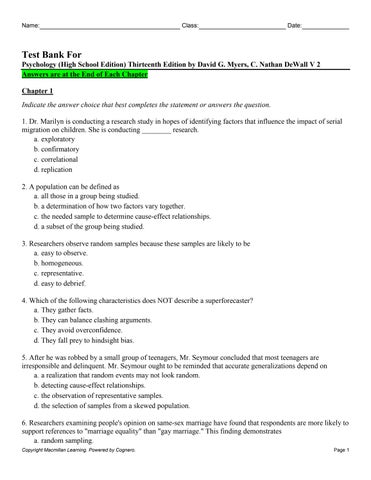
Test Bank For Psychology (High School Edition) Thirteenth Edition by David G. Myers, C. Nathan DeWall V 2 Answers are at the End of Each Chapter Chapter 1 Indicate the answer choice that best completes the statement or answers the question. 1. Dr. Marilyn is conducting a research study in hopes of identifying factors that influence the impact of serial migration on children. She is conducting ________ research. a. exploratory b. confirmatory c. correlational d. replication 2. A population can be defined as a. all those in a group being studied. b. a determination of how two factors vary together. c. the needed sample to determine cause-effect relationships. d. a subset of the group being studied. 3. Researchers observe random samples because these samples are likely to be a. easy to observe. b. homogeneous. c. representative. d. easy to debrief. 4. Which of the following characteristics does NOT describe a superforecaster? a. They gather facts. b. They can balance clashing arguments. c. They avoid overconfidence. d. They fall prey to hindsight bias. 5. After he was robbed by a small group of teenagers, Mr. Seymour concluded that most teenagers are irresponsible and delinquent. Mr. Seymour ought to be reminded that accurate generalizations depend on a. a realization that random events may not look random. b. detecting cause-effect relationships. c. the observation of representative samples. d. the selection of samples from a skewed population. 6. Researchers examining people's opinion on same-sex marriage have found that respondents are more likely to support references to "marriage equality" than "gay marriage." This finding demonstrates a. random sampling. Copyright Macmillan Learning. Powered by Cognero.
Page 1
Name:
Class:
Date:
b. naturalistic observation. c. wording effects. d. the case study. 7. To verify the reliability of a new scientific finding, psychological researchers are most likely to engage in a. naturalistic observation. b. random sampling. c. replication. d. positive correlation. 8. Dr. C has found that teenagers whose parents read to them as children are more likely to do well academically. He can reach which conclusion? a. Reading to children causes high academic performance. b. Teenagers who are naturally intelligent are more likely to be interested in books as children. c. Reading to children is correlated with high academic performance. d. Dr. C cannot make any such statement. 9. Researchers use descriptive statistics to a. organize their data. b. demonstrate a relationship between variables. c. calculate the reliability of their data. d. determine the statistical significance of their data. 10. Dr. Nuguse would like to study the relationship between room lighting and college students' test performance. He randomly assigns college students to one of two groups. The first group takes an exam in a dimly lit room and the second group takes the same exam in a regularly lit room. To ensure ethical treatment of participants, Dr. Nuguse will NOT need to a. obtain participants' informed consent prior to participation. b. keep personal information about participants confidential. c. protect his participants from harm and discomfort. d. report individual participants' results. 11. An understanding of behavior and mental processes can be misused to manipulate people. That's why some worry about the potential dangers of a. confounding variables. b. informed consent. c. experimental debriefing. d. psychology. 12. Mary's mother was always concerned about leaving food out that contained mayonnaise. Now Mary believes that foods containing mayonnaise will spoil faster than other foods. Why might Mary believe this false idea? a. false news Copyright Macmillan Learning. Powered by Cognero.
Page 2
Name:
Class:
Date:
b. repetition c. availability of powerful examples d. group identity 13. Dr. Watson is conducting an experiment designed to study the effectiveness of a new drug for treating Parkinson's. Research participants who receive a placebo have been assigned to the ________ group. a. dependent variable b. correlational c. experimental d. control 14. The formula for the ________ can be described as the lowest score subtracted from the highest score. a. mean b. median c. range d. standard deviation 15. Psychologists occasionally deceive research participants about the true purpose of an experiment in order to prevent them from a. worrying about the potential harm or discomfort they may experience. b. realizing that their privacy is being violated. c. deciding that they really don't want to take part in the experiment. d. trying to confirm the experimenters' predictions. 16. Which of the following is NOT associated with the acceptance of misinformation? a. false news b. repetition c. unmemorable examples d. group identity 17. Unusual ESP subjects who defy chance when first tested nearly always lose their "psychic powers" when retested. This decline is best explained in terms of a. illusory correlation. b. regression toward the mean. c. a placebo effect. d. a confounding variable. 18. Which of the following animals resembles humans in how they cope with stress? a. honeybees b. rats c. whales d. cats Copyright Macmillan Learning. Powered by Cognero.
Page 3
Name:
Class:
Date:
19. Evidence indicates that most animal researchers a. support government regulations protecting the humane care of animals used in research. b. believe the well-being of animals used in research studies should be placed above the well-being of humans. c. think animals should be used only in research studies that directly benefit the animals involved in those studies. d. insist that animals should be fully debriefed following their use in research studies. 20. Conducting a case study best illustrates a. random sampling. b. correlational research. c. the double-blind procedure. d. a descriptive method. 21. Philip Tetlock found that predictions made with 80 percent confidence, such as that Quebec would separate from Canada, were right less than 40 percent of the time. These predictions illustrate a. overconfidence. b. hindsight bias. c. critical thinking. d. a chance-related explanation. 22. A testable prediction that is often implied by a theory is called a(n) a. naturalistic observation. b. operational definition. c. dependent variable. d. hypothesis. 23. When provided with three-word puzzles, people underestimate the difficulty of solving the anagrams. This best illustrates a. confounding variables. b. perceiving order in random events. c. wording effects. d. overconfidence. 24. To understand the British newspaper headline "Income for 62% Is Below Average," a reader needs to appreciate the distinction between the ________ and the mean. a. range b. standard deviation c. mode d. median 25. Approximately what percentage of the cases represented by the normal curve fall between –2 and +2 standard deviations from the mean? Copyright Macmillan Learning. Powered by Cognero.
Page 4
Name:
Class:
Date:
a. 34 b. 68 c. 95 d. 100 26. Which of the following is NOT one of the most important scientific values, according to scientists? a. honesty b. perseverance c. curiosity d. overconfidence 27. A descriptive method in which one individual or group is studied in great depth is called a(n) a. replication. b. case study. c. experiment. d. double-blind procedure. 28. Scientists who are experts in their field and provide anonymous evaluations of other scientists' research in terms of theory, originality, and accuracy are called a. meta-analyzers. b. peer reviewers. c. experimental researchers. d. correlational researchers. 29. Recent research has reported that most people a. cannot tell the difference between high- and low-quality sources of information. b. can often tell the difference between high- and low-quality sources of information. c. can distinguish between false and true news reports. d. can distinguish between false and true information regardless of the topic or content. 30. Professor Schmidt has just finished collecting data on the relationship between weather changes and depression. She will use ________ to organize her data. a. inferential statistics b. the correlation coefficient c. descriptive statistics d. measures of variation 31. The scientific method is defined as a. a statistical index of the relationship between two things. b. a self-correcting process for evaluating ideas with observation and analysis. c. an experimental procedure in which both the research participants and the research staff are ignorant about whether the research participants have received the treatment or a placebo. Copyright Macmillan Learning. Powered by Cognero.
Page 5