Solution Manual For Psychology Applied to Teaching 15e Jack Snowman, Rick McCown, Amy Olson,Christopher Harris _____________________________________________________________________________________ Chapters 1-13
Chapter 01: Applying Psychology to Teaching
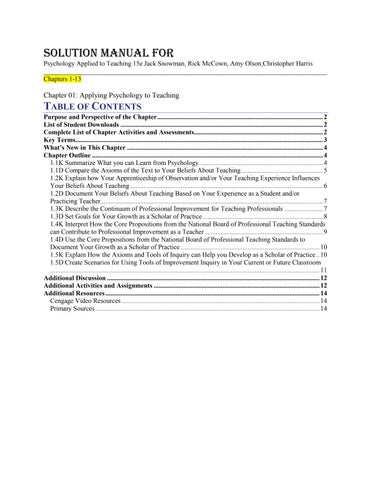
TABLE OF CONTENTS Purpose and Perspective of the Chapter ................................................................................................... 2 List of Student Downloads ......................................................................................................................... 2 Complete List of Chapter Activities and Assessments............................................................................. 2 Key Terms.................................................................................................................................................... 3 What’s New in This Chapter ..................................................................................................................... 4 Chapter Outline .......................................................................................................................................... 4 1.1K Summarize What you can Learn from Psychology .......................................................................... 4 1.1D Compare the Axioms of the Text to Your Beliefs About Teaching ................................................. 5 1.2K Explain how Your Apprenticeship of Observation and/or Your Teaching Experience Influences Your Beliefs About Teaching ................................................................................................................... 6 1.2D Document Your Beliefs About Teaching Based on Your Experience as a Student and/or Practicing Teacher..................................................................................................................................... 7 1.3K Describe the Continuum of Professional Improvement for Teaching Professionals ....................... 7 1.3D Set Goals for Your Growth as a Scholar of Practice ........................................................................ 8 1.4K Interpret How the Core Propositions from the National Board of Professional Teaching Standards can Contribute to Professional Improvement as a Teacher ....................................................................... 9 1.4D Use the Core Propositions from the National Board of Professional Teaching Standards to Document Your Growth as a Scholar of Practice ................................................................................... 10 1.5K Explain How the Axioms and Tools of Inquiry can Help you Develop as a Scholar of Practice .. 10 1.5D Create Scenarios for Using Tools of Improvement Inquiry in Your Current or Future Classroom ................................................................................................................................................................. 11 Additional Discussion ............................................................................................................................... 12 Additional Activities and Assignments ................................................................................................... 12 Additional Resources ................................................................................................................................ 14 Cengage Video Resources ...................................................................................................................... 14 Primary Sources ...................................................................................................................................... 14
PURPOSE AND PERSPECTIVE OF THE CHAPTER The purpose of this chapter is to establish foundational principles for applying psychological science to teaching practice and developing as a scholar of practice. This chapter introduces three core axioms: teaching and learning as interconnected processes, the inquiry imperative for examining instructional consequences, and continuous improvement through systematic inquiry. Readers explore how their educational experiences shape teaching beliefs while examining the professional continuum from aspiring to accomplished educator. The chapter emphasizes systems thinking over deficit perspectives, introducing improvement inquiry tools including the Plan-Do-Study-Act cycle for addressing problems of practice. Through alignment with National Board Professional Teaching Standards’ Five Core Propositions, learners develop frameworks for evidence-based decision making, reflective practice, and collaborative professional growth. The chapter prepares educators to facilitate student development, create inclusive learning communities, promote significant learning, and sustain learner-centered practices throughout their careers.
LIST OF STUDENT DOWNLOADS Students should download the following items from the Student Companion Center to complete the activities and assignments related to this chapter:
COMPLETE LIST OF CHAPTER ACTIVITIES AND ASSESSMENTS The following table organizes activities and assessments by objective, so that you can see how all this content relates to objectives and make decisions about which content you would like to emphasize in your class based on your objectives. For additional guidance, refer to the Teaching Online Guide. Chapter Objective
Activity/Assessment
Source (i.e., PPT slide, Workbook)
Duration
Certification Standard
1.1k
Check for Understanding
Text
5-10 minutes
NBPTS 4
1.2d
Reflect and Connect:
Text
20-30 minutes
NBPTS 1
1.3d
Performance of Understanding:
Text
20 minutes
NBPTS 5
1.5k
Think-Pair-Share: Inquiry in Practice
Instructor Activity
15 minutes
NBPTS 4
1.5d
PDSA Cycle Application Activity
Instructor Activity
25-30 minutes
NBPTS 4
[return to top]
KEY TERMS Accomplished Teacher: A teacher who has achieved a high level of discernment and is recognized for establishing excellence through positive impact on learners and learning communities. Apprenticeship of Observation: The wealth of ideas about teaching that aspiring teachers develop through twelve or more years of experience in classrooms as students. Aspiring Teacher: An individual enrolled in teacher preparation programs whose aspiration is to become a teacher. Axiom: A fundamental assumption or proposition that is held to be true throughout a framework or system of thought. Central Law of Improvement: The principle that every system is perfectly designed to produce the results it gets, requiring focus on changing systems rather than blaming people. Deficit Ideology: The assumption that negative learning outcomes are the fault of people in the system rather than inadequate supports and resources provided by the system. Design-Based Implementation Research (D-BIR): A research approach that includes planning to create a design for student learning, implementing the design, inquiring about effectiveness, and acting on learning to improve future designs. Discernment: The ability to observe, understand, and evaluate clearly how theoretical ideas might be applied in practice to help individual students learn and develop. Educational Leader: A teacher who uses expertise gained in establishing classroom excellence to improve systems for all learners beyond their individual classroom. Improvement Inquiry: A structured process of studying and refining practice to improve outcomes, emphasizing getting better at getting better throughout one’s career. Learning: Change in thought or behavior that enhances what a learner knows and can do. National Board for Professional Teaching Standards (NBPTS): An organization that provides standards for accomplished teaching and offers National Board Certification as the profession’s mark of accomplished teaching. Novice Teacher: A teacher in the early induction years of their career who focuses on implementing what they know and know how to do based on their preparation. PDSA Cycle: A four-phase cycle of improvement involving Plan, Do, Study, and Act phases used for continuous practice improvement. Practicing Teacher: An individual who is already teaching but is seeking to learn to improve their practice. Problems of Practice: The causes of unacceptable outcomes for learners in a system that is perfectly designed to produce those outcomes. Professional Teacher: A teacher who has learned from studying their own teaching practices and developed well-developed better practices through inquiry and discernment.
Scholar of Practice: A teacher who frames teaching and learning as two facets of the same process, takes an inquiry stance to learn from practice, and undertakes inquiry to improve student outcomes. Systems Thinking: An approach that requires examining the whole rather than separate parts, focusing on identifying interrelationships and processes within integrated systems. Teaching: Thought and action taken with the intent to facilitate learning in others. The Five Core Propositions: The foundational standards from NBPTS that describe what accomplished teachers should know and be able to do across all grade levels and disciplines. The Inquiry Imperative: The axiom that accomplished teachers must inquire into the consequences of their thoughts and actions for and with learners. [return to top]
WHAT’S NEW IN THIS CHAPTER The following elements are improvements in this chapter from the previous edition:
The three foundational axioms (Teaching as Learning, the Inquiry Imperative, and Improvement Inquiry) are introduced. The axioms are the fundamental assumptions of the book and are revisited often throughout the remaining chapters. Teaching Practice is framed as ―Scholarship of Practice.‖ The Five Core Propositions of the National Board for Professional Teaching Standards are introduced. They are used throughout the book to support teachers in learning from their practice. Systems thinking - in the form of improvement science – is introduced. A key improvement tool (the Plan, Do, Study, Act or PDSA cycle) that will be revisited in other chapters is introduced.
[return to top]
CHAPTER OUTLINE 1.1K SUMMARIZE WHAT YOU CAN LEARN FROM PSYCHOLOGY Key Concept Psychology provides theoretical frameworks that help teachers understand student thinking, motivation, development, and behavior, but teachers must develop discernment to adapt these general theories to support individual learners in specific contexts. Discussion Question How might a teacher’s understanding of developmental psychology need to be adjusted when working with students who have experienced trauma or come from different cultural backgrounds? o Sample Response: Teachers must recognize that developmental theories provide general patterns but individual students may not follow typical trajectories due to unique experiences. Cultural factors and trauma can significantly impact how students develop
socially, emotionally, and cognitively, requiring teachers to adapt their approaches accordingly. Teaching Tips/Strategies Help students understand that psychology offers tools, not recipes. Encourage them to view theories as starting points for understanding rather than rigid rules, and emphasize the importance of observing individual students carefully. Key Concept Discernment is the professional ability to observe, understand, and evaluate how psychological theories can be applied in practice to help individual students learn and develop effectively. Discussion Question What distinguishes a teacher who simply applies psychological theories from one who demonstrates professional discernment in their practice? o Sample Response: A discerning teacher carefully considers the specific circumstances, goals, and individual needs of their students before adapting theoretical knowledge. They collect evidence about what works and continuously refine their approach rather than applying one-size-fits-all solutions. Teaching Tips/Strategies Use case studies to help students practice applying theories to specific scenarios. Emphasize that developing discernment requires ongoing reflection and evidence collection about what works for different students.
1.1D COMPARE THE AXIOMS OF THE TEXT TO YOUR BELIEFS ABOUT TEACHING Key Concept The three axioms frame teaching as an integrated process where teaching and learning are interconnected, teachers must inquire into their practice, and continuous improvement requires ―getting better at getting better.‖ Discussion Question How might your current beliefs about teaching need to evolve if you fully embrace the axiom that ―teaching and learning are two facets of a single process‖? o Sample Response: This axiom challenges the traditional view that teaching can be successful even if students don’t learn. It requires teachers to measure their effectiveness by student outcomes and take responsibility for facilitating actual learning rather than just delivering content. Teaching Tips/Strategies Have students reflect on their own educational experiences where they felt teaching and learning were disconnected. Encourage them to examine how this axiom might change their approach to lesson planning and assessment.